 Add to Chrome
 Add to Firefox
 Add to Edge
Selective Test-Time Debiasing for CLIP via Reward Gating
Jul 01, 2026
Vision language models (VLMs) demonstrate strong zero-shot performance, but often perpetuate social stereotypes in person-centric queries, yielding skewed demographic distributions. Current debiasing methods apply uniform bias corrections across all input queries regardless of their bias sensitivity, creating a fundamental fairness--utility trade-off. Strong debiasing distorts semantically meaningful information in bias-insensitive queries, while weak debiasing fails to mitigate stereotypes in bias-sensitive ones. This one-size-fits-all approach hampers simultaneously achieving high utility on bias-insensitive queries and fairness on bias-sensitive queries. We introduce Reward-Gated Test-Time Adaptation (RG-TTA), a reinforcement learning-based test-time adaptation framework that selectively applies debiasing based on input sensitivity. RG-TTA adaptively triggers fairness regularization based on the bias sensitivity of each input during test-time policy adaptation, while focusing exclusively on optimizing cross-modal alignment for bias-insensitive inputs. Experiments on fairness benchmarks (e.g., FairFace, UTKFace) demonstrate substantial bias reduction while simultaneously improving zero-shot utility, resolving the trade-off of uniform debiasing.

The Pragmatic Persona: Discovering LLM Persona through Bridging Inference
Apr 27, 2026Large Language Models (LLMs) reveal inherent and distinctive personas through dialogue. However, most existing persona discovery approaches rely on surface-level lexical or stylistic cues, treating dialogue as a flat sequence of tokens and failing to capture the deeper discourse-level structures that sustain persona consistency. To address this limitation, we propose a novel analytical framework that interprets LLM dialogue through bridging inference -- implicit conceptual relations that connect utterances via shared world knowledge and discourse coherence. By modeling these relations as structured knowledge graphs, our approach captures latent semantic links that govern how LLMs organize meaning across turns, enabling persona discovery at the level of discourse coherence rather than surface realizations. Experimental results across multiple reasoning backbones and target LLMs, ranging from small-scale models to 80B-parameter systems, demonstrate that bridging-inference graphs yield significantly stronger semantic coherence and more stable persona identification than frequency or style-based baselines. These results show that persona traits are consistently encoded in the structural organization of discourse rather than isolated lexical patterns. This work presents a systematic framework for probing, extracting, and visualizing latent LLM personas through the lens of Cognitive Discourse Theory, bridging computational linguistics, cognitive semantics, and persona reasoning in large language models. Codes are available at https://github.com/JiSoo-Yang/Persona_Bridging.git
Point to Span: Zero-Shot Moment Retrieval for Navigating Unseen Hour-Long Videos
Dec 11, 2025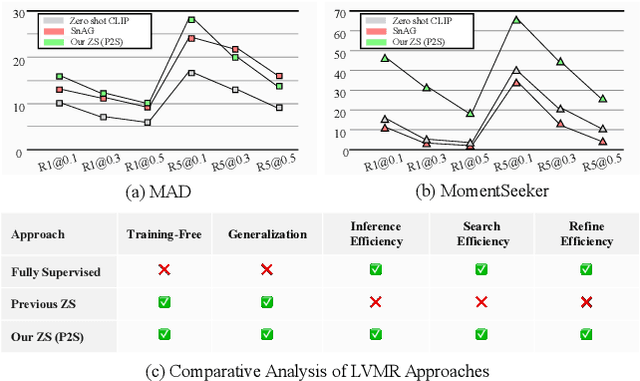
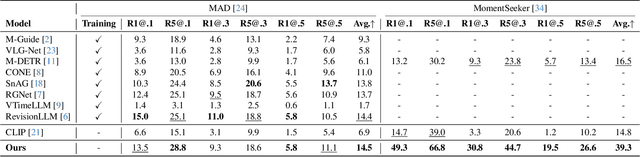
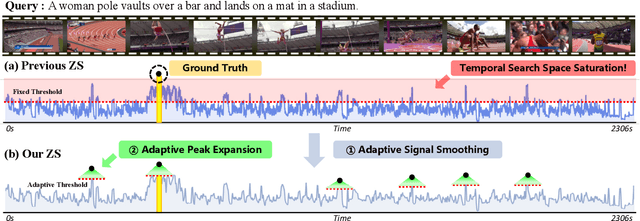
Zero-shot Long Video Moment Retrieval (ZLVMR) is the task of identifying temporal segments in hour-long videos using a natural language query without task-specific training. The core technical challenge of LVMR stems from the computational infeasibility of processing entire lengthy videos in a single pass. This limitation has established a 'Search-then-Refine' approach, where candidates are rapidly narrowed down, and only those portions are analyzed, as the dominant paradigm for LVMR. However, existing approaches to this paradigm face severe limitations. Conventional supervised learning suffers from limited scalability and poor generalization, despite substantial resource consumption. Yet, existing zero-shot methods also fail, facing a dual challenge: (1) their heuristic strategies cause a 'search' phase candidate explosion, and (2) the 'refine' phase, which is vulnerable to semantic discrepancy, requires high-cost VLMs for verification, incurring significant computational overhead. We propose \textbf{P}oint-\textbf{to}-\textbf{S}pan (P2S), a novel training-free framework to overcome this challenge of inefficient 'search' and costly 'refine' phases. P2S overcomes these challenges with two key innovations: an 'Adaptive Span Generator' to prevent the search phase candidate explosion, and 'Query Decomposition' to refine candidates without relying on high-cost VLM verification. To our knowledge, P2S is the first zero-shot framework capable of temporal grounding in hour-long videos, outperforming supervised state-of-the-art methods by a significant margin (e.g., +3.7\% on R5@0.1 on MAD).