 Add to Chrome
 Add to Firefox
 Add to Edge
See More, Store Less: Memory-Efficient Resolution for Video Moment Retrieval
Jan 14, 2026
Recent advances in Multimodal Large Language Models (MLLMs) have improved image recognition and reasoning, but video-related tasks remain challenging due to memory constraints from dense frame processing. Existing Video Moment Retrieval (VMR) methodologies rely on sparse frame sampling, risking potential information loss, especially in lengthy videos. We propose SMORE (See MORE, store less), a framework that enhances memory efficiency while maintaining high information resolution. SMORE (1) uses query-guided captions to encode semantics aligned with user intent, (2) applies query-aware importance modulation to highlight relevant segments, and (3) adaptively compresses frames to preserve key content while reducing redundancy. This enables efficient video understanding without exceeding memory budgets. Experimental validation reveals that SMORE achieves state-of-the-art performance on QVHighlights, Charades-STA, and ActivityNet-Captions benchmarks.

Point to Span: Zero-Shot Moment Retrieval for Navigating Unseen Hour-Long Videos
Dec 11, 2025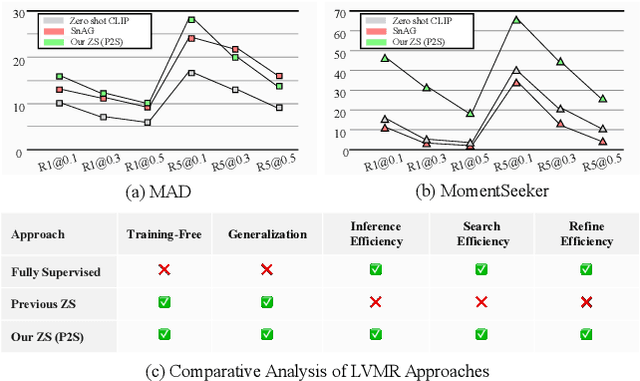
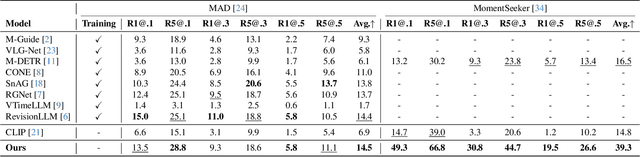
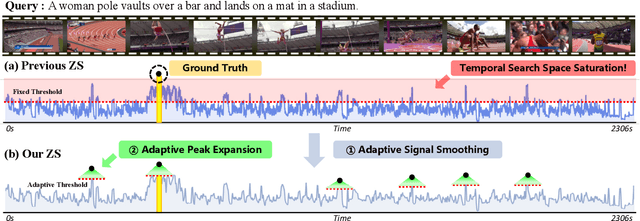
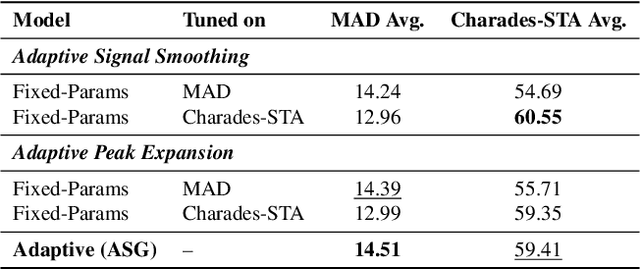
Zero-shot Long Video Moment Retrieval (ZLVMR) is the task of identifying temporal segments in hour-long videos using a natural language query without task-specific training. The core technical challenge of LVMR stems from the computational infeasibility of processing entire lengthy videos in a single pass. This limitation has established a 'Search-then-Refine' approach, where candidates are rapidly narrowed down, and only those portions are analyzed, as the dominant paradigm for LVMR. However, existing approaches to this paradigm face severe limitations. Conventional supervised learning suffers from limited scalability and poor generalization, despite substantial resource consumption. Yet, existing zero-shot methods also fail, facing a dual challenge: (1) their heuristic strategies cause a 'search' phase candidate explosion, and (2) the 'refine' phase, which is vulnerable to semantic discrepancy, requires high-cost VLMs for verification, incurring significant computational overhead. We propose \textbf{P}oint-\textbf{to}-\textbf{S}pan (P2S), a novel training-free framework to overcome this challenge of inefficient 'search' and costly 'refine' phases. P2S overcomes these challenges with two key innovations: an 'Adaptive Span Generator' to prevent the search phase candidate explosion, and 'Query Decomposition' to refine candidates without relying on high-cost VLM verification. To our knowledge, P2S is the first zero-shot framework capable of temporal grounding in hour-long videos, outperforming supervised state-of-the-art methods by a significant margin (e.g., +3.7\% on R5@0.1 on MAD).