 Add to Chrome
 Add to Firefox
 Add to Edge
Accelerating Social Science Research via Agentic Hypothesization and Experimentation
Feb 08, 2026
Data-driven social science research is inherently slow, relying on iterative cycles of observation, hypothesis generation, and experimental validation. While recent data-driven methods promise to accelerate parts of this process, they largely fail to support end-to-end scientific discovery. To address this gap, we introduce EXPERIGEN, an agentic framework that operationalizes end-to-end discovery through a Bayesian optimization inspired two-phase search, in which a Generator proposes candidate hypotheses and an Experimenter evaluates them empirically. Across multiple domains, EXPERIGEN consistently discovers 2-4x more statistically significant hypotheses that are 7-17 percent more predictive than prior approaches, and naturally extends to complex data regimes including multimodal and relational datasets. Beyond statistical performance, hypotheses must be novel, empirically grounded, and actionable to drive real scientific progress. To evaluate these qualities, we conduct an expert review of machine-generated hypotheses, collecting feedback from senior faculty. Among 25 reviewed hypotheses, 88 percent were rated moderately or strongly novel, 70 percent were deemed impactful and worth pursuing, and most demonstrated rigor comparable to senior graduate-level research. Finally, recognizing that ultimate validation requires real-world evidence, we conduct the first A/B test of LLM-generated hypotheses, observing statistically significant results with p less than 1e-6 and a large effect size of 344 percent.

Dressing the Imagination: A Dataset for AI-Powered Translation of Text into Fashion Outfits and A Novel KAN Adapter for Enhanced Feature Adaptation
Nov 21, 2024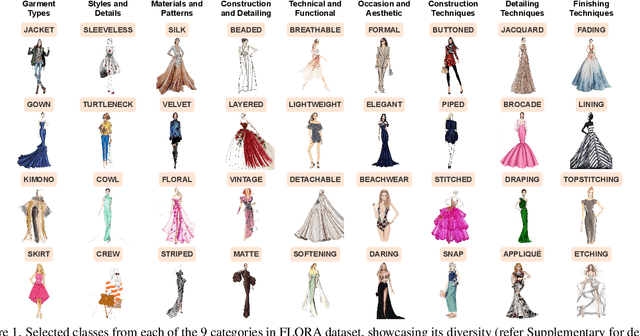
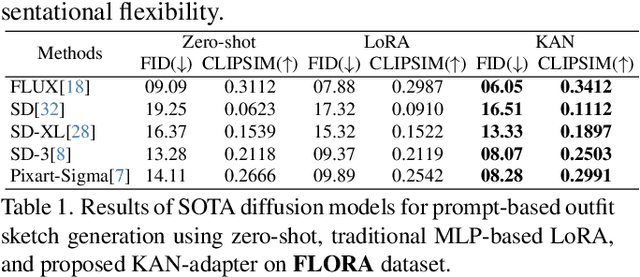
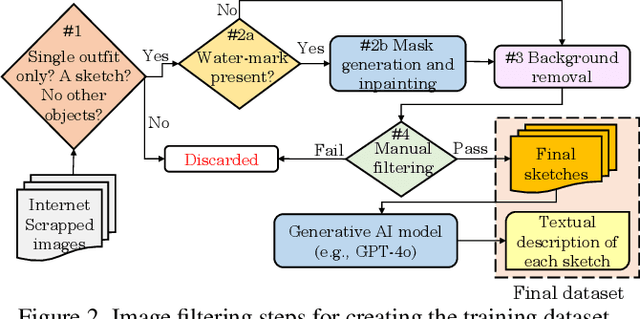
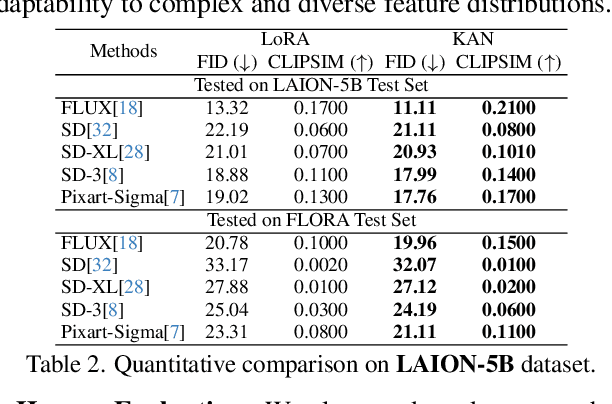
Specialized datasets that capture the fashion industry's rich language and styling elements can boost progress in AI-driven fashion design. We present FLORA (Fashion Language Outfit Representation for Apparel Generation), the first comprehensive dataset containing 4,330 curated pairs of fashion outfits and corresponding textual descriptions. Each description utilizes industry-specific terminology and jargon commonly used by professional fashion designers, providing precise and detailed insights into the outfits. Hence, the dataset captures the delicate features and subtle stylistic elements necessary to create high-fidelity fashion designs. We demonstrate that fine-tuning generative models on the FLORA dataset significantly enhances their capability to generate accurate and stylistically rich images from textual descriptions of fashion sketches. FLORA will catalyze the creation of advanced AI models capable of comprehending and producing subtle, stylistically rich fashion designs. It will also help fashion designers and end-users to bring their ideas to life. As a second orthogonal contribution, we introduce KAN Adapters, which leverage Kolmogorov-Arnold Networks (KAN) as adaptive modules. They serve as replacements for traditional MLP-based LoRA adapters. With learnable spline-based activations, KAN Adapters excel in modeling complex, non-linear relationships, achieving superior fidelity, faster convergence and semantic alignment. Extensive experiments and ablation studies on our proposed FLORA dataset validate the superiority of KAN Adapters over LoRA adapters. To foster further research and collaboration, we will open-source both the FLORA and our implementation code.
MotionAura: Generating High-Quality and Motion Consistent Videos using Discrete Diffusion
Oct 10, 2024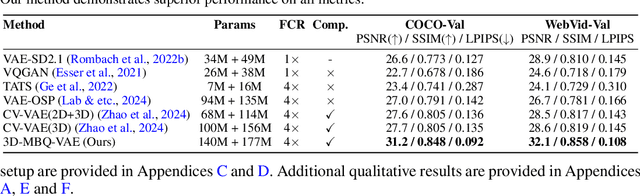
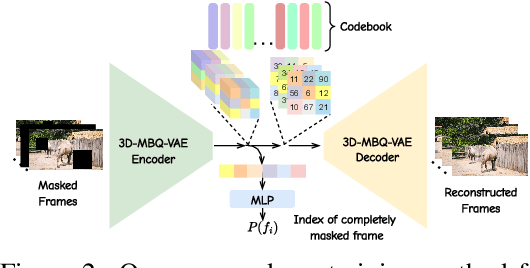
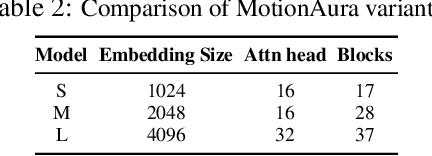
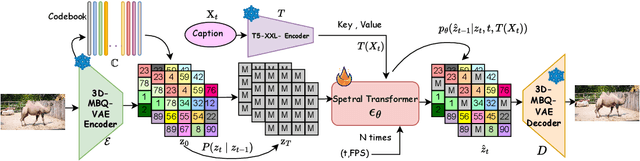
The spatio-temporal complexity of video data presents significant challenges in tasks such as compression, generation, and inpainting. We present four key contributions to address the challenges of spatiotemporal video processing. First, we introduce the 3D Mobile Inverted Vector-Quantization Variational Autoencoder (3D-MBQ-VAE), which combines Variational Autoencoders (VAEs) with masked token modeling to enhance spatiotemporal video compression. The model achieves superior temporal consistency and state-of-the-art (SOTA) reconstruction quality by employing a novel training strategy with full frame masking. Second, we present MotionAura, a text-to-video generation framework that utilizes vector-quantized diffusion models to discretize the latent space and capture complex motion dynamics, producing temporally coherent videos aligned with text prompts. Third, we propose a spectral transformer-based denoising network that processes video data in the frequency domain using the Fourier Transform. This method effectively captures global context and long-range dependencies for high-quality video generation and denoising. Lastly, we introduce a downstream task of Sketch Guided Video Inpainting. This task leverages Low-Rank Adaptation (LoRA) for parameter-efficient fine-tuning. Our models achieve SOTA performance on a range of benchmarks. Our work offers robust frameworks for spatiotemporal modeling and user-driven video content manipulation. We will release the code, datasets, and models in open-source.