 Add to Chrome
 Add to Firefox
 Add to Edge
AffordTissue: Dense Affordance Prediction for Tool-Action Specific Tissue Interaction
Apr 01, 2026
Surgical action automation has progressed rapidly toward achieving surgeon-like dexterous control, driven primarily by advances in learning from demonstration and vision-language-action models. While these have demonstrated success in table-top experiments, translating them to clinical deployment remains challenging: current methods offer limited predictability on where instruments will interact on tissue surfaces and lack explicit conditioning inputs to enforce tool-action-specific safe interaction regions. Addressing this gap, we introduce AffordTissue, a multimodal framework for predicting tool-action specific tissue affordance regions as dense heatmaps during cholecystectomy. Our approach combines a temporal vision encoder capturing tool motion and tissue dynamics across multiple viewpoints, language conditioning enabling generalization across diverse instrument-action pairs, and a DiT-style decoder for dense affordance prediction. We establish the first tissue affordance benchmark by curating and annotating 15,638 video clips across 103 cholecystectomy procedures, covering six unique tool-action pairs involving four instruments (hook, grasper, scissors, clipper) and their associated tasks: dissection, grasping, clipping, and cutting. Experiments demonstrate substantial improvement over vision-language model baselines (20.6 px ASSD vs. 60.2 px for Molmo-VLM), showing that our task-specific architecture outperforms large-scale foundation models for dense surgical affordance prediction. By predicting tool-action specific tissue affordance regions, AffordTissue provides explicit spatial reasoning for safe surgical automation, potentially unlocking explicit policy guidance toward appropriate tissue regions and early safe stop when instruments deviate outside predicted safe zones.

SAW: Toward a Surgical Action World Model via Controllable and Scalable Video Generation
Mar 13, 2026A surgical world model capable of generating realistic surgical action videos with precise control over tool-tissue interactions can address fundamental challenges in surgical AI and simulation -- from data scarcity and rare event synthesis to bridging the sim-to-real gap for surgical automation. However, current video generation methods, the very core of such surgical world models, require expensive annotations or complex structured intermediates as conditioning signals at inference, limiting their scalability. Other approaches exhibit limited temporal consistency across complex laparoscopic scenes and do not possess sufficient realism. We propose Surgical Action World (SAW) -- a step toward surgical action world modeling through video diffusion conditioned on four lightweight signals: language prompts encoding tool-action context, a reference surgical scene, tissue affordance mask, and 2D tool-tip trajectories. We design a conditional video diffusion approach that reformulates video-to-video diffusion into trajectory-conditioned surgical action synthesis. The backbone diffusion model is fine-tuned on a custom-curated dataset of 12,044 laparoscopic clips with lightweight spatiotemporal conditioning signals, leveraging a depth consistency loss to enforce geometric plausibility without requiring depth at inference. SAW achieves state-of-the-art temporal consistency (CD-FVD: 199.19 vs. 546.82) and strong visual quality on held-out test data. Furthermore, we demonstrate its downstream utility for (a) surgical AI, where augmenting rare actions with SAW-generated videos improves action recognition (clipping F1-score: 20.93% to 43.14%; cutting: 0.00% to 8.33%) on real test data, and (b) surgical simulation, where rendering tool-tissue interaction videos from simulator-derived trajectory points toward a visually faithful simulation engine.
BronchOpt : Vision-Based Pose Optimization with Fine-Tuned Foundation Models for Accurate Bronchoscopy Navigation
Nov 12, 2025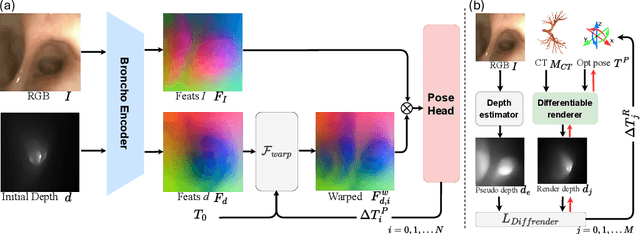
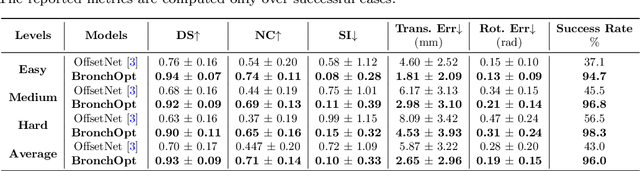
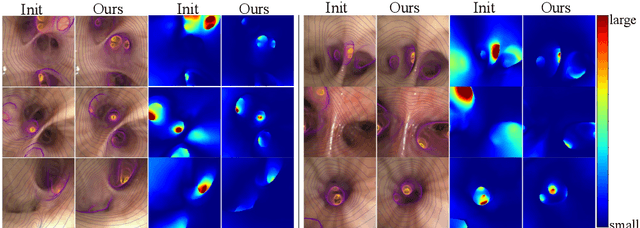
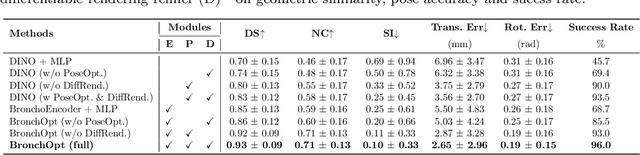
Accurate intra-operative localization of the bronchoscope tip relative to patient anatomy remains challenging due to respiratory motion, anatomical variability, and CT-to-body divergence that cause deformation and misalignment between intra-operative views and pre-operative CT. Existing vision-based methods often fail to generalize across domains and patients, leading to residual alignment errors. This work establishes a generalizable foundation for bronchoscopy navigation through a robust vision-based framework and a new synthetic benchmark dataset that enables standardized and reproducible evaluation. We propose a vision-based pose optimization framework for frame-wise 2D-3D registration between intra-operative endoscopic views and pre-operative CT anatomy. A fine-tuned modality- and domain-invariant encoder enables direct similarity computation between real endoscopic RGB frames and CT-rendered depth maps, while a differentiable rendering module iteratively refines camera poses through depth consistency. To enhance reproducibility, we introduce the first public synthetic benchmark dataset for bronchoscopy navigation, addressing the lack of paired CT-endoscopy data. Trained exclusively on synthetic data distinct from the benchmark, our model achieves an average translational error of 2.65 mm and a rotational error of 0.19 rad, demonstrating accurate and stable localization. Qualitative results on real patient data further confirm strong cross-domain generalization, achieving consistent frame-wise 2D-3D alignment without domain-specific adaptation. Overall, the proposed framework achieves robust, domain-invariant localization through iterative vision-based optimization, while the new benchmark provides a foundation for standardized progress in vision-based bronchoscopy navigation.