 Add to Chrome
 Add to Firefox
 Add to Edge
Private Generative Bootstrap via Blocking
Aug 03, 2026
With AI systems gaining more access to individuals' information, it is important to protect privacy when reporting statistical answers. Equally important is to privatize the reporting of uncertainty in such answers. To this end, we adopt a Bayesian likelihood-free framework and make simulation from the posterior private. In particular, we propose a new private instantiation of the Bayesian bootstrap using a blocking strategy. Rather than assigning idiosyncratic random weights to each individual, we randomly group individuals and assign a single weight to each group. By concealing individuals' contributions within a group, we fortify differential privacy gates. We harness amortized inference that decouples private learning from posterior sampling. A push-forward map from observation weights to posterior samples is learned privately by adding calibrated noise during training. Subsequent posterior draws require no additional privacy and computation budget. We call the resulting method the Private Generative Bayesian Bootstrap (PGBB). We establish a differential privacy guarantee, analyze convergence to the non-private blocked-bootstrap target, and quantify the discrepancy between the ordinary and blocked Bayesian-bootstrap posteriors. In addition, we derive data-free tuning of the block Dirichlet concentration parameter that restores posterior dispersion asymptotically. We also show a single fit of PGBB can support a family of loss-based decision rules simultaneously without additional privacy cost. In simulations and in applications to U.S. Census returns to schooling and U.S. natality birthweight quantiles, PGBB gives competitive private uncertainty quantification and improves over private Bayesian alternatives that require a specified data-generating model in common settings.

Statistical Matching via Schrödinger Bridge beyond Conditional Independence
Jun 22, 2026Statistical matching combines partially overlapping datasets that share covariates $X$ but observe the target $Y$ and auxiliary variables $Z$ separately. Classical approaches typically invoke the conditional independence assumption (CIA), which makes the problem identifiable but fundamentally implies that the imported auxiliary variable provides no additional predictive power for $Y$ once $X$ is known. To capture this latent $Y$--$Z$ dependence, we propose a novel dependency-aware Schrödinger bridge for predictive statistical matching. Our approach couples the two separated databases by tilting the conservative CIA baseline with a transportation-based compatibility cost, recovering an informative joint distribution. The resulting statistical learning framework yields full probabilistic posterior rules for bidirectional imputation. Theoretically, we establish a sufficient condition under which the learned bridge strictly improves over the CIA baseline, alongside an exact joint recovery guarantee in the Gaussian setting under an appropriate cost. Across synthetic benchmarks and real-world datasets (CelebA and Adult), we demonstrate that our dependency-aware completion consistently improves downstream predictive utility, proving especially beneficial in settings like data recoding where the underlying population exhibits strong $Y$--$Z$ dependence.
Task-tailored Pre-processing: Fair Downstream Supervised Learning
Jan 17, 2026Fairness-aware machine learning has recently attracted various communities to mitigate discrimination against certain societal groups in data-driven tasks. For fair supervised learning, particularly in pre-processing, there have been two main categories: data fairness and task-tailored fairness. The former directly finds an intermediate distribution among the groups, independent of the type of the downstream model, so a learned downstream classification/regression model returns similar predictive scores to individuals inputting the same covariates irrespective of their sensitive attributes. The latter explicitly takes the supervised learning task into account when constructing the pre-processing map. In this work, we study algorithmic fairness for supervised learning and argue that the data fairness approaches impose overly strong regularization from the perspective of the HGR correlation. This motivates us to devise a novel pre-processing approach tailored to supervised learning. We account for the trade-off between fairness and utility in obtaining the pre-processing map. Then we study the behavior of arbitrary downstream supervised models learned on the transformed data to find sufficient conditions to guarantee their fairness improvement and utility preservation. To our knowledge, no prior work in the branch of task-tailored methods has theoretically investigated downstream guarantees when using pre-processed data. We further evaluate our framework through comparison studies based on tabular and image data sets, showing the superiority of our framework which preserves consistent trade-offs among multiple downstream models compared to recent competing models. Particularly for computer vision data, we see our method alters only necessary semantic features related to the central machine learning task to achieve fairness.
Monotone Curve Estimation via Convex Duality
Jan 14, 2025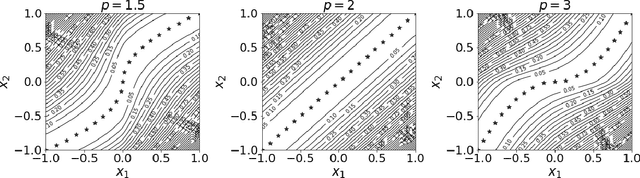
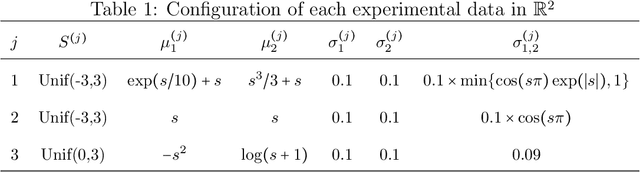
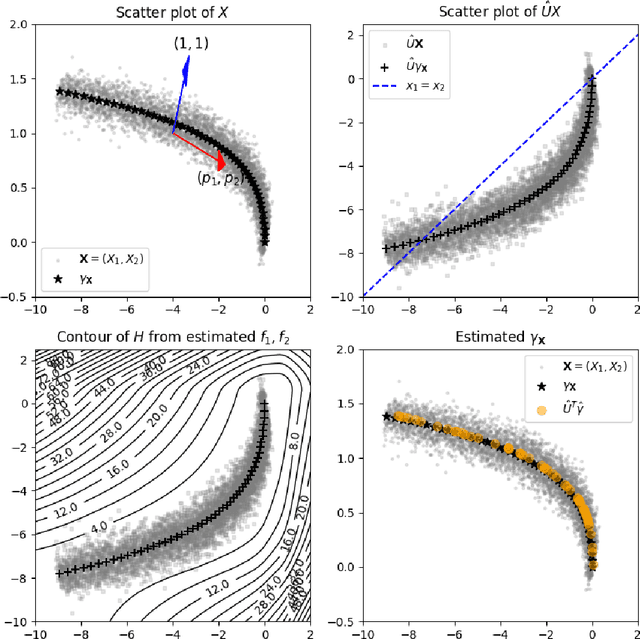

A principal curve serves as a powerful tool for uncovering underlying structures of data through 1-dimensional smooth and continuous representations. On the basis of optimal transport theories, this paper introduces a novel principal curve framework constrained by monotonicity with rigorous theoretical justifications. We establish statistical guarantees for our monotone curve estimate, including expected empirical and generalized mean squared errors, while proving the existence of such estimates. These statistical foundations justify adopting the popular early stopping procedure in machine learning to implement our numeric algorithm with neural networks. Comprehensive simulation studies reveal that the proposed monotone curve estimate outperforms competing methods in terms of accuracy when the data exhibits a monotonic structure. Moreover, through two real-world applications on future prices of copper, gold, and silver, and avocado prices and sales volume, we underline the robustness of our curve estimate against variable transformation, further confirming its effective applicability for noisy and complex data sets. We believe that this monotone curve-fitting framework offers significant potential for numerous applications where monotonic relationships are intrinsic or need to be imposed.
Parallelly Tempered Generative Adversarial Networks
Nov 18, 2024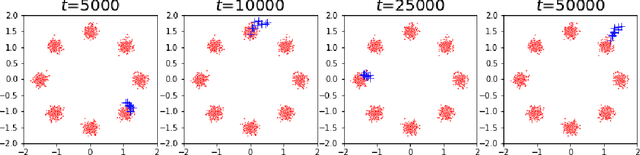
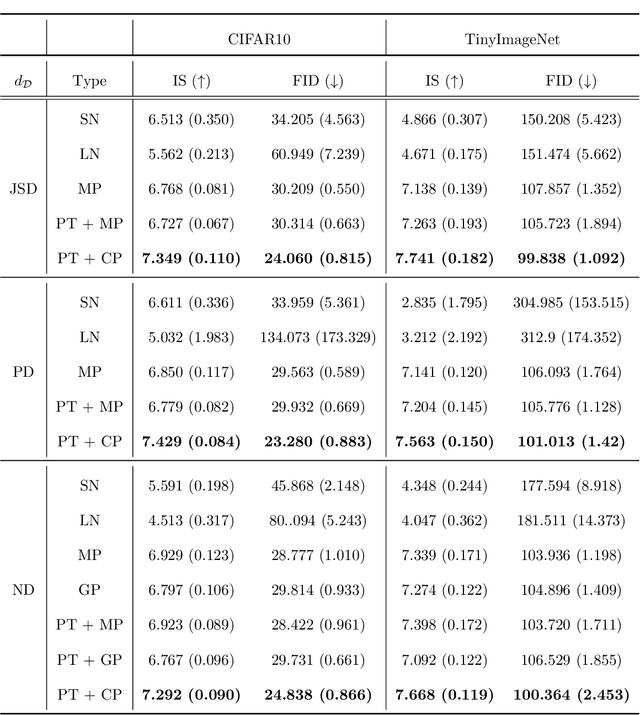

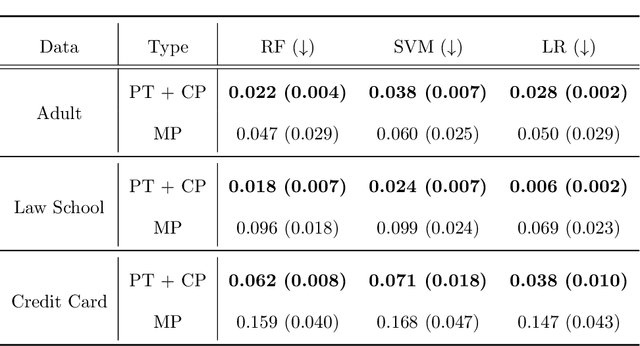
A generative adversarial network (GAN) has been a representative backbone model in generative artificial intelligence (AI) because of its powerful performance in capturing intricate data-generating processes. However, the GAN training is well-known for its notorious training instability, usually characterized by the occurrence of mode collapse. Through the lens of gradients' variance, this work particularly analyzes the training instability and inefficiency in the presence of mode collapse by linking it to multimodality in the target distribution. To ease the raised training issues from severe multimodality, we introduce a novel GAN training framework that leverages a series of tempered distributions produced via convex interpolation. With our newly developed GAN objective function, the generator can learn all the tempered distributions simultaneously, conceptually resonating with the parallel tempering in Statistics. Our simulation studies demonstrate the superiority of our approach over existing popular training strategies in both image and tabular data synthesis. We theoretically analyze that such significant improvement can arise from reducing the variance of gradient estimates by using the tempered distributions. Finally, we further develop a variant of the proposed framework aimed at generating fair synthetic data which is one of the growing interests in the field of trustworthy AI.
Fair Supervised Learning with A Simple Random Sampler of Sensitive Attributes
Nov 10, 2023
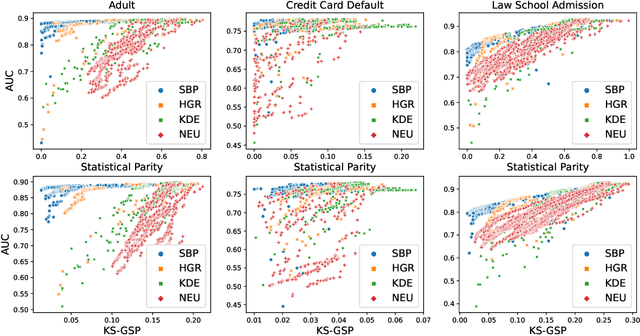

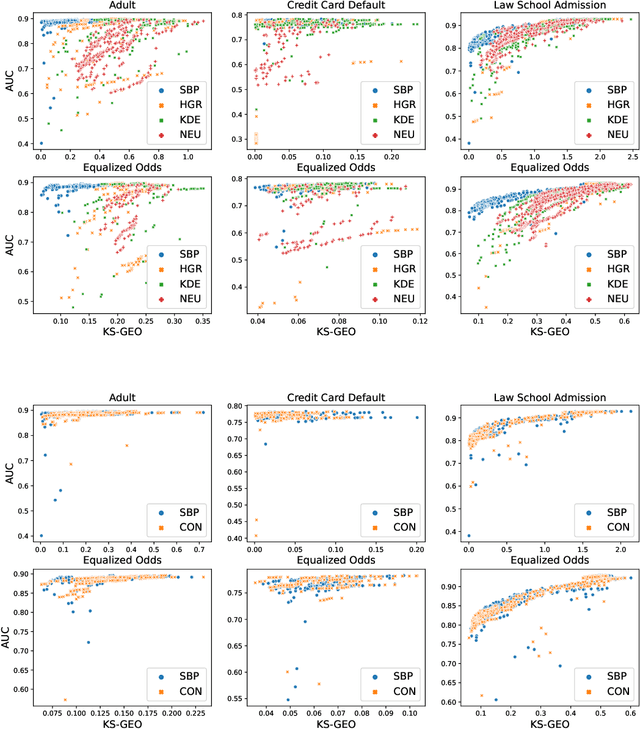
As the data-driven decision process becomes dominating for industrial applications, fairness-aware machine learning arouses great attention in various areas. This work proposes fairness penalties learned by neural networks with a simple random sampler of sensitive attributes for non-discriminatory supervised learning. In contrast to many existing works that critically rely on the discreteness of sensitive attributes and response variables, the proposed penalty is able to handle versatile formats of the sensitive attributes, so it is more extensively applicable in practice than many existing algorithms. This penalty enables us to build a computationally efficient group-level in-processing fairness-aware training framework. Empirical evidence shows that our framework enjoys better utility and fairness measures on popular benchmark data sets than competing methods. We also theoretically characterize estimation errors and loss of utility of the proposed neural-penalized risk minimization problem.
Differentially Private Topological Data Analysis
May 05, 2023This paper is the first to attempt differentially private (DP) topological data analysis (TDA), producing near-optimal private persistence diagrams. We analyze the sensitivity of persistence diagrams in terms of the bottleneck distance, and we show that the commonly used \v{C}ech complex has sensitivity that does not decrease as the sample size $n$ increases. This makes it challenging for the persistence diagrams of \v{C}ech complexes to be privatized. As an alternative, we show that the persistence diagram obtained by the $L^1$-distance to measure (DTM) has sensitivity $O(1/n)$. Based on the sensitivity analysis, we propose using the exponential mechanism whose utility function is defined in terms of the bottleneck distance of the $L^1$-DTM persistence diagrams. We also derive upper and lower bounds of the accuracy of our privacy mechanism; the obtained bounds indicate that the privacy error of our mechanism is near-optimal. We demonstrate the performance of our privatized persistence diagrams through simulations as well as on a real dataset tracking human movement.