 Add to Chrome
 Add to Firefox
 Add to Edge
Statistical Matching via Schrödinger Bridge beyond Conditional Independence
Jun 22, 2026
Statistical matching combines partially overlapping datasets that share covariates $X$ but observe the target $Y$ and auxiliary variables $Z$ separately. Classical approaches typically invoke the conditional independence assumption (CIA), which makes the problem identifiable but fundamentally implies that the imported auxiliary variable provides no additional predictive power for $Y$ once $X$ is known. To capture this latent $Y$--$Z$ dependence, we propose a novel dependency-aware Schrödinger bridge for predictive statistical matching. Our approach couples the two separated databases by tilting the conservative CIA baseline with a transportation-based compatibility cost, recovering an informative joint distribution. The resulting statistical learning framework yields full probabilistic posterior rules for bidirectional imputation. Theoretically, we establish a sufficient condition under which the learned bridge strictly improves over the CIA baseline, alongside an exact joint recovery guarantee in the Gaussian setting under an appropriate cost. Across synthetic benchmarks and real-world datasets (CelebA and Adult), we demonstrate that our dependency-aware completion consistently improves downstream predictive utility, proving especially beneficial in settings like data recoding where the underlying population exhibits strong $Y$--$Z$ dependence.

Data denoising with self consistency, variance maximization, and the Kantorovich dominance
Feb 05, 2025We introduce a new framework for data denoising, partially inspired by martingale optimal transport. For a given noisy distribution (the data), our approach involves finding the closest distribution to it among all distributions which 1) have a particular prescribed structure (expressed by requiring they lie in a particular domain), and 2) are self-consistent with the data. We show that this amounts to maximizing the variance among measures in the domain which are dominated in convex order by the data. For particular choices of the domain, this problem and a relaxed version of it, in which the self-consistency condition is removed, are intimately related to various classical approaches to denoising. We prove that our general problem has certain desirable features: solutions exist under mild assumptions, have certain robustness properties, and, for very simple domains, coincide with solutions to the relaxed problem. We also introduce a novel relationship between distributions, termed Kantorovich dominance, which retains certain aspects of the convex order while being a weaker, more robust, and easier-to-verify condition. Building on this, we propose and analyze a new denoising problem by substituting the convex order in the previously described framework with Kantorovich dominance. We demonstrate that this revised problem shares some characteristics with the full convex order problem but offers enhanced stability, greater computational efficiency, and, in specific domains, more meaningful solutions. Finally, we present simple numerical examples illustrating solutions for both the full convex order problem and the Kantorovich dominance problem.
Monotone Curve Estimation via Convex Duality
Jan 14, 2025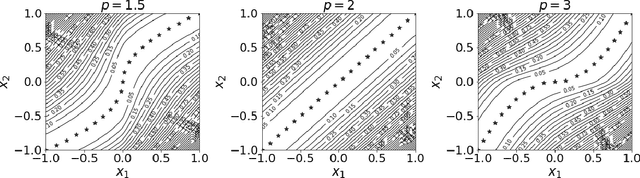
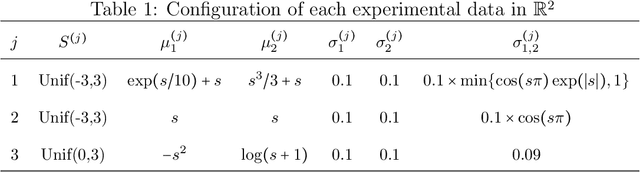
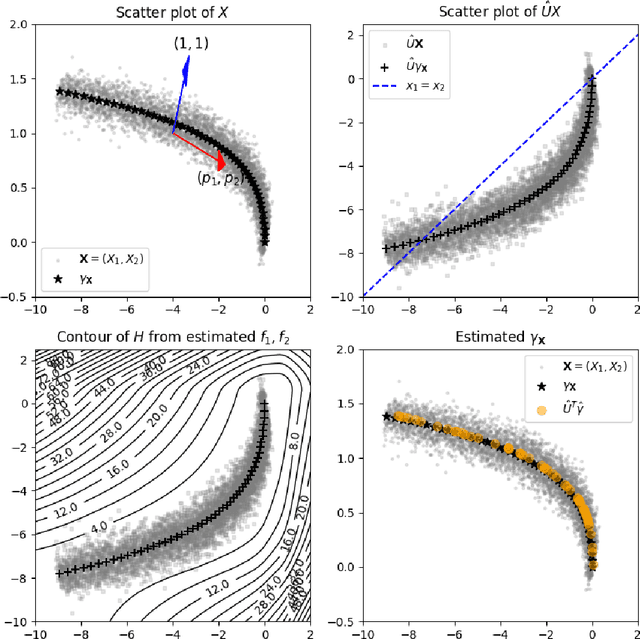

A principal curve serves as a powerful tool for uncovering underlying structures of data through 1-dimensional smooth and continuous representations. On the basis of optimal transport theories, this paper introduces a novel principal curve framework constrained by monotonicity with rigorous theoretical justifications. We establish statistical guarantees for our monotone curve estimate, including expected empirical and generalized mean squared errors, while proving the existence of such estimates. These statistical foundations justify adopting the popular early stopping procedure in machine learning to implement our numeric algorithm with neural networks. Comprehensive simulation studies reveal that the proposed monotone curve estimate outperforms competing methods in terms of accuracy when the data exhibits a monotonic structure. Moreover, through two real-world applications on future prices of copper, gold, and silver, and avocado prices and sales volume, we underline the robustness of our curve estimate against variable transformation, further confirming its effective applicability for noisy and complex data sets. We believe that this monotone curve-fitting framework offers significant potential for numerous applications where monotonic relationships are intrinsic or need to be imposed.