 Add to Chrome
 Add to Firefox
 Add to Edge
STAR: SpatioTemporal Adaptive Reward Allocation for Text-to-Image RL Post-Training
Jun 18, 2026
Existing RL post-training methods for text-to-image generation usually convert the final-image reward into a single scalar advantage and apply it with the same strength to the entire generative trajectory. However, text-to-image generation naturally has temporal and spatial structure: different denoising steps are responsible for different generation stages, and the content that truly determines text alignment often appears only in part of the image. This granularity mismatch makes it difficult for policy updates to focus on the generative components that actually affect the reward. To address this issue, we propose \textbf{SpatioTemporal Adaptive Reward (STAR) Allocation} for RL post-training of text-to-image diffusion and flow models. STAR uses text-image attention inside the generative model and starts from the core content that the user truly cares about in the prompt. It constructs spatial allocation maps that dynamically vary across denoising steps and rollouts, and allocates the same group-relative advantage to more relevant latent regions with almost no additional computational overhead. STAR then applies stronger policy updates to these regions through a spatially resolved policy objective. We use Stable Diffusion 3.5 Medium as the base model and evaluate on three tasks: GenEval, OCR text rendering, and PickScore. Experimental results show that STAR improves compositional semantic alignment, text rendering, and preference optimization without changing the external reward source, achieving $\mathbf{0.9759}$, $\mathbf{0.9757}$, and $\mathbf{23.60}$ on GenEval, OCR, and PickScore, respectively.

CORE: Conflict-Oriented Reasoning for General Multimodal Manipulation Detection
Jun 02, 2026The rapid rise of generative AI has made multimodal fake news increasingly realistic and pervasive, posing severe threats to public trust and social stability. Existing detection methods rely heavily on manipulation-specific models and large-scale labeled data, resulting in poor generalization to emerging manipulation types. We observed that the essence of manipulated misinformation lies in its intrinsic conflicts, \textbf{i.e.,} semantic or physical inconsistencies either across modalities or with common world knowledge. Inspired by this observation, we propose \textbf{C}onflict-\textbf{O}riented \textbf{RE}asoning (\textbf{CORE}) framework, an effective paradigm that learns to endows multimodal large language models (MLLMs) with explicit conflict-capturing capability. To this end, CORE first constructs the Conflict Attribution Corpus (CAC) with fine-grained annotations of conflict factors and sources, providing essential data support for subsequent conflict perception training. By performing conflict-oriented representation enhancement and reasoning based on CAC, CORE achieves robust and generalizable conflict detection, effectively and rapidly adapting to unseen manipulation types with a few samples or in even zero-shot settings. Extensive experiments demonstrate that CORE surpasses state-of-the-art models. The dataset and code are publicly available at https://github.com/shen8424/CORE.
OmniVL-Guard: Towards Unified Vision-Language Forgery Detection and Grounding via Balanced RL
Feb 12, 2026Existing forgery detection methods are often limited to uni-modal or bi-modal settings, failing to handle the interleaved text, images, and videos prevalent in real-world misinformation. To bridge this gap, this paper targets to develop a unified framework for omnibus vision-language forgery detection and grounding. In this unified setting, the {interplay} between diverse modalities and the dual requirements of simultaneous detection and localization pose a critical ``difficulty bias`` problem: the simpler veracity classification task tends to dominate the gradients, leading to suboptimal performance in fine-grained grounding during multi-task optimization. To address this challenge, we propose \textbf{OmniVL-Guard}, a balanced reinforcement learning framework for omnibus vision-language forgery detection and grounding. Particularly, OmniVL-Guard comprises two core designs: Self-Evolving CoT Generatio and Adaptive Reward Scaling Policy Optimization (ARSPO). {Self-Evolving CoT Generation} synthesizes high-quality reasoning paths, effectively overcoming the cold-start challenge. Building upon this, {Adaptive Reward Scaling Policy Optimization (ARSPO)} dynamically modulates reward scales and task weights, ensuring a balanced joint optimization. Extensive experiments demonstrate that OmniVL-Guard significantly outperforms state-of-the-art methods and exhibits zero-shot robust generalization across out-of-domain scenarios.
Beyond Artificial Misalignment: Detecting and Grounding Semantic-Coordinated Multimodal Manipulations
Sep 16, 2025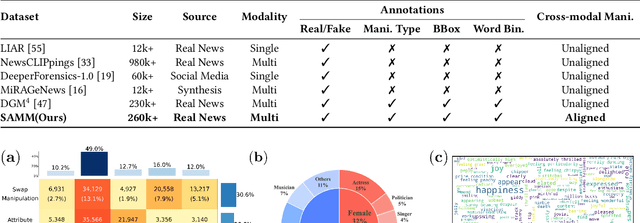
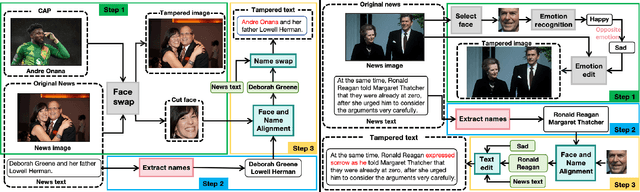
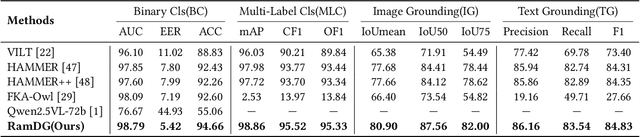
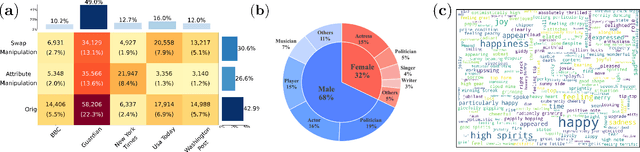
The detection and grounding of manipulated content in multimodal data has emerged as a critical challenge in media forensics. While existing benchmarks demonstrate technical progress, they suffer from misalignment artifacts that poorly reflect real-world manipulation patterns: practical attacks typically maintain semantic consistency across modalities, whereas current datasets artificially disrupt cross-modal alignment, creating easily detectable anomalies. To bridge this gap, we pioneer the detection of semantically-coordinated manipulations where visual edits are systematically paired with semantically consistent textual descriptions. Our approach begins with constructing the first Semantic-Aligned Multimodal Manipulation (SAMM) dataset, generated through a two-stage pipeline: 1) applying state-of-the-art image manipulations, followed by 2) generation of contextually-plausible textual narratives that reinforce the visual deception. Building on this foundation, we propose a Retrieval-Augmented Manipulation Detection and Grounding (RamDG) framework. RamDG commences by harnessing external knowledge repositories to retrieve contextual evidence, which serves as the auxiliary texts and encoded together with the inputs through our image forgery grounding and deep manipulation detection modules to trace all manipulations. Extensive experiments demonstrate our framework significantly outperforms existing methods, achieving 2.06\% higher detection accuracy on SAMM compared to state-of-the-art approaches. The dataset and code are publicly available at https://github.com/shen8424/SAMM-RamDG-CAP.