 Add to Chrome
 Add to Firefox
 Add to Edge
SeeTraceAct: Visibility-Aware Latent Planning from Cross-Embodiment Demonstration Videos
Jun 01, 2026
Vision-language-action models (VLAs) are promising general-purpose robot policies, but adapting them to new tasks typically requires costly task-specific teleoperation data. As an alternative, we study one-shot demo-conditioned VLAs, where a robot policy is conditioned on a single demonstration video of an unseen task. We find that existing end-to-end approaches often struggle when successful execution requires precisely localizing small target regions. To address this limitation, we propose SeeTraceAct, a demo-conditioned VLA framework that encourages precise spatial grounding through visibility-aware prediction of future end-effector traces. To enable reproducible evaluation with cross-embodiment demonstrations, we introduce and release RoboCasa-DC, a demo-conditioned extension of RoboCasa with episode-paired humanoid videos. Experiments on RoboCasa-DC and a real-world benchmark, where a Franka Panda arm is conditioned on human demonstrations, show that SeeTraceAct outperforms baselines, achieving the best success rate across all four RoboCasa-DC settings and improving real-world average success by 12.5 percentage points.

Tactile Probabilistic Contact Dynamics Estimation of Unknown Objects
Sep 26, 2024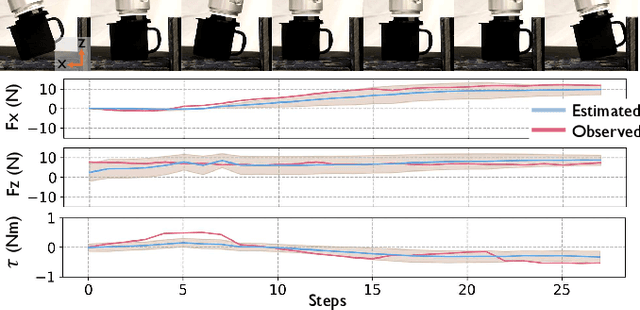
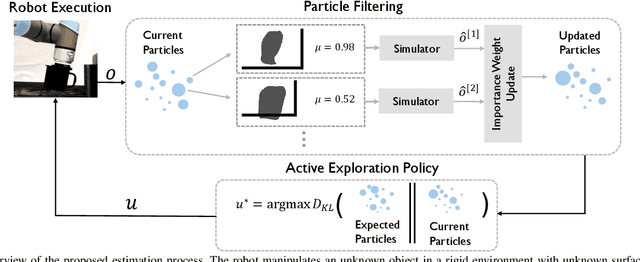
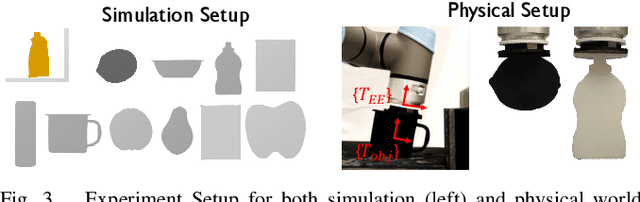
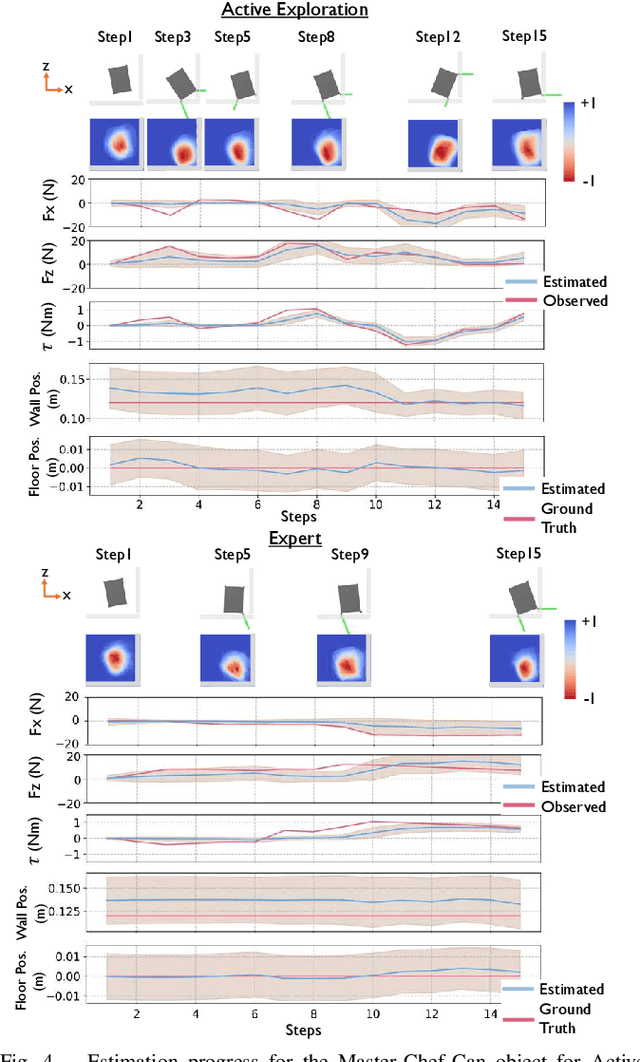
We study the problem of rapidly identifying contact dynamics of unknown objects in partially known environments. The key innovation of our method is a novel formulation of the contact dynamics estimation problem as the joint estimation of contact geometries and physical parameters. We leverage DeepSDF, a compact and expressive neural-network-based geometry representation over a distribution of geometries, and adopt a particle filter to estimate both the geometries in contact and the physical parameters. In addition, we couple the estimator with an active exploration strategy that plans information-gathering moves to further expedite online estimation. Through simulation and physical experiments, we show that our method estimates accurate contact dynamics with fewer than 30 exploration moves for unknown objects touching partially known environments.