 Add to Chrome
 Add to Firefox
 Add to Edge
NestDex: Nested Policy Learning with Copilot Assisted Teleoperation for Dexterous Manipulation
Aug 13, 2026
Dexterous manipulation promises substantially richer robot interaction with the physical world, but learning these behaviours remains constrained by the difficulty of collecting consistent, complete-task demonstrations. Unlike parallel-jaw manipulation, dexterous tasks require the operator to coordinate arm motion with precise, contact-rich finger behaviour throughout the task. We introduce NestDex, a nested policy-learning framework that reduces this burden by using learned hand skills to assist demonstration collection. The operator controls the arm and regulates the active hand skill through a single-DoF clutch, rather than directly specifying the full finger trajectory. The inner hand policy adapts its motion from the latest proprioceptive history, while a vision-language selector activates the appropriate skill for each task stage. The resulting demonstrations train a separate outer visuomotor policy that controls both the arm and hand without the inner policies at deployment. A hand-action variational autoencoder provides compact hand-action targets while retaining arm commands in joint space. Across real-world dexterous manipulation experiments, NestDex improves demonstration reliability and efficiency, and the resulting empirical evaluations support effective autonomous policy learning. Video Demo are available at project website https://aus.bot/research/nestdex.

AutoIntervene: Calibrated Intervention for Action-Chunking Imitation Learning Policies
Aug 07, 2026Action-chunking visuomotor policies learn from demonstrations and improve temporal consistency by predicting short action sequences rather than single-step commands. Yet perception errors and execution drift can move the robot outside the demonstration distribution, while the policy continues to produce smooth action chunks that are inconsistent with the observed state. We present AutoIntervene, an online framework that selectively transfers control between an action-chunking policy and an operator during deployment. AutoIntervene evaluates proposed chunks against a visual-action support memory built from successful task executions, combining visual similarity with consistency between proposed and reference actions. Phase-local support governs policy-to-operator transfer within the current task phase, whereas global support governs the return to policy control after operator recovery. We calibrate separate switching thresholds for the two directions from empirical quantiles of evaluation-level scores on held-out expert demonstrations, avoiding direct manual tuning of score cutoffs. Intervention segments retained from successful rollouts target learner-induced states and provide corrective supervision for subsequent policy updates. Experiments on real-world bimanual manipulation tasks show higher post-adaptation task success and lower operator-control time than manual intervention. Videos and additional results are available at https://aus.bot/research/autointervene/.
RepoMasterEval: Evaluating Code Completion via Real-World Repositories
Aug 07, 2024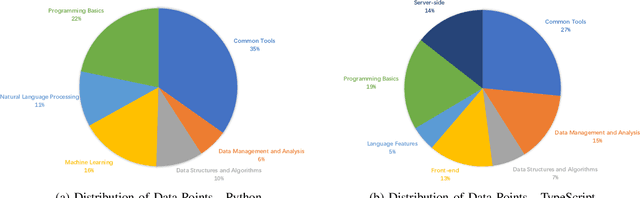
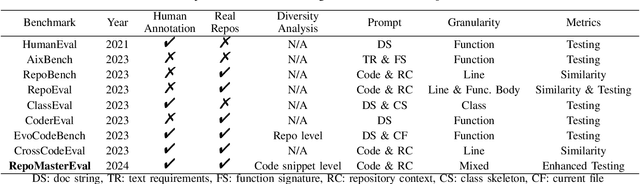
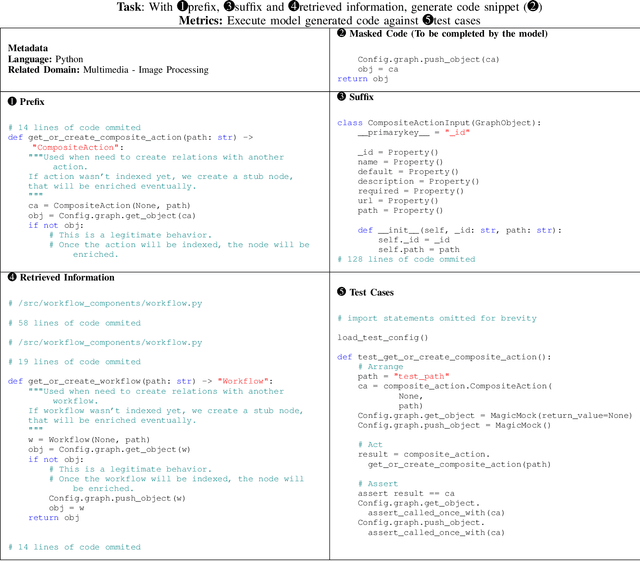
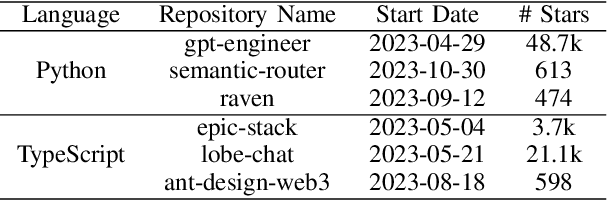
With the growing reliance on automated code completion tools in software development, the need for robust evaluation benchmarks has become critical. However, existing benchmarks focus more on code generation tasks in function and class level and provide rich text description to prompt the model. By contrast, such descriptive prompt is commonly unavailable in real development and code completion can occur in wider range of situations such as in the middle of a function or a code block. These limitations makes the evaluation poorly align with the practical scenarios of code completion tools. In this paper, we propose RepoMasterEval, a novel benchmark for evaluating code completion models constructed from real-world Python and TypeScript repositories. Each benchmark datum is generated by masking a code snippet (ground truth) from one source code file with existing test suites. To improve test accuracy of model generated code, we employ mutation testing to measure the effectiveness of the test cases and we manually crafted new test cases for those test suites with low mutation score. Our empirical evaluation on 6 state-of-the-art models shows that test argumentation is critical in improving the accuracy of the benchmark and RepoMasterEval is able to report difference in model performance in real-world scenarios. The deployment of RepoMasterEval in a collaborated company for one month also revealed that the benchmark is useful to give accurate feedback during model training and the score is in high correlation with the model's performance in practice. Based on our findings, we call for the software engineering community to build more LLM benchmarks tailored for code generation tools taking the practical and complex development environment into consideration.