 Add to Chrome
 Add to Firefox
 Add to Edge
Ablate and Rescue: A Causal Analysis of Residual Stream Hyper-Connections
Mar 16, 2026
Multi-stream transformer architectures have recently been proposed as a promising direction for managing representation collapse and the vanishing gradient problem for residual connections, yet their internal mechanisms remain unexplored. In particular, the recently introduced Manifold-Constrained Hyper-Connections (mHC) architecture posits multiple residual streams with constrained interaction, but lacks in-depth mechanistic analysis. We present the first open-source mHC language model (https://huggingface.co/wgpeng/mhc-780m) and analyze the multiple-stream architecture with a suite of representation-level metrics and causal interventions to probe how parallel streams encode and utilize information. Specifically, we introduce a systematic stream ablation-and-rescue framework that enables direct causal comparison of residual streams during inference. Through targeted pairwise interventions and controlled recovery experiments, we distinguish functional redundancy from asymmetric utilization and reveal how information is distributed across streams beyond what is observable from representational similarity alone.

An Agentic Operationalization of DISARM for FIMI Investigation on Social Media
Jan 21, 2026The interoperability of data and intelligence across allied partners and their respective end-user groups is considered a foundational enabler to the collective defense capability--both conventional and hybrid--of NATO countries. Foreign Information Manipulation and Interference (FIMI) and related hybrid activities are conducted across various societal dimensions and infospheres, posing an ever greater challenge to the characterization of threats, sustaining situational awareness, and response coordination. Recent advances in AI have further led to the decreasing cost of AI-augmented trolling and interference activities, such as through the generation and amplification of manipulative content. Despite the introduction of the DISARM framework as a standardized metadata and analytical framework for FIMI, operationalizing it at the scale of social media remains a challenge. We propose a framework-agnostic agent-based operationalization of DISARM to investigate FIMI on social media. We develop a multi-agent pipeline in which specialized agentic AI components collaboratively (1) detect candidate manipulative behaviors, and (2) map these behaviors onto standard DISARM taxonomies in a transparent manner. We evaluated the approach on two real-world datasets annotated by domain practitioners. We demonstrate that our approach is effective in scaling the predominantly manual and heavily interpretive work of FIMI analysis, providing a direct contribution to enhancing the situational awareness and data interoperability in the context of operating in media and information-rich settings.
MiniScope: A Least Privilege Framework for Authorizing Tool Calling Agents
Dec 11, 2025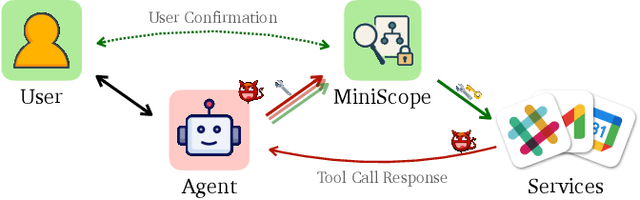

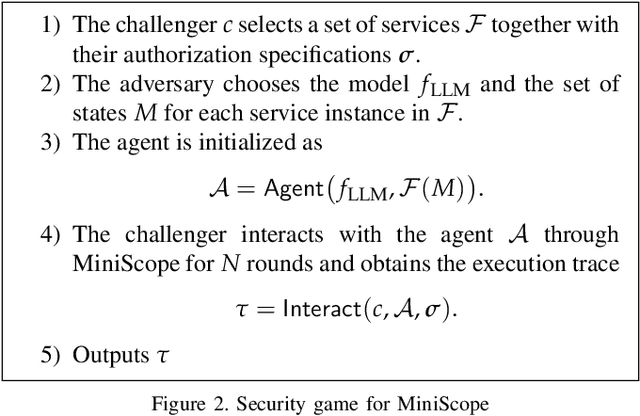

Tool calling agents are an emerging paradigm in LLM deployment, with major platforms such as ChatGPT, Claude, and Gemini adding connectors and autonomous capabilities. However, the inherent unreliability of LLMs introduces fundamental security risks when these agents operate over sensitive user services. Prior approaches either rely on manually written policies that require security expertise, or place LLMs in the confinement loop, which lacks rigorous security guarantees. We present MiniScope, a framework that enables tool calling agents to operate on user accounts while confining potential damage from unreliable LLMs. MiniScope introduces a novel way to automatically and rigorously enforce least privilege principles by reconstructing permission hierarchies that reflect relationships among tool calls and combining them with a mobile-style permission model to balance security and ease of use. To evaluate MiniScope, we create a synthetic dataset derived from ten popular real-world applications, capturing the complexity of realistic agentic tasks beyond existing simplified benchmarks. Our evaluation shows that MiniScope incurs only 1-6% latency overhead compared to vanilla tool calling agents, while significantly outperforming the LLM based baseline in minimizing permissions as well as computational and operational costs.