 Add to Chrome
 Add to Firefox
 Add to Edge
AptAvatar: Fast and Vivid Long-Form Audio-Driven Video Generation for Production-Ready Avatars
Jul 27, 2026
Production-ready audio-driven avatar generation requires efficient inference without sacrificing fidelity or motion expressiveness. However, existing acceleration methods often compromise quality through restrictive architectural choices, such as causal attention and short temporal horizons, or by reducing model capacity and resolution. Without such compromises, we propose AptAvatar, a 14B-parameter long-form audio-driven avatar generation framework that delivers fast and expressive inference. For efficiency in production-level applications, AptAvatar addresses the extreme two-step generation challenge. To bridge the gap between the multi-step teacher model and the two-step student model, we introduce Endpoint-Anchored Distribution Distillation. It augments vanilla distribution matching with a dedicated Anchor Score Estimator trained on the trajectory-endpoint distribution defined from a frozen pretrained 4-step bridge generator. This provides an attainable endpoint-level anchor for the evolving two-step student. To improve long-horizon consistency, we further introduce Self-Generated History Replay, which reuses cached outputs from earlier generator checkpoints as history conditions during chunk-wise training. This approximates inference-time conditioning on self-generated histories without costly online rollouts, mitigating quality degradation from accumulated history errors. Extensive experiments demonstrate that AptAvatar generates vivid 720p long-form avatar videos with only 2 NFEs, achieving a 60x speedup while preserving visual fidelity and long-horizon identity. Code is available at https://github.com/TaoLiveAIGC/AptAvatar

Detailed Region-Adaptive Normalization for Heavy Makeup Transfer
Sep 30, 2021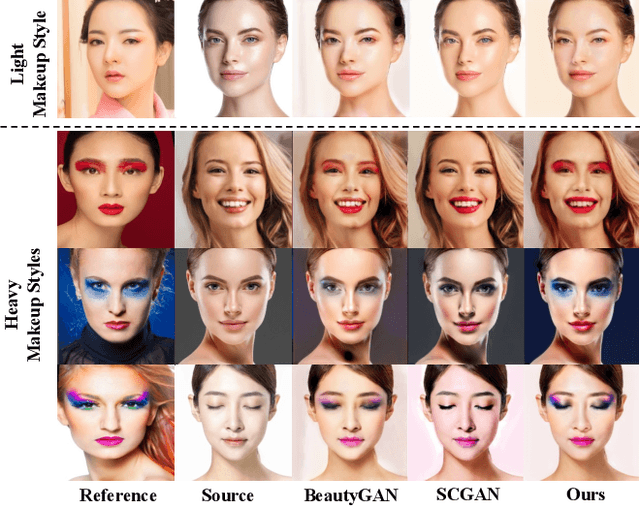

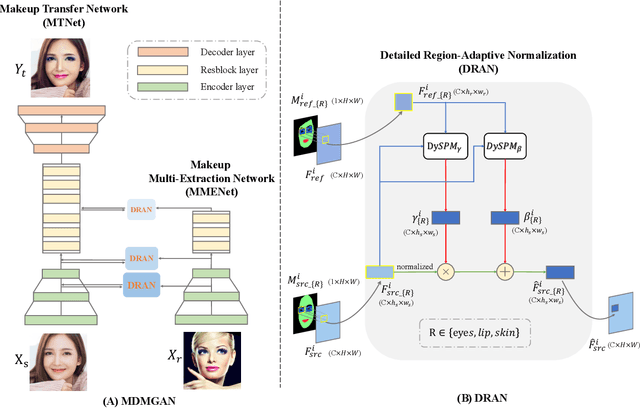
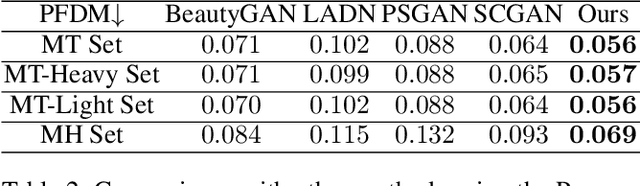
In recent years, facial makeup transfer has attracted growing attention due to its efficiency and flexibility in transferring makeup styles between different faces. Although recent works have achieved realistic results, most of them fail to handle heavy makeup styles with multiple colors and subtle details. Hence we propose a novel GAN model to handle heavy makeup transfer, while maintaining the robustness to different poses and expressions. Firstly, a Makeup Multi-Extraction Network is introduced to learn region-wise makeup features from multiple layers. Then, a key transferring module called Detailed Region-Adaptive Normalization is proposed to fuse different levels of makeup styles in an adaptive way, making great improvement to the quality of heavy makeup transfer. With the outputs from the two components, Makeup Transfer Network is used to perform makeup transfer. To evaluate the efficacy of our proposed method, we collected a new makeup dataset containing a wide range of heavy styles. Experiments show that our method achieves state-of-the-art results both on light and heavy makeup styles, and is robust to different poses and expressions.