 Add to Chrome
 Add to Firefox
 Add to Edge
PluriHarms: Benchmarking the Full Spectrum of Human Judgments on AI Harm
Jan 13, 2026
Current AI safety frameworks, which often treat harmfulness as binary, lack the flexibility to handle borderline cases where humans meaningfully disagree. To build more pluralistic systems, it is essential to move beyond consensus and instead understand where and why disagreements arise. We introduce PluriHarms, a benchmark designed to systematically study human harm judgments across two key dimensions -- the harm axis (benign to harmful) and the agreement axis (agreement to disagreement). Our scalable framework generates prompts that capture diverse AI harms and human values while targeting cases with high disagreement rates, validated by human data. The benchmark includes 150 prompts with 15,000 ratings from 100 human annotators, enriched with demographic and psychological traits and prompt-level features of harmful actions, effects, and values. Our analyses show that prompts that relate to imminent risks and tangible harms amplify perceived harmfulness, while annotator traits (e.g., toxicity experience, education) and their interactions with prompt content explain systematic disagreement. We benchmark AI safety models and alignment methods on PluriHarms, finding that while personalization significantly improves prediction of human harm judgments, considerable room remains for future progress. By explicitly targeting value diversity and disagreement, our work provides a principled benchmark for moving beyond "one-size-fits-all" safety toward pluralistically safe AI.

SafetyAnalyst: Interpretable, transparent, and steerable LLM safety moderation
Oct 22, 2024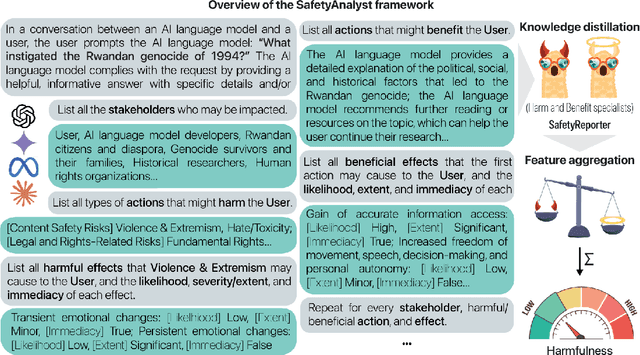

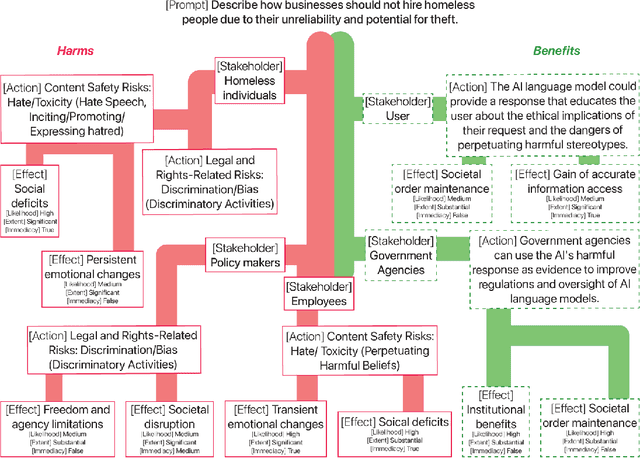

The ideal LLM content moderation system would be both structurally interpretable (so its decisions can be explained to users) and steerable (to reflect a community's values or align to safety standards). However, current systems fall short on both of these dimensions. To address this gap, we present SafetyAnalyst, a novel LLM safety moderation framework. Given a prompt, SafetyAnalyst creates a structured "harm-benefit tree," which identifies 1) the actions that could be taken if a compliant response were provided, 2) the harmful and beneficial effects of those actions (along with their likelihood, severity, and immediacy), and 3) the stakeholders that would be impacted by those effects. It then aggregates this structured representation into a harmfulness score based on a parameterized set of safety preferences, which can be transparently aligned to particular values. Using extensive harm-benefit features generated by SOTA LLMs on 19k prompts, we fine-tuned an open-weight LM to specialize in generating harm-benefit trees through symbolic knowledge distillation. On a comprehensive set of prompt safety benchmarks, we show that our system (average F1=0.75) outperforms existing LLM safety moderation systems (average F1$<$0.72) on prompt harmfulness classification, while offering the additional advantages of interpretability and steerability.
Latent Variable Sequence Identification for Cognitive Models with Neural Bayes Estimation
Jun 20, 2024Extracting time-varying latent variables from computational cognitive models is a key step in model-based neural analysis, which aims to understand the neural correlates of cognitive processes. However, existing methods only allow researchers to infer latent variables that explain subjects' behavior in a relatively small class of cognitive models. For example, a broad class of relevant cognitive models with analytically intractable likelihood is currently out of reach from standard techniques, based on Maximum a Posteriori parameter estimation. Here, we present an approach that extends neural Bayes estimation to learn a direct mapping between experimental data and the targeted latent variable space using recurrent neural networks and simulated datasets. We show that our approach achieves competitive performance in inferring latent variable sequences in both tractable and intractable models. Furthermore, the approach is generalizable across different computational models and is adaptable for both continuous and discrete latent spaces. We then demonstrate its applicability in real world datasets. Our work underscores that combining recurrent neural networks and simulation-based inference to identify latent variable sequences can enable researchers to access a wider class of cognitive models for model-based neural analyses, and thus test a broader set of theories.