 Add to Chrome
 Add to Firefox
 Add to Edge
High-Fidelity Mural Restoration via a Unified Hybrid Mask-Aware Transformer
Apr 05, 2026
Ancient murals are valuable cultural artifacts, but many have suffered severe degradation due to environmental exposure, material aging, and human activity. Restoring these artworks is challenging because it requires both reconstructing large missing structures and strictly preserving authentic, undamaged regions. This paper presents the Hybrid Mask-Aware Transformer (HMAT), a unified framework for high-fidelity mural restoration. HMAT integrates Mask-Aware Dynamic Filtering for robust local texture modeling with a Transformer bottleneck for long-range structural inference. To further address the diverse morphology of degradation, we introduce a mask-conditional style fusion module that dynamically guides the generative process. In addition, a Teacher-Forcing Decoder with hard-gated skip connections is designed to enforce fidelity in valid regions and focus reconstruction on missing areas. We evaluate HMAT on the DHMural dataset and a curated Nine-Colored Deer dataset under varying degradation levels. Experimental results demonstrate that the proposed method achieves competitive performance compared to state-of-the-art approaches, while producing more structurally coherent and visually faithful restorations. These findings suggest that HMAT provides an effective solution for the digital restoration of cultural heritage murals.

Revisiting the Modifiable Areal Unit Problem in Deep Traffic Prediction with Visual Analytics
Sep 07, 2020
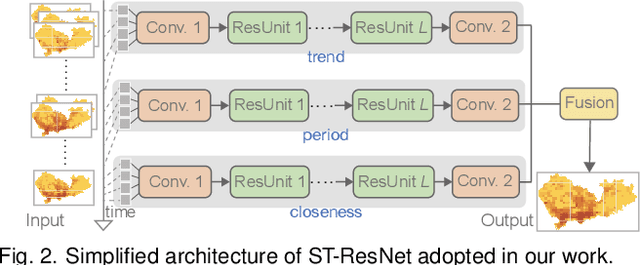
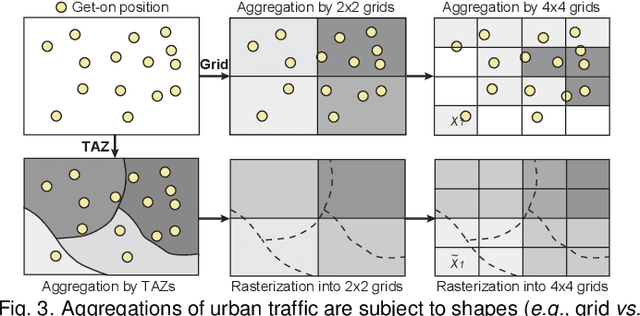
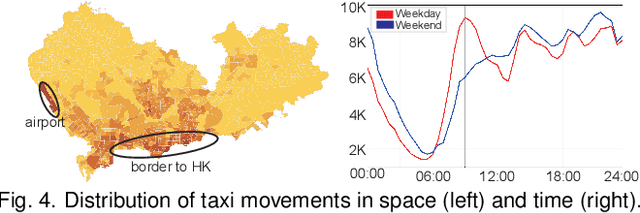
Deep learning methods are being increasingly used for urban traffic prediction where spatiotemporal traffic data is aggregated into sequentially organized matrices that are then fed into convolution-based residual neural networks. However, the widely known modifiable areal unit problem within such aggregation processes can lead to perturbations in the network inputs. This issue can significantly destabilize the feature embeddings and the predictions, rendering deep networks much less useful for the experts. This paper approaches this challenge by leveraging unit visualization techniques that enable the investigation of many-to-many relationships between dynamically varied multi-scalar aggregations of urban traffic data and neural network predictions. Through regular exchanges with a domain expert, we design and develop a visual analytics solution that integrates 1) a Bivariate Map equipped with an advanced bivariate colormap to simultaneously depict input traffic and prediction errors across space, 2) a Morans I Scatterplot that provides local indicators of spatial association analysis, and 3) a Multi-scale Attribution View that arranges non-linear dot plots in a tree layout to promote model analysis and comparison across scales. We evaluate our approach through a series of case studies involving a real-world dataset of Shenzhen taxi trips, and through interviews with domain experts. We observe that geographical scale variations have important impact on prediction performances, and interactive visual exploration of dynamically varying inputs and outputs benefit experts in the development of deep traffic prediction models.