 Add to Chrome
 Add to Firefox
 Add to Edge
MixFormer: Co-Scaling Up Dense and Sequence in Industrial Recommenders
Feb 15, 2026
As industrial recommender systems enter a scaling-driven regime, Transformer architectures have become increasingly attractive for scaling models towards larger capacity and longer sequence. However, existing Transformer-based recommendation models remain structurally fragmented, where sequence modeling and feature interaction are implemented as separate modules with independent parameterization. Such designs introduce a fundamental co-scaling challenge, as model capacity must be suboptimally allocated between dense feature interaction and sequence modeling under a limited computational budget. In this work, we propose MixFormer, a unified Transformer-style architecture tailored for recommender systems, which jointly models sequential behaviors and feature interactions within a single backbone. Through a unified parameterization, MixFormer enables effective co-scaling across both dense capacity and sequence length, mitigating the trade-off observed in decoupled designs. Moreover, the integrated architecture facilitates deep interaction between sequential and non-sequential representations, allowing high-order feature semantics to directly inform sequence aggregation and enhancing overall expressiveness. To ensure industrial practicality, we further introduce a user-item decoupling strategy for efficiency optimizations that significantly reduce redundant computation and inference latency. Extensive experiments on large-scale industrial datasets demonstrate that MixFormer consistently exhibits superior accuracy and efficiency. Furthermore, large-scale online A/B tests on two production recommender systems, Douyin and Douyin Lite, show consistent improvements in user engagement metrics, including active days and in-app usage duration.

Make It Long, Keep It Fast: End-to-End 10k-Sequence Modeling at Billion Scale on Douyin
Nov 08, 2025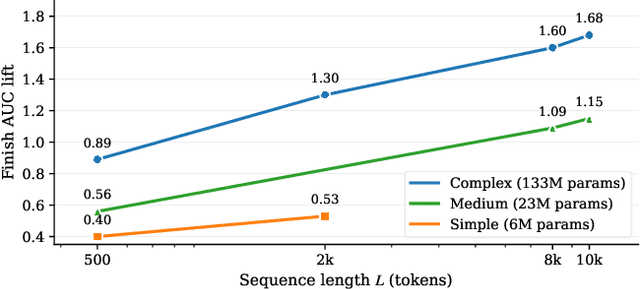
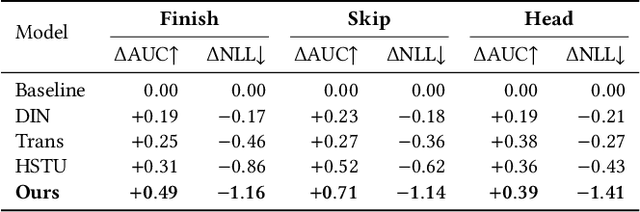
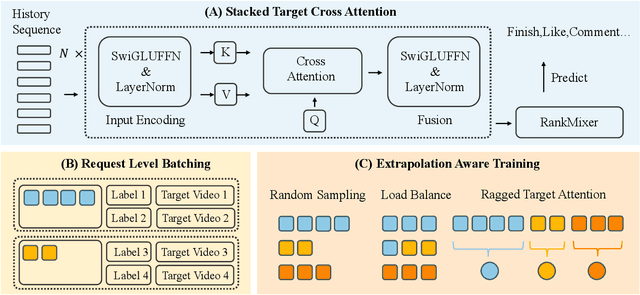

Short-video recommenders such as Douyin must exploit extremely long user histories without breaking latency or cost budgets. We present an end-to-end system that scales long-sequence modeling to 10k-length histories in production. First, we introduce Stacked Target-to-History Cross Attention (STCA), which replaces history self-attention with stacked cross-attention from the target to the history, reducing complexity from quadratic to linear in sequence length and enabling efficient end-to-end training. Second, we propose Request Level Batching (RLB), a user-centric batching scheme that aggregates multiple targets for the same user/request to share the user-side encoding, substantially lowering sequence-related storage, communication, and compute without changing the learning objective. Third, we design a length-extrapolative training strategy -- train on shorter windows, infer on much longer ones -- so the model generalizes to 10k histories without additional training cost. Across offline and online experiments, we observe predictable, monotonic gains as we scale history length and model capacity, mirroring the scaling law behavior observed in large language models. Deployed at full traffic on Douyin, our system delivers significant improvements on key engagement metrics while meeting production latency, demonstrating a practical path to scaling end-to-end long-sequence recommendation to the 10k regime.