 Add to Chrome
 Add to Firefox
 Add to Edge
PragReST: Self-Reinforcing Counterfactual Reasoning for Pragmatic Language Understanding
Jun 17, 2026
Natural language understanding often depends on meanings that are implied rather than explicitly stated, requiring pragmatic reasoning. Despite strong performance on math and logical reasoning, large language models (LLMs) still struggle with making pragmatic inferences, often choosing literal interpretations. To improve LLM pragmatic reasoning, we introduce PragReST, a self-supervised framework that constructs pragmatic QA data, generates counterfactual reasoning traces, and trains models to internalize them through supervised fine-tuning and reinforcement learning, without human-labeled training data or distillation from a stronger teacher. Across four pragmatic benchmarks (PragMega, Ludwig, MetoQA, and AltPrag), PragReST improves over backbone models, task-specific pragmatic tuning baselines, and non-counterfactual variants of the same pipeline. On accuracy-based benchmarks, PragReST improves over the instruct backbone by 5.37 and 5.50% (absolute) for Qwen3-8B and Qwen3-14B, respectively. Our error analysis and ablations underscore the importance of counterfactual reasoning: PragReST primarily reduces errors caused by failures to contrast observed utterances with plausible alternatives, and removing counterfactual reasoning substantially reduces performance. Moreover, our training preserves out-of-domain performance on general-knowledge and mathematical reasoning benchmarks.

SafeMate: A Modular RAG-Based Agent for Context-Aware Emergency Guidance
May 19, 2025

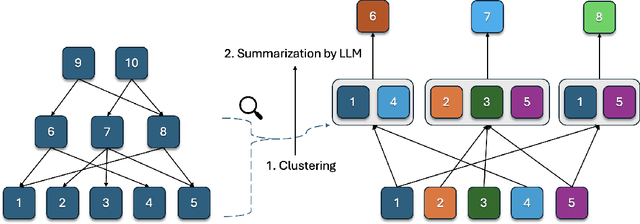
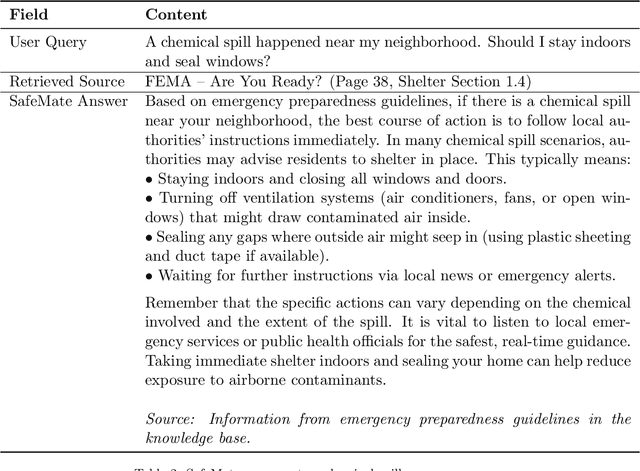
Despite the abundance of public safety documents and emergency protocols, most individuals remain ill-equipped to interpret and act on such information during crises. Traditional emergency decision support systems (EDSS) are designed for professionals and rely heavily on static documents like PDFs or SOPs, which are difficult for non-experts to navigate under stress. This gap between institutional knowledge and public accessibility poses a critical barrier to effective emergency preparedness and response. We introduce SafeMate, a retrieval-augmented AI assistant that delivers accurate, context-aware guidance to general users in both preparedness and active emergency scenarios. Built on the Model Context Protocol (MCP), SafeMate dynamically routes user queries to tools for document retrieval, checklist generation, and structured summarization. It uses FAISS with cosine similarity to identify relevant content from trusted sources.
SafeMate: A Model Context Protocol-Based Multimodal Agent for Emergency Preparedness
May 05, 2025Despite the abundance of public safety documents and emergency protocols, most individuals remain ill-equipped to interpret and act on such information during crises. Traditional emergency decision support systems (EDSS) are designed for professionals and rely heavily on static documents like PDFs or SOPs, which are difficult for non-experts to navigate under stress. This gap between institutional knowledge and public accessibility poses a critical barrier to effective emergency preparedness and response. We introduce SafeMate, a retrieval-augmented AI assistant that delivers accurate, context-aware guidance to general users in both preparedness and active emergency scenarios. Built on the Model Context Protocol (MCP), SafeMate dynamically routes user queries to tools for document retrieval, checklist generation, and structured summarization. It uses FAISS with cosine similarity to identify relevant content from trusted sources.