 Add to Chrome
 Add to Firefox
 Add to Edge
Channel-Oriented Design for EEG-to-Music Reconstruction
Jun 02, 2026
Brain-computer interfaces aim to decode naturalistic stimuli from neural signals, yet most progress to date has focused on vision and language. In this article, we study a more challenging but far less explored setting, EEG-to-music reconstruction, where signals are weak, distributed, and highly susceptible to noise and channel variability. Our central finding is that early channel mixing destroys weak but discriminative EEG signals. To address this, we propose a channel-oriented design with three key components. Specifically, channel-wise tokenization treats each electrode as an explicit token to retain spatially localized neural evidence, channel-wise multi-view self-distillation enforces consistency across temporal crops and random channel subsets to learn robust and distributed representations, and channel-wise data augmentation introduces structured channel dropout to improve invariance to noise, artifacts, and missing electrodes. Together, these components preserve weak yet informative signals across channels and enable stable alignment to a semantic music representation space. We integrate this channel-oriented design within an encoding-alignment-decoding pipeline for EEG-to-music reconstruction. Theoretically, we characterize when preserving channel-level structure leads to improved alignment. Empirically, we compare with a range of state-of-the-art baselines and demonstrate consistent and significant performance gains.

Dive into Waves: Morlet Spectral Transformer for Cross-Subject Emotion Decoding from EEG
May 30, 2026We study cross-subject emotion recognition from EEG, a practically important yet challenging problem in brain-computer interfaces. Unlike tasks with clear waveform signatures, emotion-related EEG signals are primarily encoded in spectral power and are weak, noisy, and highly variable across subjects. Existing approaches rely either on large pretrained EEG foundation models, which require massive data yet still struggle with cross-subject variability, or frequency-domain encoders, which better reflect spectral structure but suffer from mismatched representations, drift-dominated tokenization, and lack of band-specific spatial modeling. In this article, we propose the Morlet Spectral Transformer (MST), built around three key components and integrated with a spatiotemporal Transformer backbone. First, Morlet wavelet tokenization provides a time-frequency representation that matches the multi-scale structure of brain rhythms, and extends classical differential entropy features to a form suitable for Transformers. Second, long-context baseline removal acts as a simple temporal normalization that removes subject-specific drift and redundancy across nearby windows. Third, frequency-specific spatial projection learns a separate channel mixer for each frequency band, capturing interpretable band-specific patterns and reducing cross-channel mixing. We show that, even without pretraining, MST consistently outperforms both large pretrained EEG foundation models and frequency-based methods across all SEED-family datasets. These results suggest that careful representation design can yield an accurate, cost-effective, and interpretable alternative to large-scale pretraining.
Cinematic Mindscapes: High-quality Video Reconstruction from Brain Activity
May 19, 2023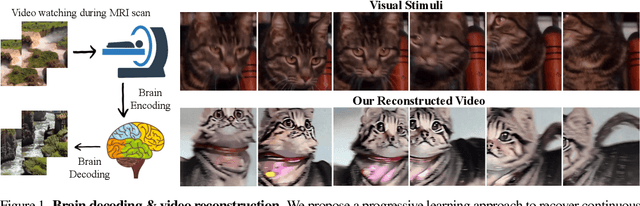
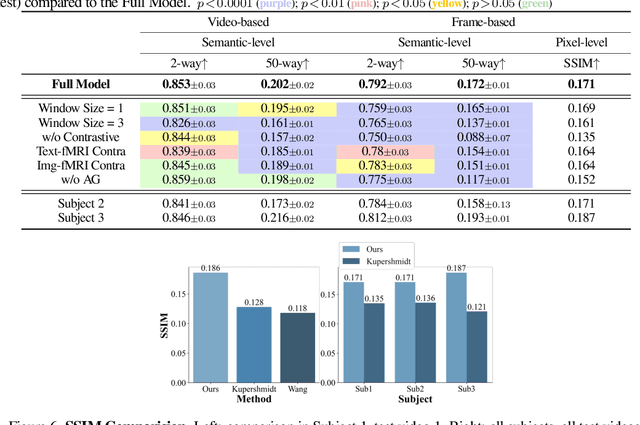
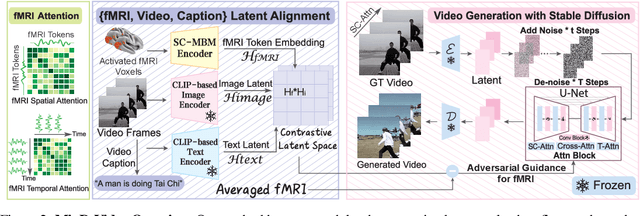

Reconstructing human vision from brain activities has been an appealing task that helps to understand our cognitive process. Even though recent research has seen great success in reconstructing static images from non-invasive brain recordings, work on recovering continuous visual experiences in the form of videos is limited. In this work, we propose Mind-Video that learns spatiotemporal information from continuous fMRI data of the cerebral cortex progressively through masked brain modeling, multimodal contrastive learning with spatiotemporal attention, and co-training with an augmented Stable Diffusion model that incorporates network temporal inflation. We show that high-quality videos of arbitrary frame rates can be reconstructed with Mind-Video using adversarial guidance. The recovered videos were evaluated with various semantic and pixel-level metrics. We achieved an average accuracy of 85% in semantic classification tasks and 0.19 in structural similarity index (SSIM), outperforming the previous state-of-the-art by 45%. We also show that our model is biologically plausible and interpretable, reflecting established physiological processes.
Seeing Beyond the Brain: Conditional Diffusion Model with Sparse Masked Modeling for Vision Decoding
Nov 15, 2022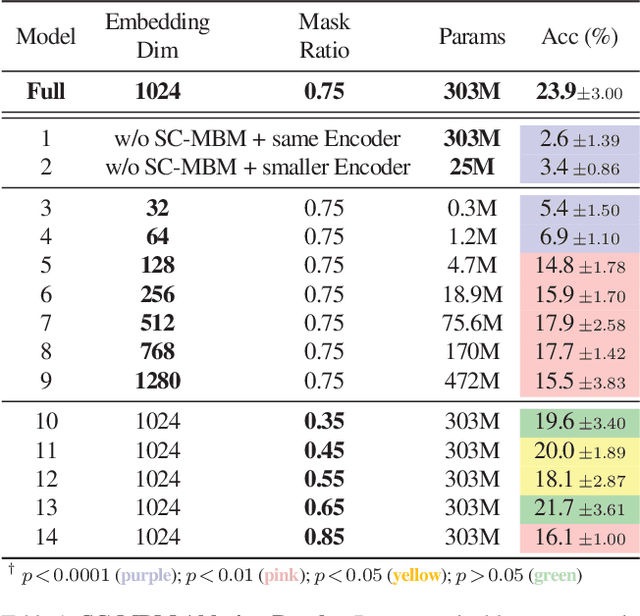

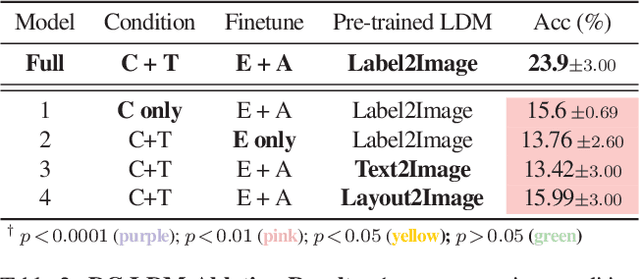
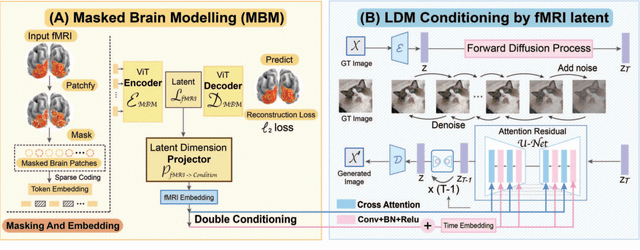
Decoding visual stimuli from brain recordings aims to deepen our understanding of the human visual system and build a solid foundation for bridging human and computer vision through the Brain-Computer Interface. However, reconstructing high-quality images with correct semantics from brain recordings is a challenging problem due to the complex underlying representations of brain signals and the scarcity of data annotations. In this work, we present MinD-Vis: Sparse Masked Brain Modeling with Double-Conditioned Latent Diffusion Model for Human Vision Decoding. Firstly, we learn an effective self-supervised representation of fMRI data using mask modeling in a large latent space inspired by the sparse coding of information in the primary visual cortex. Then by augmenting a latent diffusion model with double-conditioning, we show that MinD-Vis can reconstruct highly plausible images with semantically matching details from brain recordings using very few paired annotations. We benchmarked our model qualitatively and quantitatively; the experimental results indicate that our method outperformed state-of-the-art in both semantic mapping (100-way semantic classification) and generation quality (FID) by 66% and 41% respectively. An exhaustive ablation study was also conducted to analyze our framework.