 Add to Chrome
 Add to Firefox
 Add to Edge
Ro-SLM: Onboard Small Language Models for Robot Task Planning and Operation Code Generation
Apr 14, 2026
Recent advances in large language models (LLMs) provide robots with contextual reasoning abilities to comprehend human instructions. Yet, current LLM-enabled robots typically depend on cloud-based models or high-performance computing infrastructure, which limit their deployment on robots under unreliable internet environments or with constrained computational resources, such as UAVs and small ground vehicles. Thus, deploying fine-tuned small language models (SLMs) that support onboard deployment offers a promising alternative. This paper introduces Ro-SLM, a framework that enables reliable SLM-driven robot operation by distilling LLMs' knowledge and reasoning. Ro-SLM starts from dataset synthesis by leveraging LLMs to generate diverse task instructions, produce corresponding ground truth code with minimal human assistance, and augment instructions into real-world application scenarios. Ro-SLM is then fine-tuned with the dataset, in which LLM serves as a reward function to guide the training. Extensive experiments on UAV operation tasks demonstrate that Ro-SLM improves the performance of SLM from being incapable of supporting robotic task planning and code generation to achieving performance that approaches LLM.

Physics Encoded Spatial and Temporal Generative Adversarial Network for Tropical Cyclone Image Super-resolution
Feb 19, 2026High-resolution satellite imagery is indispensable for tracking the genesis, intensification, and trajectory of tropical cyclones (TCs). However, existing deep learning-based super-resolution (SR) methods often treat satellite image sequences as generic videos, neglecting the underlying atmospheric physical laws governing cloud motion. To address this, we propose a Physics Encoded Spatial and Temporal Generative Adversarial Network (PESTGAN) for TC image super-resolution. Specifically, we design a disentangled generator architecture incorporating a PhyCell module, which approximates the vorticity equation via constrained convolutions and encodes the resulting approximate physical dynamics as implicit latent representations to separate physical dynamics from visual textures. Furthermore, a dual-discriminator framework is introduced, employing a temporal discriminator to enforce motion consistency alongside spatial realism. Experiments on the Digital Typhoon dataset for 4$\times$ upscaling demonstrate that PESTGAN establishes a better performance in structural fidelity and perceptual quality. While maintaining competitive pixel-wise accuracy compared to existing approaches, our method significantly excels in reconstructing meteorologically plausible cloud structures with superior physical fidelity.
Large Language Model-Driven Closed-Loop UAV Operation with Semantic Observations
Jul 03, 2025Recent advances in large Language Models (LLMs) have revolutionized mobile robots, including unmanned aerial vehicles (UAVs), enabling their intelligent operation within Internet of Things (IoT) ecosystems. However, LLMs still face challenges from logical reasoning and complex decision-making, leading to concerns about the reliability of LLM-driven UAV operations in IoT applications. In this paper, we propose a LLM-driven closed-loop control framework that enables reliable UAV operations powered by effective feedback and refinement using two LLM modules, i.e., a Code Generator and an Evaluator. Our framework transforms numerical state observations from UAV operations into natural language trajectory descriptions to enhance the evaluator LLM's understanding of UAV dynamics for precise feedback generation. Our framework also enables a simulation-based refinement process, and hence eliminates the risks to physical UAVs caused by incorrect code execution during the refinement. Extensive experiments on UAV control tasks with different complexities are conducted. The experimental results show that our framework can achieve reliable UAV operations using LLMs, which significantly outperforms baseline approaches in terms of success rate and completeness with the increase of task complexity.
GSCE: A Prompt Framework with Enhanced Reasoning for Reliable LLM-driven Drone Control
Feb 18, 2025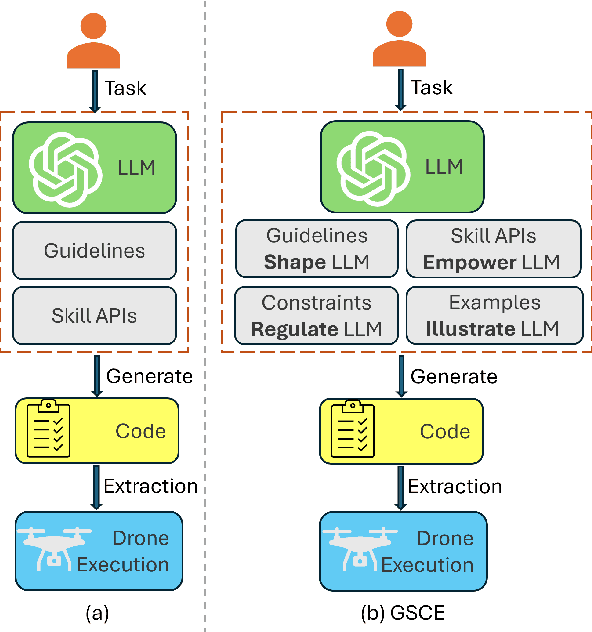
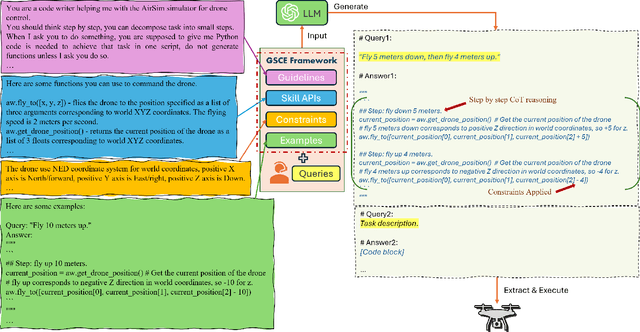
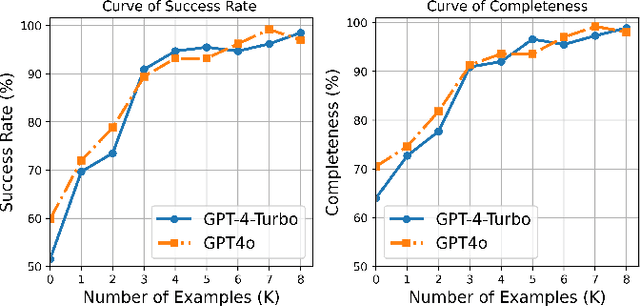
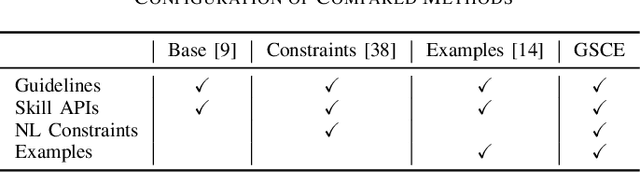
The integration of Large Language Models (LLMs) into robotic control, including drones, has the potential to revolutionize autonomous systems. Research studies have demonstrated that LLMs can be leveraged to support robotic operations. However, when facing tasks with complex reasoning, concerns and challenges are raised about the reliability of solutions produced by LLMs. In this paper, we propose a prompt framework with enhanced reasoning to enable reliable LLM-driven control for drones. Our framework consists of novel technical components designed using Guidelines, Skill APIs, Constraints, and Examples, namely GSCE. GSCE is featured by its reliable and constraint-compliant code generation. We performed thorough experiments using GSCE for the control of drones with a wide level of task complexities. Our experiment results demonstrate that GSCE can significantly improve task success rates and completeness compared to baseline approaches, highlighting its potential for reliable LLM-driven autonomous drone systems.