 Add to Chrome
 Add to Firefox
 Add to Edge
BAMU: Bitstream-Aware Marginal-Utility Allocation for Frozen Pretrained Neural Speech Codecs
Aug 09, 2026
Pretrained neural speech codecs typically use a fixed residual vector quantization (RVQ) depth for all frames, ignoring temporal variation in quantization difficulty. We propose BAMU, a bitstream-aware dynamic RVQ allocation framework for frozen pretrained codecs. A lightweight, rate-independent predictor estimates frame- and layer-wise marginal latent-distortion reductions, while a constrained allocator selects prefix-valid depths under an exact serialized-size budget. Experiments on EnCodec and DAC over LibriSpeech, together with VCTK evaluation, show consistent EnCodec gains and DAC improvements mainly at medium and high rates. A 30-listener study confirms a MOS improvement from 3.449 to 3.780 over matched fixed-depth coding.

SketchSong: Hierarchical Song Generation with Sketch Planning and Fine-Grained Multi-Track Modeling
Jun 02, 2026Recent song generation systems can synthesize realistic audio, yet generating complete songs remains challenging for two reasons. First, explicit song-level arrangement planning remains limited in existing methods, so models often need to organize overall arrangement development while generating low-level audio details. This often leads to incoherence in arrangements, such as weak section transitions and limited dynamic progression. Second, coarse modeling of different musical parts obscures their distinct roles and interactions, limiting arrangement richness of generated songs. In this paper, we present SketchSong, a hierarchical song generation framework that addresses these issues through song-level sketch planning and fine-grained multi-track modeling. Along the temporal dimension, SketchSong first predicts a compact sequence of high-level sketch tokens derived from compressed audio representations, and then generates audio tokens conditioned on these sketches. This coarse-to-fine process gives the model an explicit arrangement plan before detailed audio generation. Along the track dimension, SketchSong explicitly models four tracks, i.e., vocals, bass, drums and other instruments. This enables the model to capture the roles and interactions of different musical parts more precisely. Experiments on song generation benchmarks show that SketchSong consistently outperforms our baseline on both objective metrics and human listening tests. Despite not employing additional post-training for preference optimization such as lyrics and text-prompt alignments, SketchSong achieves competitive results against strong, post-trained open-source systems, demonstrating the effectiveness of our overall design.
Efficient Long-Sequence Diffusion Modeling for Symbolic Music Generation
Feb 28, 2026Symbolic music generation is a challenging task in multimedia generation, involving long sequences with hierarchical temporal structures, long-range dependencies, and fine-grained local details. Though recent diffusion-based models produce high quality generations, they tend to suffer from high training and inference costs with long symbolic sequences due to iterative denoising and sequence-length-related costs. To deal with such problem, we put forth a diffusing strategy named SMDIM to combine efficient global structure construction and light local refinement. SMDIM uses structured state space models to capture long range musical context at near linear cost, and selectively refines local musical details via a hybrid refinement scheme. Experiments performed on a wide range of symbolic music datasets which encompass various Western classical music, popular music and traditional folk music show that the SMDIM model outperforms the other state-of-the-art approaches on both the generation quality and the computational efficiency, and it has robust generalization to underexplored musical styles. These results show that SMDIM offers a principled solution for long-sequence symbolic music generation, including associated attributes that accompany the sequences. We provide a project webpage with audio examples and supplementary materials at https://3328702107.github.io/smdim-music/.
Tutti: Expressive Multi-Singer Synthesis via Structure-Level Timbre Control and Vocal Texture Modeling
Feb 09, 2026While existing Singing Voice Synthesis systems achieve high-fidelity solo performances, they are constrained by global timbre control, failing to address dynamic multi-singer arrangement and vocal texture within a single song. To address this, we propose Tutti, a unified framework designed for structured multi-singer generation. Specifically, we introduce a Structure-Aware Singer Prompt to enable flexible singer scheduling evolving with musical structure, and propose Complementary Texture Learning via Condition-Guided VAE to capture implicit acoustic textures (e.g., spatial reverberation and spectral fusion) that are complementary to explicit controls. Experiments demonstrate that Tutti excels in precise multi-singer scheduling and significantly enhances the acoustic realism of choral generation, offering a novel paradigm for complex multi-singer arrangement. Audio samples are available at https://annoauth123-ctrl.github.io/Tutii_Demo/.
MusicMamba: A Dual-Feature Modeling Approach for Generating Chinese Traditional Music with Modal Precision
Sep 04, 2024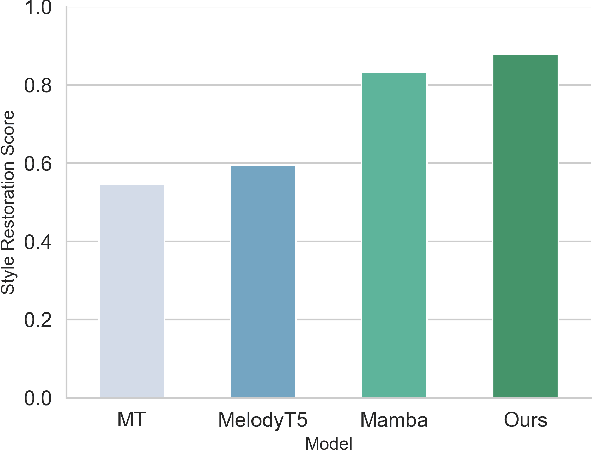
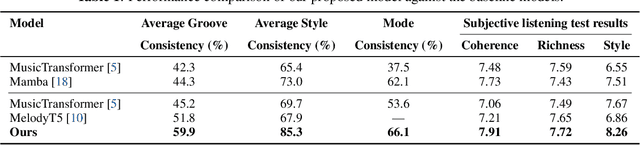
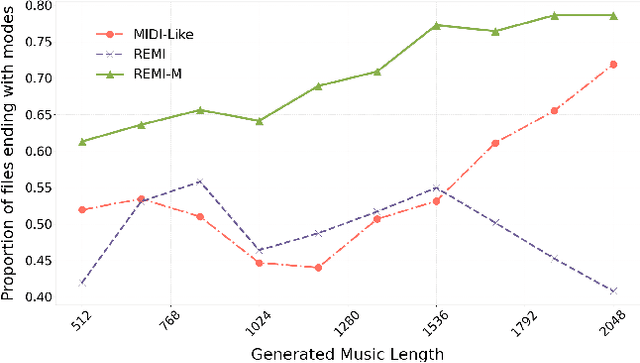
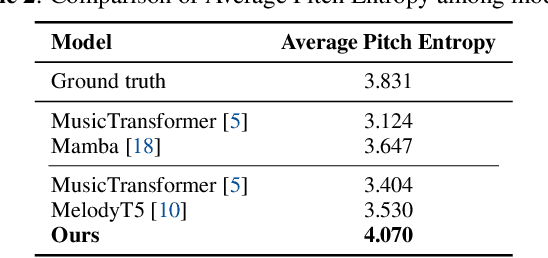
In recent years, deep learning has significantly advanced the MIDI domain, solidifying music generation as a key application of artificial intelligence. However, existing research primarily focuses on Western music and encounters challenges in generating melodies for Chinese traditional music, especially in capturing modal characteristics and emotional expression. To address these issues, we propose a new architecture, the Dual-Feature Modeling Module, which integrates the long-range dependency modeling of the Mamba Block with the global structure capturing capabilities of the Transformer Block. Additionally, we introduce the Bidirectional Mamba Fusion Layer, which integrates local details and global structures through bidirectional scanning, enhancing the modeling of complex sequences. Building on this architecture, we propose the REMI-M representation, which more accurately captures and generates modal information in melodies. To support this research, we developed FolkDB, a high-quality Chinese traditional music dataset encompassing various styles and totaling over 11 hours of music. Experimental results demonstrate that the proposed architecture excels in generating melodies with Chinese traditional music characteristics, offering a new and effective solution for music generation.