 Add to Chrome
 Add to Firefox
 Add to Edge
Let Relations Speak: An End-to-End LLM-GNN Soft Prompt Framework for Fraud Detection
May 27, 2026
In recent years, Large Language Models (LLMs) have shown great capability in processing graph tasks such as fraud detection. However, most existing methods rely heavily on rich text attributes, which poses difficulties for this domain due to the lack of textual data. Although some pioneering methods attempt to overcome it, their textualization of graph structures via hard prompts easily leads to feature distortion. Additionally, fraud detection often exhibits multi-relational complexity, where current methods struggle to capture this deep semantic information. To address these challenges, we propose LLM-GNN Soft Prompt Framework (LGSPF). Specifically, LGSPF bridges the graph structure and semantic space using soft prompt to eliminate reliance on text. We further introduce a parallel Graph Neural Network (GNN) encoder to translate multi-relational topologies into graph tokens for fine-grained LLM fraud comprehension. Through end-to-end optimization, LGSPF enhances deep semantic alignment between LLM and GNN. Experiments across diverse fraud detection benchmarks demonstrate our method achieves state-of-the-art performance. Moreover, we further validate the contribution of LGSPF on enhancing the semantic interpretability of fraud behaviors.

SFL-LEO: Asynchronous Split-Federated Learning Design for LEO Satellite-Ground Network Framework
Apr 18, 2025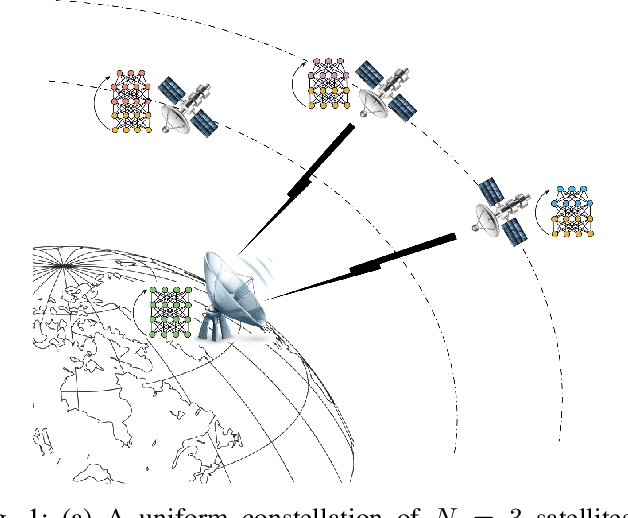
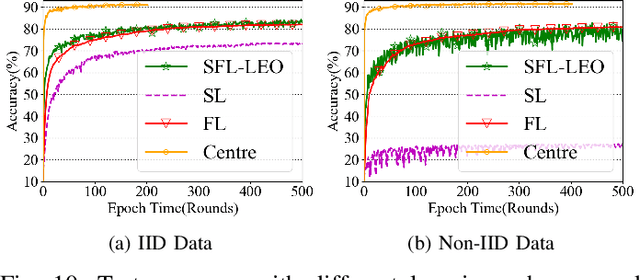
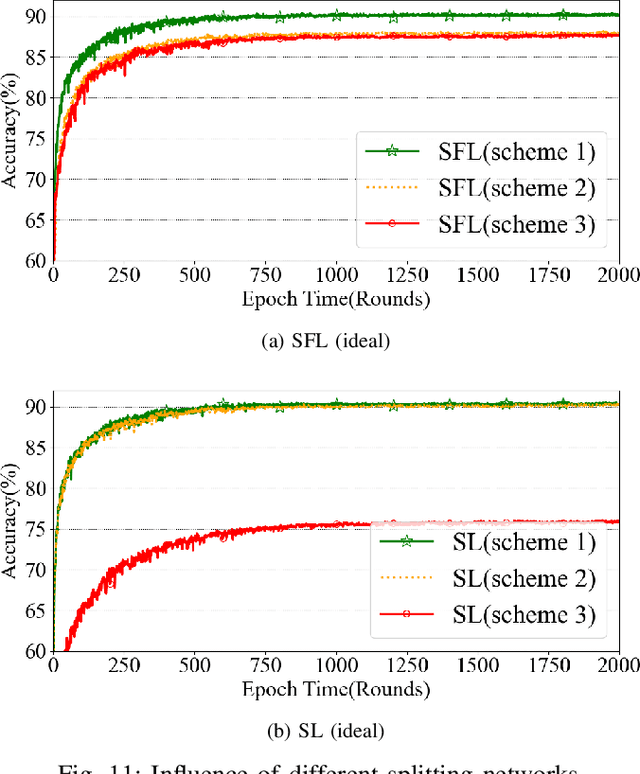
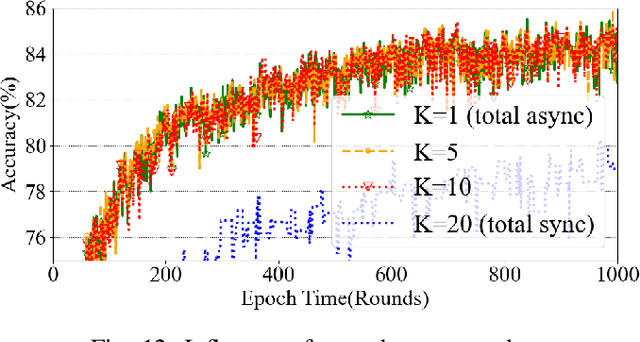
Recently, the rapid development of LEO satellite networks spurs another widespread concern-data processing at satellites. However, achieving efficient computation at LEO satellites in highly dynamic satellite networks is challenging and remains an open problem when considering the constrained computation capability of LEO satellites. For the first time, we propose a novel distributed learning framework named SFL-LEO by combining Federated Learning (FL) with Split Learning (SL) to accommodate the high dynamics of LEO satellite networks and the constrained computation capability of LEO satellites by leveraging the periodical orbit traveling feature. The proposed scheme allows training locally by introducing an asynchronous training strategy, i.e., achieving local update when LEO satellites disconnect with the ground station, to provide much more training space and thus increase the training performance. Meanwhile, it aggregates client-side sub-models at the ground station and then distributes them to LEO satellites by borrowing the idea from the federated learning scheme. Experiment results driven by satellite-ground bandwidth measured in Starlink demonstrate that SFL-LEO provides a similar accuracy performance with the conventional SL scheme because it can perform local training even within the disconnection duration.
Deep Reinforcement Learning Based Resource Allocation for Cloud Native Wireless Network
May 10, 2023Cloud native technology has revolutionized 5G beyond and 6G communication networks, offering unprecedented levels of operational automation, flexibility, and adaptability. However, the vast array of cloud native services and applications presents a new challenge in resource allocation for dynamic cloud computing environments. To tackle this challenge, we investigate a cloud native wireless architecture that employs container-based virtualization to enable flexible service deployment. We then study two representative use cases: network slicing and Multi-Access Edge Computing. To optimize resource allocation in these scenarios, we leverage deep reinforcement learning techniques and introduce two model-free algorithms capable of monitoring the network state and dynamically training allocation policies. We validate the effectiveness of our algorithms in a testbed developed using Free5gc. Our findings demonstrate significant improvements in network efficiency, underscoring the potential of our proposed techniques in unlocking the full potential of cloud native wireless networks.