 Add to Chrome
 Add to Firefox
 Add to Edge
ExpressEdit: Fast Editing of Stylized Facial Expressions with Diffusion Models in Photoshop
Apr 03, 2026
Facial expressions of characters are a vital component of visual storytelling. While current AI image editing models hold promise for assisting artists in the task of stylized expression editing, these models introduce global noise and pixel drift into the edited image, preventing the integration of these models into professional image editing software and workflows. To bridge this gap, we introduce ExpressEdit, a fully open-source Photoshop plugin that is free from common artifacts of proprietary image editing models and robustly synergizes with native Photoshop operations such as Liquify. ExpressEdit seamlessly edits an expression within 3 seconds on a single consumer-grade GPU, significantly faster than popular proprietary models. Moreover, to support the generation of diverse expressions according to different narrative needs, we compile a comprehensive expression database of 135 expression tags enriched with example stories and images designed for retrieval-augmented generation. We open source the code and dataset to facilitate future research and artistic exploration.

Dark-ISP: Enhancing RAW Image Processing for Low-Light Object Detection
Sep 11, 2025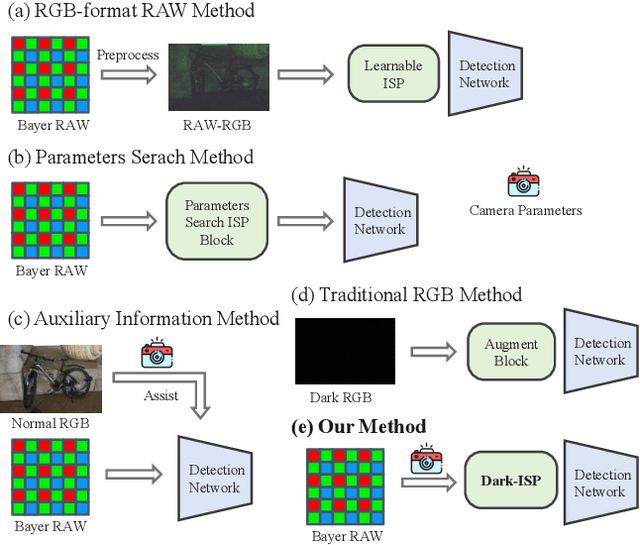
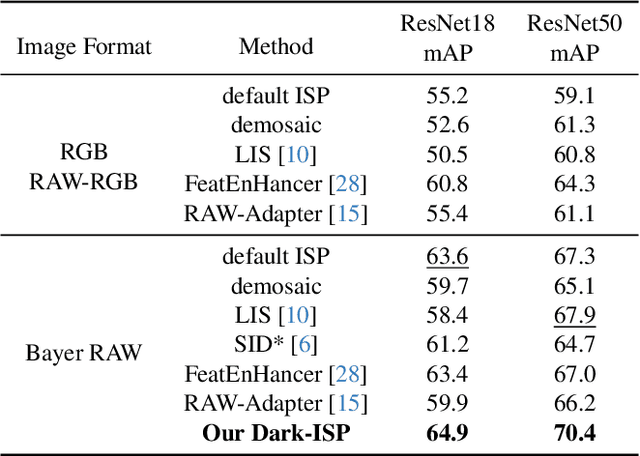
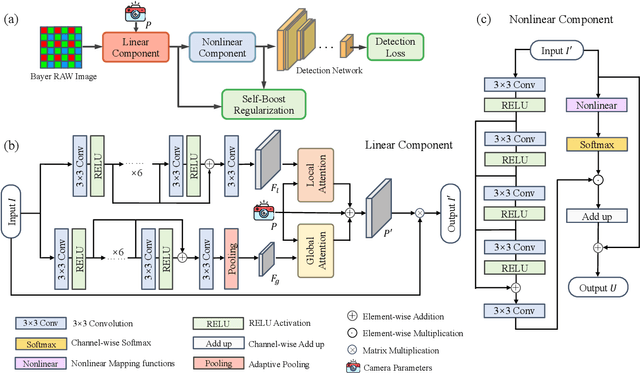
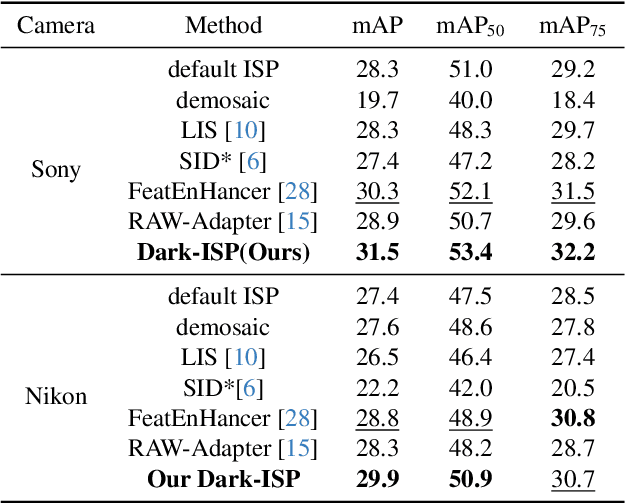
Low-light Object detection is crucial for many real-world applications but remains challenging due to degraded image quality. While recent studies have shown that RAW images offer superior potential over RGB images, existing approaches either use RAW-RGB images with information loss or employ complex frameworks. To address these, we propose a lightweight and self-adaptive Image Signal Processing (ISP) plugin, Dark-ISP, which directly processes Bayer RAW images in dark environments, enabling seamless end-to-end training for object detection. Our key innovations are: (1) We deconstruct conventional ISP pipelines into sequential linear (sensor calibration) and nonlinear (tone mapping) sub-modules, recasting them as differentiable components optimized through task-driven losses. Each module is equipped with content-aware adaptability and physics-informed priors, enabling automatic RAW-to-RGB conversion aligned with detection objectives. (2) By exploiting the ISP pipeline's intrinsic cascade structure, we devise a Self-Boost mechanism that facilitates cooperation between sub-modules. Through extensive experiments on three RAW image datasets, we demonstrate that our method outperforms state-of-the-art RGB- and RAW-based detection approaches, achieving superior results with minimal parameters in challenging low-light environments.
* 11 pages, 6 figures, conference