 Add to Chrome
 Add to Firefox
 Add to Edge
BrowseComp-$V^3$: A Visual, Vertical, and Verifiable Benchmark for Multimodal Browsing Agents
Feb 13, 2026
Multimodal large language models (MLLMs), equipped with increasingly advanced planning and tool-use capabilities, are evolving into autonomous agents capable of performing multimodal web browsing and deep search in open-world environments. However, existing benchmarks for multimodal browsing remain limited in task complexity, evidence accessibility, and evaluation granularity, hindering comprehensive and reproducible assessments of deep search capabilities. To address these limitations, we introduce BrowseComp-$V^3$, a novel benchmark consisting of 300 carefully curated and challenging questions spanning diverse domains. The benchmark emphasizes deep, multi-level, and cross-modal multi-hop reasoning, where critical evidence is interleaved across textual and visual modalities within and across web pages. All supporting evidence is strictly required to be publicly searchable, ensuring fairness and reproducibility. Beyond final-answer accuracy, we incorporate an expert-validated, subgoal-driven process evaluation mechanism that enables fine-grained analysis of intermediate reasoning behaviors and systematic characterization of capability boundaries. In addition, we propose OmniSeeker, a unified multimodal browsing agent framework integrating diverse web search and visual perception tools. Comprehensive experiments demonstrate that even state-of-the-art models achieve only 36% accuracy on our benchmark, revealing critical bottlenecks in multimodal information integration and fine-grained perception. Our results highlight a fundamental gap between current model capabilities and robust multimodal deep search in real-world settings.

OTLRM: Orthogonal Learning-based Low-Rank Metric for Multi-Dimensional Inverse Problems
Dec 15, 2024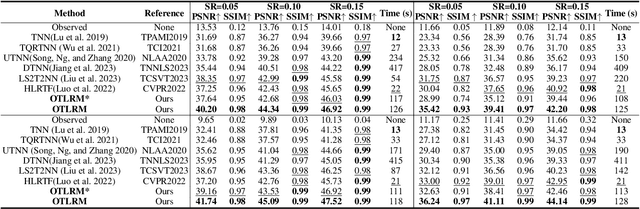
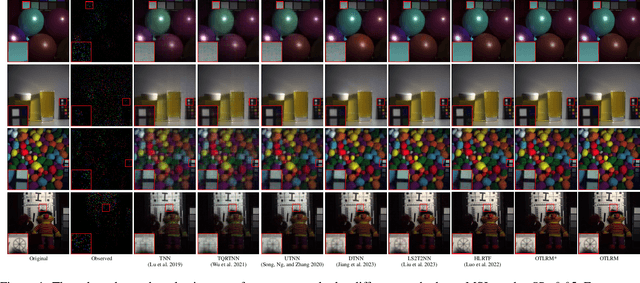


In real-world scenarios, complex data such as multispectral images and multi-frame videos inherently exhibit robust low-rank property. This property is vital for multi-dimensional inverse problems, such as tensor completion, spectral imaging reconstruction, and multispectral image denoising. Existing tensor singular value decomposition (t-SVD) definitions rely on hand-designed or pre-given transforms, which lack flexibility for defining tensor nuclear norm (TNN). The TNN-regularized optimization problem is solved by the singular value thresholding (SVT) operator, which leverages the t-SVD framework to obtain the low-rank tensor. However, it is quite complicated to introduce SVT into deep neural networks due to the numerical instability problem in solving the derivatives of the eigenvectors. In this paper, we introduce a novel data-driven generative low-rank t-SVD model based on the learnable orthogonal transform, which can be naturally solved under its representation. Prompted by the linear algebra theorem of the Householder transformation, our learnable orthogonal transform is achieved by constructing an endogenously orthogonal matrix adaptable to neural networks, optimizing it as arbitrary orthogonal matrices. Additionally, we propose a low-rank solver as a generalization of SVT, which utilizes an efficient representation of generative networks to obtain low-rank structures. Extensive experiments highlight its significant restoration enhancements.