 Add to Chrome
 Add to Firefox
 Add to Edge
Tensor Probabilistic Model Checking of Finite-Horizon Markov Chains (Extended Version)
Aug 01, 2026
We reexamine the problem of verifying Markov chains with respect to step-bounded reachability probabilities. Prevailing approaches rely on encoding the state-transition matrix using either explicit or symbolic representations. While these approaches are effective for sparse transition dynamics, they scale less favorably in the dense regime. Our insight is to cast probabilistic model checking of Markov chains as computations over dense tensors. This methodology enables the use of off-the-shelf compiler toolchains for optimized execution of these tensor computations on hardware accelerators. We prove the soundness of the methodology of mapping probabilistic model checking to tensor computations. We implement our approach in a tool called Tessa . Empirical evaluation shows that Tessa unlocks massive speedups over state-of-theart methods on selected benchmarks from the literature.

Improving Neural Network Verification through Spurious Region Guided Refinement
Oct 15, 2020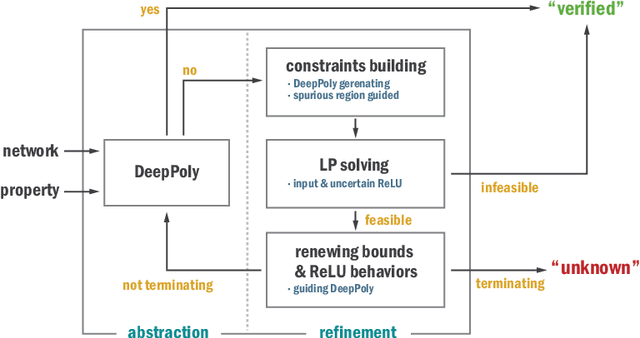
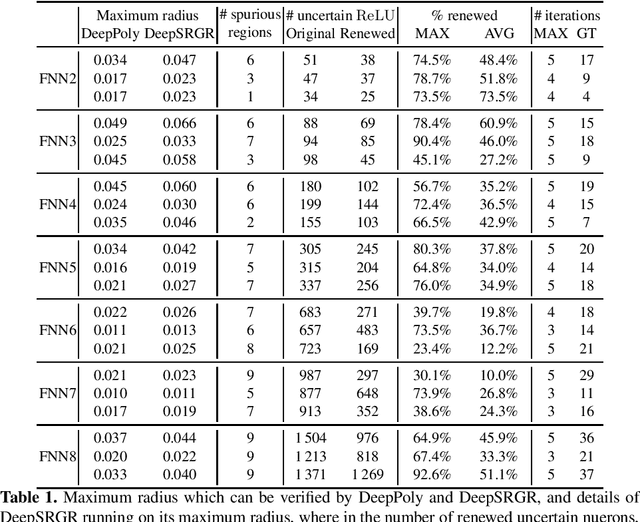
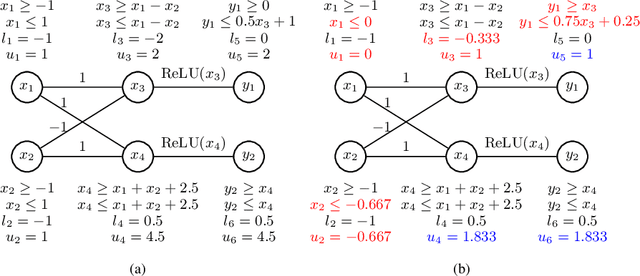
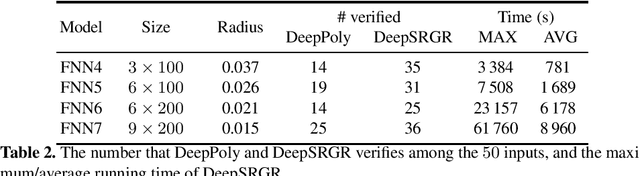
We propose a spurious region guided refinement approach for robustness verification of deep neural networks. Our method starts with applying the DeepPoly abstract domain to analyze the network. If the robustness property cannot be verified, the result is inconclusive. Due to the over-approximation, the computed region in the abstraction may be spurious in the sense that it does not contain any true counterexample. Our goal is to identify such spurious regions and use them to guide the abstraction refinement. The core idea is to make use of the obtained constraints of the abstraction to infer new bounds for the neurons. This is achieved by linear programming techniques. With the new bounds, we iteratively apply DeepPoly, aiming to eliminate spurious regions. We have implemented our approach in a prototypical tool DeepSRGR. Experimental results show that a large amount of regions can be identified as spurious, and as a result, the precision of DeepPoly can be significantly improved. As a side contribution, we show that our approach can be applied to verify quantitative robustness properties.
Analyzing Deep Neural Networks with Symbolic Propagation: Towards Higher Precision and Faster Verification
Feb 26, 2019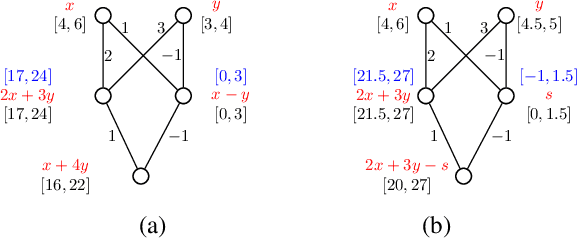
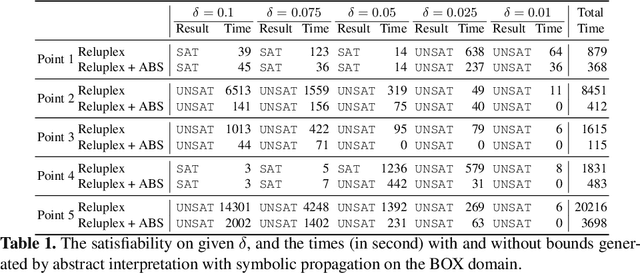
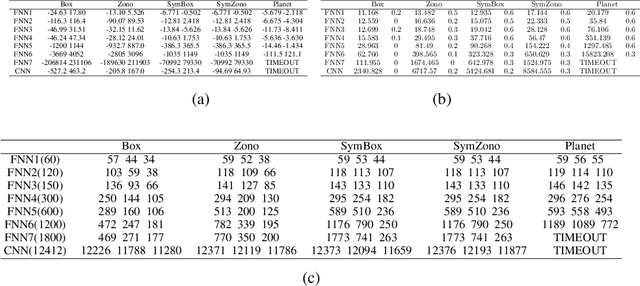
Deep neural networks (DNNs) have been shown lack of robustness for the vulnerability of their classification to small perturbations on the inputs. This has led to safety concerns of applying DNNs to safety-critical domains. Several verification approaches have been developed to automatically prove or disprove safety properties of DNNs. However, these approaches suffer from either the scalability problem, i.e., only small DNNs can be handled, or the precision problem, i.e., the obtained bounds are loose. This paper improves on a recent proposal of analyzing DNNs through the classic abstract interpretation technique, by a novel symbolic propagation technique. More specifically, the values of neurons are represented symbolically and propagated forwardly from the input layer to the output layer, on top of abstract domains. We show that our approach can achieve significantly higher precision and thus can prove more properties than using only abstract domains. Moreover, we show that the bounds derived from our approach on the hidden neurons, when applied to a state-of-the-art SMT based verification tool, can improve its performance. We implement our approach into a software tool and validate it over a few DNNs trained on benchmark datasets such as MNIST, etc.