 Add to Chrome
 Add to Firefox
 Add to Edge
Towards Faithful Graph Explanations with Synergistic Edge Effects via Granular Balls
Jul 23, 2026
Instance-level explanations aim to reveal the rationale behind a model's decisions for a specific graph. Previous methods explain graph neural networks (GNNs) by selecting important edges to induce subgraphs, where edge importance is assessed by perturbing each edge and observing changes in the model predictions. However, they often neglect the synergistic effects among edges, which are crucial for accurately characterizing edge importance. To address this issue, we propose SeeExplainer, a parameter-free explainer to interpret GNNs. Specifically, we first introduce a granular-ball graph refinement mechanism that decomposes a graph into several disjoint granular-balls with no fixed size, and utilize them as nodes to construct a structural graph. This process can better capture the synergistic effects among edges. Then, we perturb nodes and edges in the structural graph to generate explanatory subgraphs based on their respective contributions. Experiments on several graph classification datasets of different networks show that SeeExplainer outperforms state-of-the-art baselines.

Granular-ball Optimization Algorithm
Mar 18, 2023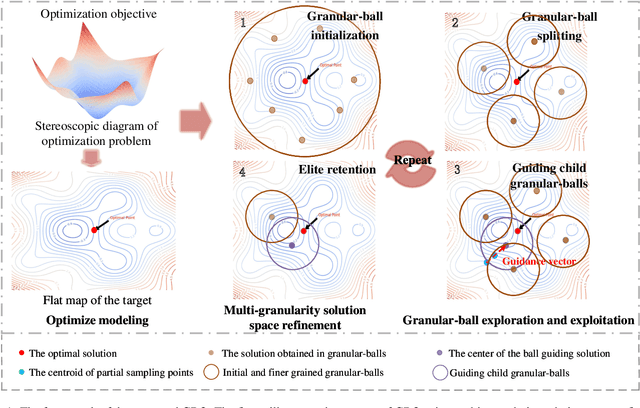
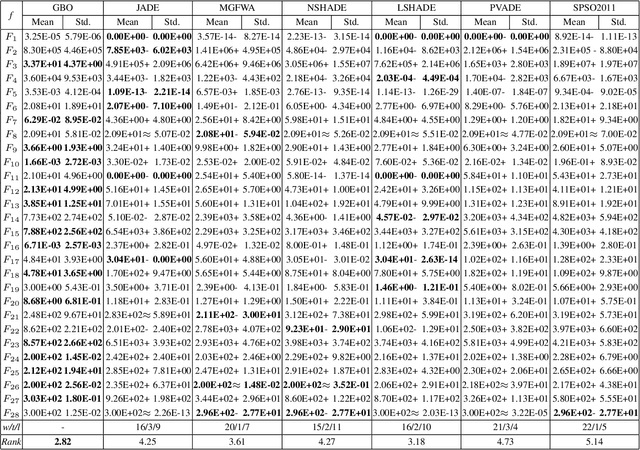
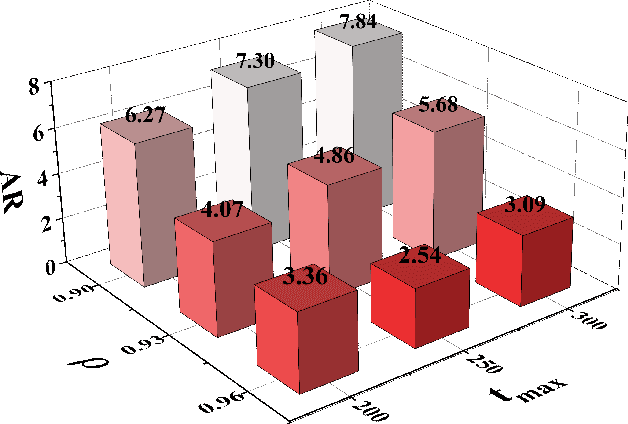
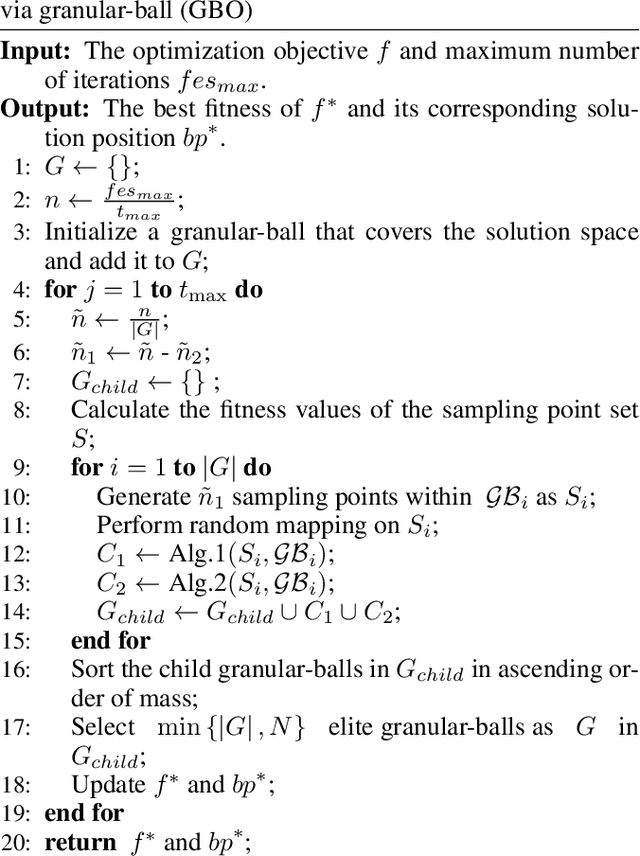
The existing intelligent optimization algorithms are designed based on the finest granularity, i.e., a point. This leads to weak global search ability and inefficiency. To address this problem, we proposed a novel multi-granularity optimization algorithm, namely granular-ball optimization algorithm (GBO), by introducing granular-ball computing. GBO uses many granular-balls to cover the solution space. Quite a lot of small and fine-grained granular-balls are used to depict the important parts, and a little number of large and coarse-grained granular-balls are used to depict the inessential parts. Fine multi-granularity data description ability results in a higher global search capability and faster convergence speed. In comparison with the most popular and state-of-the-art algorithms, the experiments on twenty benchmark functions demonstrate its better performance. The faster speed, higher approximation ability of optimal solution, no hyper-parameters, and simpler design of GBO make it an all-around replacement of most of the existing popular intelligent optimization algorithms.