 Add to Chrome
 Add to Firefox
 Add to Edge
Continuity-driven Synergistic Diffusion with Neural Priors for Ultra-Sparse-View CBCT Reconstruction
Feb 08, 2026
The clinical application of cone-beam computed tomography (CBCT) is constrained by the inherent trade-off between radiation exposure and image quality. Ultra-sparse angular sampling, employed to reduce dose, introduces severe undersampling artifacts and inter-slice inconsistencies, compromising diagnostic reliability. Existing reconstruction methods often struggle to balance angular continuity with spatial detail fidelity. To address these challenges, we propose a Continuity-driven Synergistic Diffusion with Neural priors (CSDN) for ultra-sparse-view CBCT reconstruction. Neural priors are introduced as a structural foundation to encode a continuous threedimensional attenuation representation, enabling the synthesis of physically consistent dense projections from ultra-sparse measurements. Building upon this neural-prior-based initialization, a synergistic diffusion strategy is developed, consisting of two collaborative refinement paths: a Sinogram Refinement Diffusion (Sino-RD) process that restores angular continuity and a Digital Radiography Refinement Diffusion (DR-RD) process that enforces inter-slice consistency from the projection image perspective. The outputs of the two diffusion paths are adaptively fused by the Dual-Projection Reconstruction Fusion (DPRF) module to achieve coherent volumetric reconstruction. Extensive experiments demonstrate that the proposed CSDN effectively suppresses artifacts and recovers fine textures under ultra-sparse-view conditions, outperforming existing state-of-the-art techniques.

Iterative Diffusion-Refined Neural Attenuation Fields for Multi-Source Stationary CT Reconstruction: NAF Meets Diffusion Model
Nov 18, 2025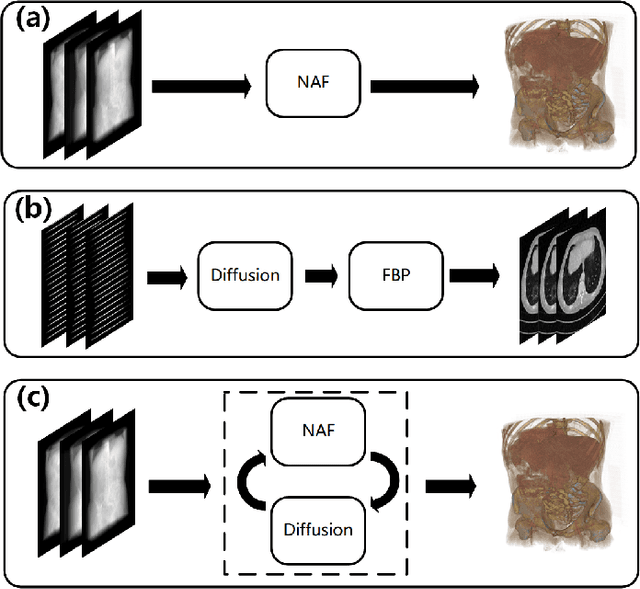
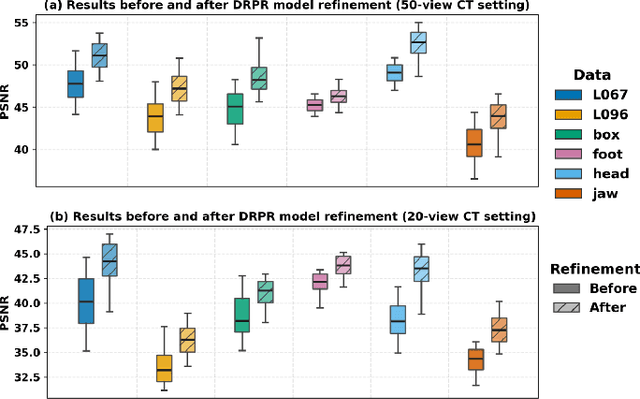
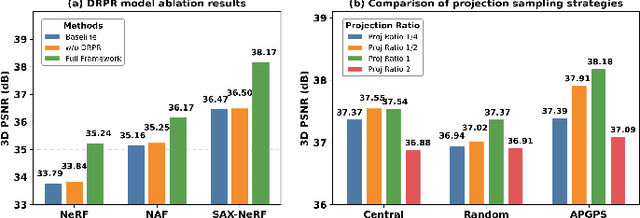
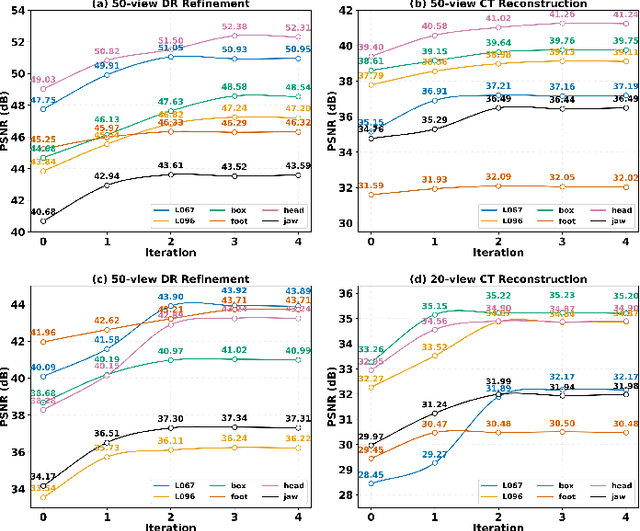
Multi-source stationary computed tomography (CT) has recently attracted attention for its ability to achieve rapid image reconstruction, making it suitable for time-sensitive clinical and industrial applications. However, practical systems are often constrained by ultra-sparse-view sampling, which significantly degrades reconstruction quality. Traditional methods struggle under ultra-sparse-view settings, where interpolation becomes inaccurate and the resulting reconstructions are unsatisfactory. To address this challenge, this study proposes Diffusion-Refined Neural Attenuation Fields (Diff-NAF), an iterative framework tailored for multi-source stationary CT under ultra-sparse-view conditions. Diff-NAF combines a Neural Attenuation Field representation with a dual-branch conditional diffusion model. The process begins by training an initial NAF using ultra-sparse-view projections. New projections are then generated through an Angle-Prior Guided Projection Synthesis strategy that exploits inter view priors, and are subsequently refined by a Diffusion-driven Reuse Projection Refinement Module. The refined projections are incorporated as pseudo-labels into the training set for the next iteration. Through iterative refinement, Diff-NAF progressively enhances projection completeness and reconstruction fidelity under ultra-sparse-view conditions, ultimately yielding high-quality CT reconstructions. Experimental results on multiple simulated 3D CT volumes and real projection data demonstrate that Diff-NAF achieves the best performance under ultra-sparse-view conditions.