 Add to Chrome
 Add to Firefox
 Add to Edge
TriDF: Evaluating Perception, Detection, and Hallucination for Interpretable DeepFake Detection
Dec 23, 2025
Advances in generative modeling have made it increasingly easy to fabricate realistic portrayals of individuals, creating serious risks for security, communication, and public trust. Detecting such person-driven manipulations requires systems that not only distinguish altered content from authentic media but also provide clear and reliable reasoning. In this paper, we introduce TriDF, a comprehensive benchmark for interpretable DeepFake detection. TriDF contains high-quality forgeries from advanced synthesis models, covering 16 DeepFake types across image, video, and audio modalities. The benchmark evaluates three key aspects: Perception, which measures the ability of a model to identify fine-grained manipulation artifacts using human-annotated evidence; Detection, which assesses classification performance across diverse forgery families and generators; and Hallucination, which quantifies the reliability of model-generated explanations. Experiments on state-of-the-art multimodal large language models show that accurate perception is essential for reliable detection, but hallucination can severely disrupt decision-making, revealing the interdependence of these three aspects. TriDF provides a unified framework for understanding the interaction between detection accuracy, evidence identification, and explanation reliability, offering a foundation for building trustworthy systems that address real-world synthetic media threats.

RecipeGen: A Benchmark for Real-World Recipe Image Generation
Mar 07, 2025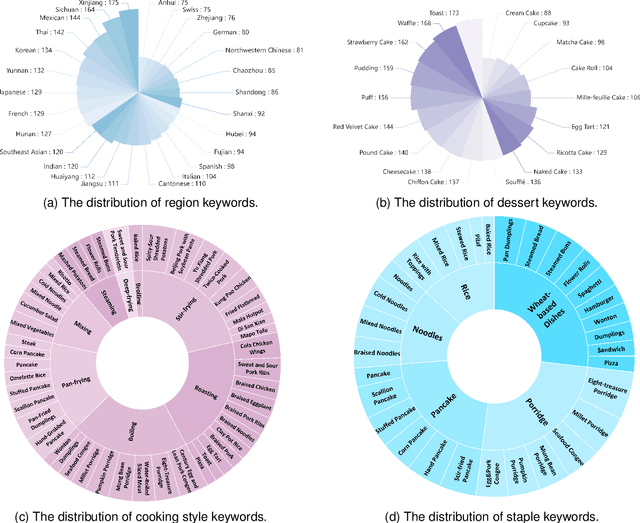
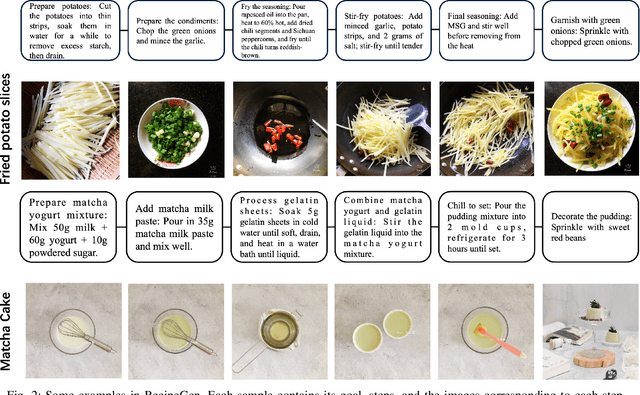

Recipe image generation is an important challenge in food computing, with applications from culinary education to interactive recipe platforms. However, there is currently no real-world dataset that comprehensively connects recipe goals, sequential steps, and corresponding images. To address this, we introduce RecipeGen, the first real-world goal-step-image benchmark for recipe generation, featuring diverse ingredients, varied recipe steps, multiple cooking styles, and a broad collection of food categories. Data is in https://github.com/zhangdaxia22/RecipeGen.
ReCorD: Reasoning and Correcting Diffusion for HOI Generation
Jul 25, 2024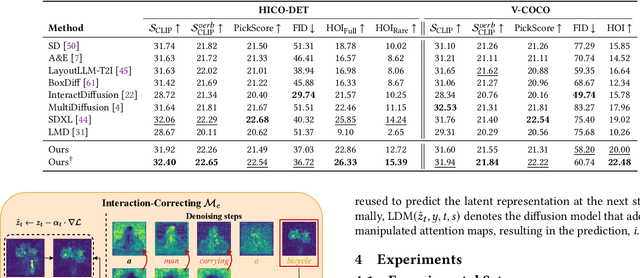


Diffusion models revolutionize image generation by leveraging natural language to guide the creation of multimedia content. Despite significant advancements in such generative models, challenges persist in depicting detailed human-object interactions, especially regarding pose and object placement accuracy. We introduce a training-free method named Reasoning and Correcting Diffusion (ReCorD) to address these challenges. Our model couples Latent Diffusion Models with Visual Language Models to refine the generation process, ensuring precise depictions of HOIs. We propose an interaction-aware reasoning module to improve the interpretation of the interaction, along with an interaction correcting module to refine the output image for more precise HOI generation delicately. Through a meticulous process of pose selection and object positioning, ReCorD achieves superior fidelity in generated images while efficiently reducing computational requirements. We conduct comprehensive experiments on three benchmarks to demonstrate the significant progress in solving text-to-image generation tasks, showcasing ReCorD's ability to render complex interactions accurately by outperforming existing methods in HOI classification score, as well as FID and Verb CLIP-Score. Project website is available at https://alberthkyhky.github.io/ReCorD/ .