 Add to Chrome
 Add to Firefox
 Add to Edge
Schedulable Job-Level Dependencies for Cause-Effect Chains via Graph Neural Networks
Jul 02, 2026
Modern automotive software architectures comprise large sets of mixed-criticality functions executing on shared multi-core platforms with strict real-time and end-to-end timing requirements. Sensor-to-actuator data propagation in such systems is typically expressed via cause-effect chains with worst-case data-age budgets. Job-level dependencies (JLDs) have been introduced to provide a schedule-agnostic mechanism for bounding the data age independently of the underlying scheduler. The state-of-the-art methods for synthesizing JLDs, however, do not check whether the produced JLDs are enforceable under a concrete scheduling policy or jointly schedulable at the system level. In this paper we propose the first machine-learning-based JLD synthesis method, built around a two-level Graph Neural Network with temperature-controlled sampling that learns the structural patterns connecting cause-effect chain configurations to their JLD solutions. Since learned outputs may not be correct by construction, we embed the GNN in a novel Generate-and-Verify architecture in which a safe DP data-age checker, together with a per-chain EDF feasibility checker and a system-level demand-bound test, accept or reject each candidate. We show that the ML-based generator substantially outperforms the original greedy heuristic while achieving orders-of-magnitude lower synthesis time, demonstrating that learned structural priors can effectively replace exponential propagation-tree enumeration on this class of real-time scheduling problems.

Dustin: Draft-Augmented Sparse Verification for Efficient Long-Context Generation with Speculative Decoding
Jun 23, 2026While speculative decoding improves inference throughput for multi-batch long-context Large Language Models (LLMs), its efficiency is often limited by a verification bottleneck where Key-Value (KV) cache loading dominates latency. Existing compression methods fail in this regime: static eviction incurs accuracy loss due to saliency shift, while dynamic selection introduces prohibitive computational overhead during the verification path. We propose Dustin, a sparse verification framework designed for long-context speculative decoding. Dustin integrates lookahead signals from the draft model with historical attention from the target model to identify critical tokens with high fidelity across multi-step verification windows. To reduce recomputation latency, this approach further employs a sparse estimation scheme that restricts importance scoring to a minimal subset of attention heads. Evaluations on PG-19 and LongBench with Qwen2.5-72B demonstrate that Dustin achieves a 27.85x speedup in self-attention and a 9.17x end-to-end decoding speedup at a 32k sequence length, all with negligible accuracy degradation.
Deterministic Execution of ROS 2 Applications via Lingua Franca
Jun 09, 2026The Robot Operating System 2 (ROS 2) is a widely used middleware for robotic systems, characterized by a publish-subscribe (pub-sub) communication mechanism in which computation is structured as callbacks dispatched by ROS 2 executors. Despite its popularity, the pub-sub pattern in ROS 2 is inherently nondeterministic: the order in which these callbacks run is nondeterministic even within a single executor, and distributed deployments add further nondeterminism from the interleaving of messages across nodes and from network latency. Such nondeterminism often leads to concurrency issues and makes it virtually impossible to analyze for safeness and provide guarantees. We present a framework that is able to convert an unmodified ROS 2 application and run it under Lingua Franca (LF), a coordination language for deterministic execution using logical time, so that the same input always produces the same deterministic execution order. We first describe which ROS 2 features can be executed deterministically under logical time. Such features enable the possibility to establish an automatic conversion framework to extract information from a ROS 2 application and directly convert it into an LF program. The rich features of LF, such as logical-time delays, federated execution across processes, and fault handling, can then be applied to make the ROS 2 application be executed in a deterministic and timing-predictable manner without changing the ROS 2 code. We evaluate the framework on a synthetic example and on the Autoware reference system. We show that the order in which callbacks are executed differs in default ROS 2, while also having end-to-end latencies that vary across executions. In contrast, our LF-controlled ROS 2 system produces a deterministic execution order and consistent end-to-end latencies.
Detecting Diffusion-Generated Time Series Under Generator Shift
May 27, 2026The boundary between real and diffusion-generated time series is becoming increasingly difficult to draw, yet detection in this domain remains underexplored, especially when the generator is unknown. We compare white-box detection, which requires access to the generator, against black-box detection, which operates on the raw signal alone. The white-box approach, a reconstruction-based detector adapted from the image domain, works well in in-distribution but breaks down under generator shift: reconstruction-based detection in images succeeds because large generic generators provide a near-universal reconstruction prior, and no analogous generator exists for time series. In contrast, a simple off-the-shelf classifier used as a black-box detector performs remarkably well, achieving an average F1 of 79.2, a 22.1% relative improvement over the white-box approach, and a TPR@1%FPR of 57.2. Diffusion-generated time series detection is therefore not a direct transfer of the image domain problem. This work provides the first systematic exploration of white-box and black-box detection for diffusion-generated time series. We close by identifying several open and promising directions.
TMPDiff: Temporal Mixed-Precision for Diffusion Models
Mar 14, 2026Diffusion models are the go-to method for Text-to-Image generation, but their iterative denoising processes has high inference latency. Quantization reduces compute time by using lower bitwidths, but applies a fixed precision across all denoising timesteps, leaving an entire optimization axis unexplored. We propose TMPDiff, a temporal mixed-precision framework for diffusion models that assigns different numeric precision to different denoising timesteps. We hypothesize that quantization errors accumulate additively across timesteps, which we then validate experimentally. Based on our observations, we develop an adaptive bisectioning-based algorithm, which assigns per-step precisions with linear evaluation complexity, reducing an otherwise exponential search problem. Across four state-of-the-art diffusion models and three datasets, TMPDiff consistently outperforms uniform-precision baselines at matched speedup, achieving 10 to 20% improvement in perceptual quality. On FLUX.1-dev, TMPDiff achieves 90% SSIM relative to the full-precision model at a speedup of 2.5x over 16-bit inference.
Jump Like A Squirrel: Optimized Execution Step Order for Anytime Random Forest Inference
Mar 02, 2026Due to their efficiency and small size, decision trees and random forests are popular machine learning models used for classification on resource-constrained systems. In such systems, the available execution time for inference in a random forest might not be sufficient for a complete model execution. Ideally, the already gained prediction confidence should be retained. An anytime algorithm is designed to be able to be aborted anytime, while giving a result with an increasing quality over time. Previous approaches have realized random forests as anytime algorithms on the granularity of trees, stopping after some but not all trees of a forest have been executed. However, due to the way decision trees subdivide the sample space in every step, an increase in prediction quality is achieved with every additional step in one tree. In this paper, we realize decision trees and random forest as anytime algorithms on the granularity of single steps in trees. This approach opens a design space to define the step order in a forest, which has the potential to optimize the mean accuracy. We propose the Optimal Order, which finds a step order with a maximal mean accuracy in exponential runtime and the polynomial runtime heuristics Forward Squirrel Order and Backward Squirrel Order, which greedily maximize the accuracy for each additional step taken down and up the trees, respectively. Our evaluation shows, that the Backward Squirrel Order performs $\sim94\%$ as well as the Optimal Order and $\sim99\%$ as well as all other step orders.
CertMask: Certifiable Defense Against Adversarial Patches via Theoretically Optimal Mask Coverage
Nov 13, 2025Adversarial patch attacks inject localized perturbations into images to mislead deep vision models. These attacks can be physically deployed, posing serious risks to real-world applications. In this paper, we propose CertMask, a certifiably robust defense that constructs a provably sufficient set of binary masks to neutralize patch effects with strong theoretical guarantees. While the state-of-the-art approach (PatchCleanser) requires two rounds of masking and incurs $O(n^2)$ inference cost, CertMask performs only a single round of masking with $O(n)$ time complexity, where $n$ is the cardinality of the mask set to cover an input image. Our proposed mask set is computed using a mathematically rigorous coverage strategy that ensures each possible patch location is covered at least $k$ times, providing both efficiency and robustness. We offer a theoretical analysis of the coverage condition and prove its sufficiency for certification. Experiments on ImageNet, ImageNette, and CIFAR-10 show that CertMask improves certified robust accuracy by up to +13.4\% over PatchCleanser, while maintaining clean accuracy nearly identical to the vanilla model.
WCDT: Systematic WCET Optimization for Decision Tree Implementations
Jan 29, 2025

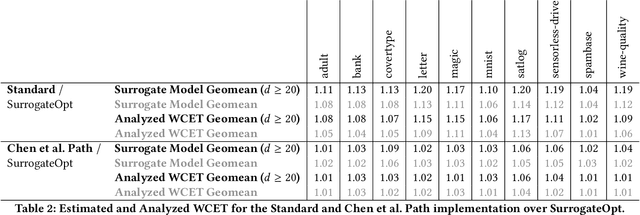
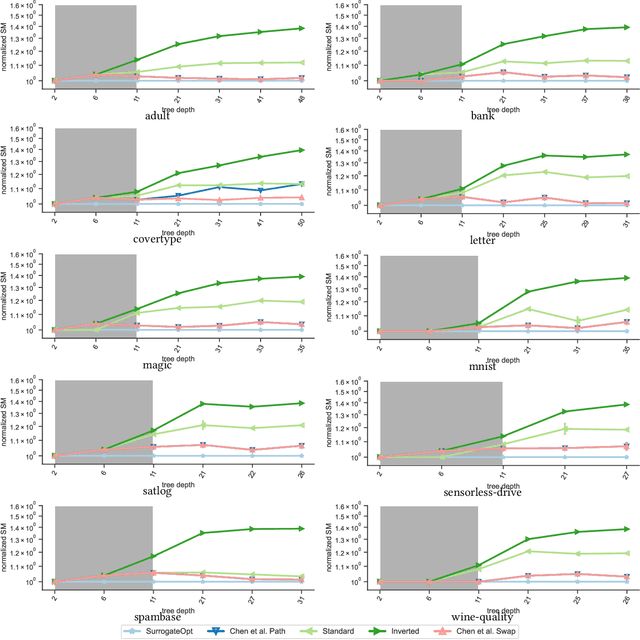
Machine-learning models are increasingly deployed on resource-constrained embedded systems with strict timing constraints. In such scenarios, the worst-case execution time (WCET) of the models is required to ensure safe operation. Specifically, decision trees are a prominent class of machine-learning models and the main building blocks of tree-based ensemble models (e.g., random forests), which are commonly employed in resource-constrained embedded systems. In this paper, we develop a systematic approach for WCET optimization of decision tree implementations. To this end, we introduce a linear surrogate model that estimates the execution time of individual paths through a decision tree based on the path's length and the number of taken branches. We provide an optimization algorithm that constructively builds a WCET-optimal implementation of a given decision tree with respect to this surrogate model. We experimentally evaluate both the surrogate model and the WCET-optimization algorithm. The evaluation shows that the optimization algorithm improves analytically determined WCET by up to $17\%$ compared to an unoptimized implementation.
Language-specific Calibration for Pruning Multilingual Language Models
Aug 26, 2024Recent advances in large language model (LLM) pruning have shown state-of-the-art compression results in post-training and retraining-free settings while maintaining high predictive performance. However, such research mainly considers calibrating pruning using English text, despite the multilingual nature of modern LLMs and their frequent uses in non-English languages. In this paper, we set out to explore effective strategies for calibrating the pruning of multilingual language models. We present the first comprehensive empirical study, comparing different calibration languages for pruning multilingual models across diverse tasks, models, and state-of-the-art pruning techniques. Our results present practical suggestions, for example, calibrating in the target language can efficiently yield lower perplexity, but does not necessarily benefit downstream tasks. Our further analysis experiments unveil that calibration in the target language mainly contributes to preserving language-specific features related to fluency and coherence, but might not contribute to capturing language-agnostic features such as language understanding and reasoning. Last, we provide practical recommendations for future practitioners.
Bridging the Gap between ROS~2 and Classical Real-Time Scheduling for Periodic Tasks
Aug 07, 2024The Robot Operating System 2 (ROS~2) is a widely used middleware that provides software libraries and tools for developing robotic systems. In these systems, tasks are scheduled by ROS~2 executors. Since the scheduling behavior of the default ROS~2 executor is inherently different from classical real-time scheduling theory, dedicated analyses or alternative executors, requiring substantial changes to ROS~2, have been required. In 2023, the events executor, which features an events queue and allows the possibility to make scheduling decisions immediately after a job completes, was introduced into ROS~2. In this paper, we show that, with only minor modifications of the events executor, a large body of research results from classical real-time scheduling theory becomes applicable. Hence, this enables analytical bounds on the worst-case response time and the end-to-end latency, outperforming bounds for the default ROS 2 executor in many scenarios. Our solution is easy to integrate into existing ROS 2 systems since it requires only minor backend modifications of the events executor, which is natively included in ROS 2. The evaluation results show that our ROS~2 events executor with minor modifications can have significant improvement in terms of dropped jobs, worst-case response time, end-to-end latency, and performance compared to the default ROS~2 executor.