 Add to Chrome
 Add to Firefox
 Add to Edge
CertMask: Certifiable Defense Against Adversarial Patches via Theoretically Optimal Mask Coverage
Nov 13, 2025
Adversarial patch attacks inject localized perturbations into images to mislead deep vision models. These attacks can be physically deployed, posing serious risks to real-world applications. In this paper, we propose CertMask, a certifiably robust defense that constructs a provably sufficient set of binary masks to neutralize patch effects with strong theoretical guarantees. While the state-of-the-art approach (PatchCleanser) requires two rounds of masking and incurs $O(n^2)$ inference cost, CertMask performs only a single round of masking with $O(n)$ time complexity, where $n$ is the cardinality of the mask set to cover an input image. Our proposed mask set is computed using a mathematically rigorous coverage strategy that ensures each possible patch location is covered at least $k$ times, providing both efficiency and robustness. We offer a theoretical analysis of the coverage condition and prove its sufficiency for certification. Experiments on ImageNet, ImageNette, and CIFAR-10 show that CertMask improves certified robust accuracy by up to +13.4\% over PatchCleanser, while maintaining clean accuracy nearly identical to the vanilla model.

WCDT: Systematic WCET Optimization for Decision Tree Implementations
Jan 29, 2025

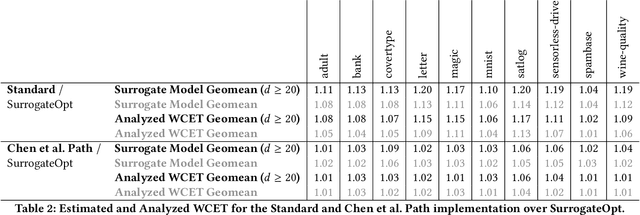
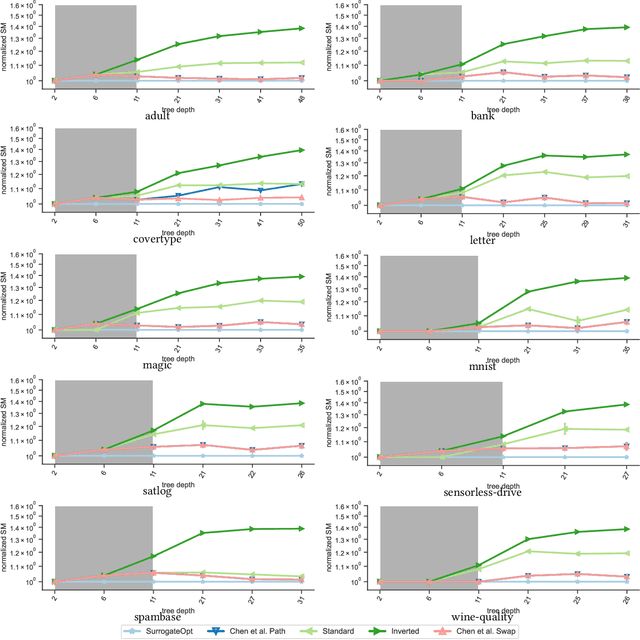
Machine-learning models are increasingly deployed on resource-constrained embedded systems with strict timing constraints. In such scenarios, the worst-case execution time (WCET) of the models is required to ensure safe operation. Specifically, decision trees are a prominent class of machine-learning models and the main building blocks of tree-based ensemble models (e.g., random forests), which are commonly employed in resource-constrained embedded systems. In this paper, we develop a systematic approach for WCET optimization of decision tree implementations. To this end, we introduce a linear surrogate model that estimates the execution time of individual paths through a decision tree based on the path's length and the number of taken branches. We provide an optimization algorithm that constructively builds a WCET-optimal implementation of a given decision tree with respect to this surrogate model. We experimentally evaluate both the surrogate model and the WCET-optimization algorithm. The evaluation shows that the optimization algorithm improves analytically determined WCET by up to $17\%$ compared to an unoptimized implementation.