 Add to Chrome
 Add to Firefox
 Add to Edge
EmoS: A Theory-Grounded Framework for Evaluating and Aligning Emotional Intelligence in Spoken Language Models
Aug 10, 2026
Despite significant advances in instruction-following and auditory comprehension, the evaluation of Emotional Intelligence (EI) in Spoken Language Models (SLMs) remains confined to rudimentary paralinguistic perception, lacking a systematic, theory-driven cognitive framework. We introduce EmoSBench, the first comprehensive EI evaluation benchmark for SLMs constructed upon the four-branch theoretical model, covering Perceiving, Understanding, Using, and Managing Emotion across ten sub-tasks. Preliminary assessments on EmoSBench reveal a substantial gap: even leading proprietary models like GPT-4o-Audio achieve only 52.6%, significantly trailing human baselines. To bridge this gap, we develop EmoS, a specialized evaluator model optimized via Supervised Fine-Tuning (SFT) and Group Relative Policy Optimization (GRPO). To facilitate its effective training, we curate EmoDialogue, a bilingual dataset providing necessary fine-grained supervision through response pairs with rigorously defined EI gradations. Concurrently, we introduce a reward mechanism integrating a Steep Exponential Accuracy Reward (SEAR) and a Rationale Fidelity Reward (RFR) to enforce precise ordinal scoring and valid reasoning. Experiments demonstrate that EmoS reaches 83.8% accuracy, approaching human-level performance. Furthermore, evaluations on authentic, unconstrained spoken interactions validate its robust real-world generalization, establishing a foundational framework for advancing emotionally intelligent dialogue systems.

EChO-Agent: Evidence Chain Orchestration Agent for Audio Reasoning
Jun 13, 2026While LALMs show promise on audio question answering, they fail to focus on question-relevant segments of audio and provide a clear, checkable reasoning process when dealing with complex audio reasoning. Reinforcement learning and tool-augmented prompting can help models better relate questions to audio but lack a reliable way to understand, integrate, and self-verify audio segments. To address this gap, we present EChO-Agent, a modular agent framework that reformulates complex audio QA as a planning, tool execution, evidence integration, and answer verification workflow. Experiments on MMAR benchmark show EChO-Agent improves both accuracy and rubric scores over baseline and ablation studies show evidence integration is the key factor.
Tri-Branch Convolutional Neural Networks for Top-$k$ Focused Academic Performance Prediction
Jul 22, 2021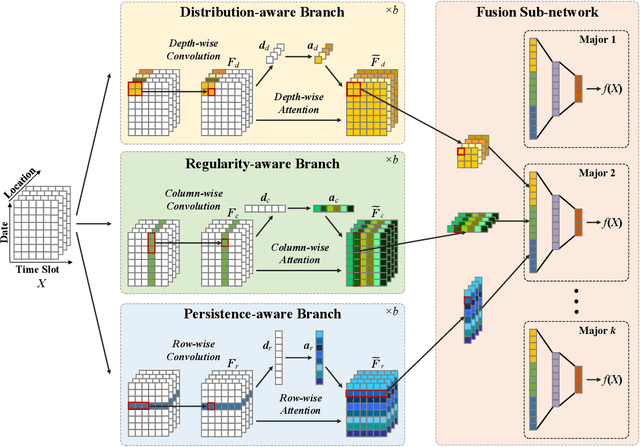
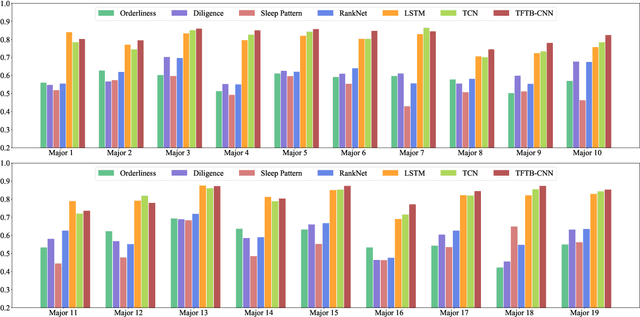
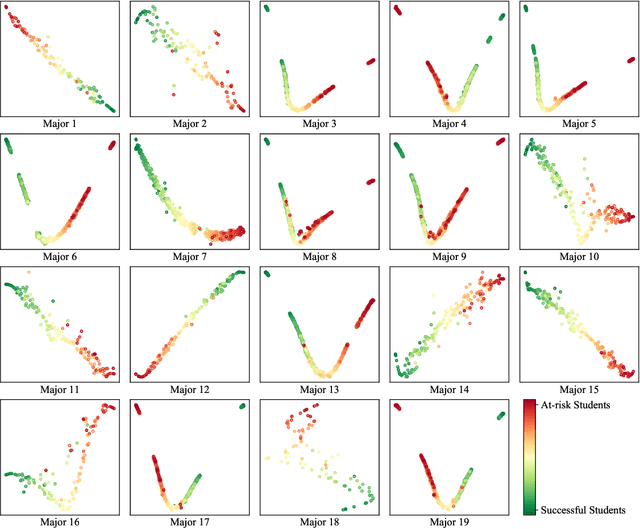
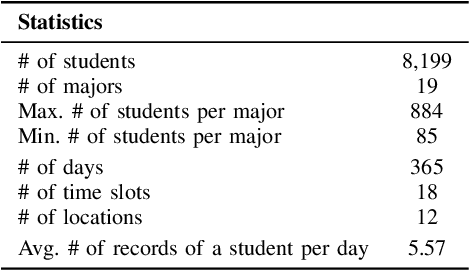
Academic performance prediction aims to leverage student-related information to predict their future academic outcomes, which is beneficial to numerous educational applications, such as personalized teaching and academic early warning. In this paper, we address the problem by analyzing students' daily behavior trajectories, which can be comprehensively tracked with campus smartcard records. Different from previous studies, we propose a novel Tri-Branch CNN architecture, which is equipped with row-wise, column-wise, and depth-wise convolution and attention operations, to capture the characteristics of persistence, regularity, and temporal distribution of student behavior in an end-to-end manner, respectively. Also, we cast academic performance prediction as a top-$k$ ranking problem, and introduce a top-$k$ focused loss to ensure the accuracy of identifying academically at-risk students. Extensive experiments were carried out on a large-scale real-world dataset, and we show that our approach substantially outperforms recently proposed methods for academic performance prediction. For the sake of reproducibility, our codes have been released at https://github.com/ZongJ1111/Academic-Performance-Prediction.