 Add to Chrome
 Add to Firefox
 Add to Edge
SearchLog: A Web Browser Extension for Capturing Search Logs in Laboratory Studies
Jun 03, 2026
Natural search logs are valuable for studying search behavior in information seeking settings. We present SearchLog, an easy-to-install web browser extension for collecting natural search logs during lab-based studies. SearchLog allows participants to search the open web using a browser while recording structured interaction data across mouse, keyboard, search activity, and browser state modules. The extension captures clicks, scrolling, hovered text, typed words, search queries, result rankings, AI-generated summaries when available, tab activity, and window changes. A local Flask backend stores each session as an ordered JSON event stream, with HTML snapshots and preprocessed search result data for later analysis. These logs can be used to derive measures such as query reformulation, page visits, dwell time, scroll behavior, tab switching, search path complexity, and exposure to AI-generated search content. By supporting natural browser-based search with structured experimental metadata, SearchLog provides a reusable resource to study search behavior across traditional and AI-enhanced search interfaces.

Characterizing Personality from Eye-Tracking: The Role of Gaze and Its Absence in Interactive Search Environments
Jan 13, 2026Personality traits influence how individuals engage, behave, and make decisions during the information-seeking process. However, few studies have linked personality to observable search behaviors. This study aims to characterize personality traits through a multimodal time-series model that integrates eye-tracking data and gaze missingness-periods when the user's gaze is not captured. This approach is based on the idea that people often look away when they think, signaling disengagement or reflection. We conducted a user study with 25 participants, who used an interactive application on an iPad, allowing them to engage with digital artifacts from a museum. We rely on raw gaze data from an eye tracker, minimizing preprocessing so that behavioral patterns can be preserved without substantial data cleaning. From this perspective, we trained models to predict personality traits using gaze signals. Our results from a five-fold cross-validation study demonstrate strong predictive performance across all five dimensions: Neuroticism (Macro F1 = 77.69%), Conscientiousness (74.52%), Openness (77.52%), Agreeableness (73.09%), and Extraversion (76.69%). The ablation study examines whether the absence of gaze information affects the model performance, demonstrating that incorporating missingness improves multimodal time-series modeling. The full model, which integrates both time-series signals and missingness information, achieves 10-15% higher accuracy and macro F1 scores across all Big Five traits compared to the model without time-series signals and missingness. These findings provide evidence that personality can be inferred from search-related gaze behavior and demonstrate the value of incorporating missing gaze data into time-series multimodal modeling.
Characterising Topic Familiarity and Query Specificity Using Eye-Tracking Data
May 06, 2025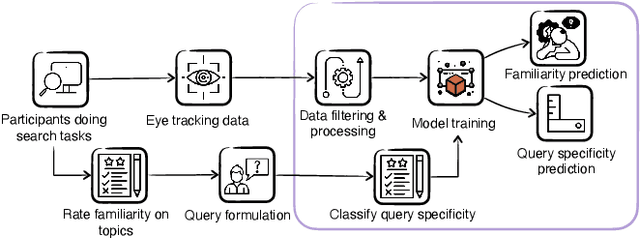


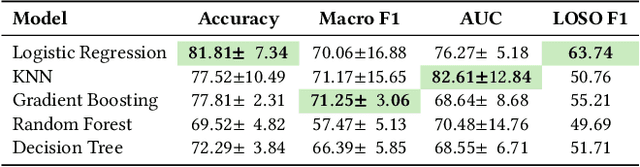
Eye-tracking data has been shown to correlate with a user's knowledge level and query formulation behaviour. While previous work has focused primarily on eye gaze fixations for attention analysis, often requiring additional contextual information, our study investigates the memory-related cognitive dimension by relying solely on pupil dilation and gaze velocity to infer users' topic familiarity and query specificity without needing any contextual information. Using eye-tracking data collected via a lab user study (N=18), we achieved a Macro F1 score of 71.25% for predicting topic familiarity with a Gradient Boosting classifier, and a Macro F1 score of 60.54% with a k-nearest neighbours (KNN) classifier for query specificity. Furthermore, we developed a novel annotation guideline -- specifically tailored for question answering -- to manually classify queries as Specific or Non-specific. This study demonstrates the feasibility of eye-tracking to better understand topic familiarity and query specificity in search.