 Add to Chrome
 Add to Firefox
 Add to Edge
Genie Sim PanoWorld: An Infinite Indoor 3D World Generation Pipeline via Panoramic Scene Modeling and Simulation
Jul 29, 2026
We address the problem of reconstructing a high-fidelity, freely navigable 3D scene from a single $360^\circ$ panorama, without per-scene optimization or multi-view capture. Existing methods either lack metric trajectory control, which hinders reliable downstream 3D reconstruction, or struggle with large disocclusions under long-range camera motion while requiring high-end multi-GPU servers.We present Genie Sim PanoWorld, a two-stage feed-forward pipeline that bridges generation and reconstruction via an explicit, trajectory-controllable panoramic video. A NavMesh-planned $\mathrm{SE}(3)$ roaming trajectory is injected into a latent video diffusion model through dense geometry-warped conditioning; long--short trajectory mixed training and a self-consistency objective based on shortcut models together yield high-fidelity video in four CFG-free denoising steps. A feed-forward panoramic reconstructor then lifts the generated video into a high-fidelity 3D Gaussian scene that supports real-time, free-viewpoint roaming and can be directly used as a simulation-ready asset for embodied AI applications. Experiments show that Genie Sim PanoWorld outperforms geometry-conditioned baselines in both panoramic video generation and downstream 3D reconstruction, while generalizing zero-shot to unseen indoor scenes.

GIU-GANs: Global Information Utilization for Generative Adversarial Networks
Jan 25, 2022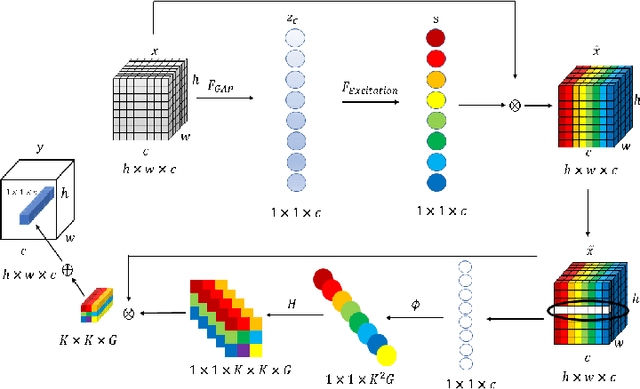
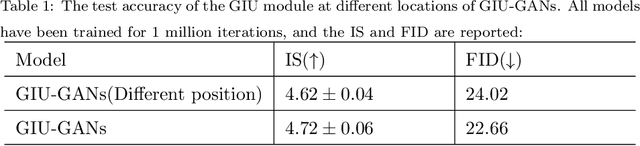
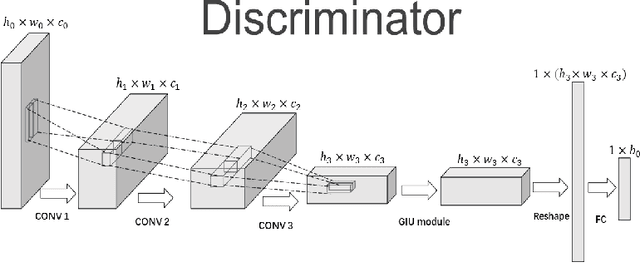
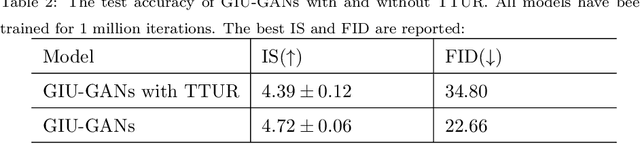
In recent years, with the rapid development of artificial intelligence, image generation based on deep learning has dramatically advanced. Image generation based on Generative Adversarial Networks (GANs) is a promising study. However, since convolutions are limited by spatial-agnostic and channel-specific, features extracted by traditional GANs based on convolution are constrained. Therefore, GANs are unable to capture any more details per image. On the other hand, straightforwardly stacking of convolutions causes too many parameters and layers in GANs, which will lead to a high risk of overfitting. To overcome the aforementioned limitations, in this paper, we propose a new GANs called Involution Generative Adversarial Networks (GIU-GANs). GIU-GANs leverages a brand new module called the Global Information Utilization (GIU) module, which integrates Squeeze-and-Excitation Networks (SENet) and involution to focus on global information by channel attention mechanism, leading to a higher quality of generated images. Meanwhile, Batch Normalization(BN) inevitably ignores the representation differences among noise sampled by the generator, and thus degrade the generated image quality. Thus we introduce Representative Batch Normalization(RBN) to the GANs architecture for this issue. The CIFAR-10 and CelebA datasets are employed to demonstrate the effectiveness of our proposed model. A large number of experiments prove that our model achieves state-of-the-art competitive performance.