 Add to Chrome
 Add to Firefox
 Add to Edge
BackendForge: Benchmarking Agentic End-to-End Code Generation with Backend Services
Jul 13, 2026
Large language models (LLMs) are increasingly used in agentic coding settings, where they can inspect files, execute commands, run tests, observe failures, and iteratively revise code. This shift raises a central evaluation question: can an agentic LLM generate an end-to-end software artifact that is both deployable and behaviorally correct under execution? Backend services provide a controlled but realistic substrate for this evaluation. Their APIs expose application-level executable semantics, and deployed behavior can be checked deterministically against an OpenAPI contract through black-box HTTP interactions. We introduce BackendForge, a benchmark of 56 contract-defined backend generation tasks rewritten from real open-source applications. Given a visible specification and an OpenAPI contract, an LLM must generate a Dockerized service that is built, deployed, and evaluated only through HTTP tests. To strengthen evaluation without introducing hidden requirements, BackendForge uses a test agent and a code agent to co-evolve the test oracle and reference service, where the test agent proposes specification-grounded backend tests and the code agent repairs the reference implementation. Although the best-performing model, GPT-5.5, succeeds on 55.4\% of tasks under the base oracle, it succeeds on only 28.6\% under the final oracle. This gap suggests that current LLMs can implement many local API behaviors, but still struggle to produce complete backend services.

AppForge: From Assistant to Independent Developer - Are GPTs Ready for Software Development?
Oct 09, 2025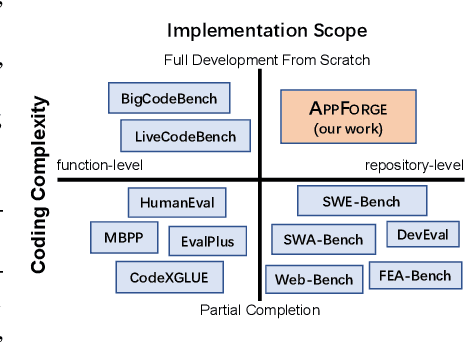
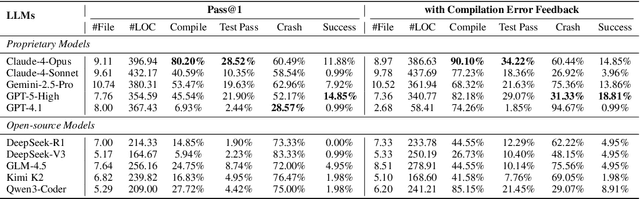
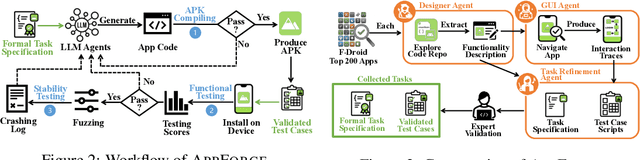

Large language models (LLMs) have demonstrated remarkable capability in function-level code generation tasks. Unlike isolated functions, real-world applications demand reasoning over the entire software system: developers must orchestrate how different components interact, maintain consistency across states over time, and ensure the application behaves correctly within the lifecycle and framework constraints. Yet, no existing benchmark adequately evaluates whether LLMs can bridge this gap and construct entire software systems from scratch. To address this gap, we propose APPFORGE, a benchmark consisting of 101 software development problems drawn from real-world Android apps. Given a natural language specification detailing the app functionality, a language model is tasked with implementing the functionality into an Android app from scratch. Developing an Android app from scratch requires understanding and coordinating app states, lifecycle management, and asynchronous operations, calling for LLMs to generate context-aware, robust, and maintainable code. To construct APPFORGE, we design a multi-agent system to automatically summarize the main functionalities from app documents and navigate the app to synthesize test cases validating the functional correctness of app implementation. Following rigorous manual verification by Android development experts, APPFORGE incorporates the test cases within an automated evaluation framework that enables reproducible assessment without human intervention, making it easily adoptable for future research. Our evaluation on 12 flagship LLMs show that all evaluated models achieve low effectiveness, with the best-performing model (GPT-5) developing only 18.8% functionally correct applications, highlighting fundamental limitations in current models' ability to handle complex, multi-component software engineering challenges.