 Add to Chrome
 Add to Firefox
 Add to Edge
DCA-LUT: Deep Chromatic Alignment with 5D LUT for Purple Fringing Removal
Nov 15, 2025
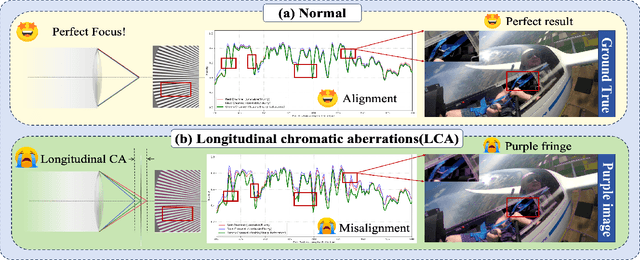
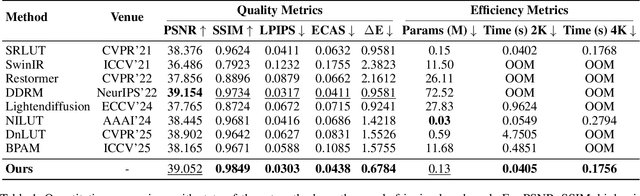
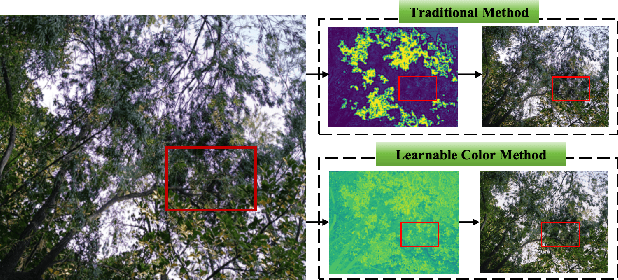
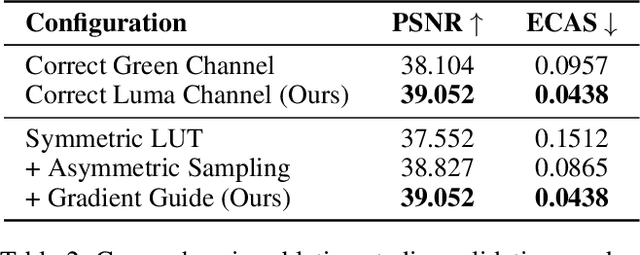
Purple fringing, a persistent artifact caused by Longitudinal Chromatic Aberration (LCA) in camera lenses, has long degraded the clarity and realism of digital imaging. Traditional solutions rely on complex and expensive apochromatic (APO) lens hardware and the extraction of handcrafted features, ignoring the data-driven approach. To fill this gap, we introduce DCA-LUT, the first deep learning framework for purple fringing removal. Inspired by the physical root of the problem, the spatial misalignment of RGB color channels due to lens dispersion, we introduce a novel Chromatic-Aware Coordinate Transformation (CA-CT) module, learning an image-adaptive color space to decouple and isolate fringing into a dedicated dimension. This targeted separation allows the network to learn a precise ``purple fringe channel", which then guides the accurate restoration of the luminance channel. The final color correction is performed by a learned 5D Look-Up Table (5D LUT), enabling efficient and powerful% non-linear color mapping. To enable robust training and fair evaluation, we constructed a large-scale synthetic purple fringing dataset (PF-Synth). Extensive experiments in synthetic and real-world datasets demonstrate that our method achieves state-of-the-art performance in purple fringing removal.

CAST-LUT: Tokenizer-Guided HSV Look-Up Tables for Purple Flare Removal
Nov 10, 2025Purple flare, a diffuse chromatic aberration artifact commonly found around highlight areas, severely degrades the tone transition and color of the image. Existing traditional methods are based on hand-crafted features, which lack flexibility and rely entirely on fixed priors, while the scarcity of paired training data critically hampers deep learning. To address this issue, we propose a novel network built upon decoupled HSV Look-Up Tables (LUTs). The method aims to simplify color correction by adjusting the Hue (H), Saturation (S), and Value (V) components independently. This approach resolves the inherent color coupling problems in traditional methods. Our model adopts a two-stage architecture: First, a Chroma-Aware Spectral Tokenizer (CAST) converts the input image from RGB space to HSV space and independently encodes the Hue (H) and Value (V) channels into a set of semantic tokens describing the Purple flare status; second, the HSV-LUT module takes these tokens as input and dynamically generates independent correction curves (1D-LUTs) for the three channels H, S, and V. To effectively train and validate our model, we built the first large-scale purple flare dataset with diverse scenes. We also proposed new metrics and a loss function specifically designed for this task. Extensive experiments demonstrate that our model not only significantly outperforms existing methods in visual effects but also achieves state-of-the-art performance on all quantitative metrics.
DeepSPG: Exploring Deep Semantic Prior Guidance for Low-light Image Enhancement with Multimodal Learning
Apr 27, 2025

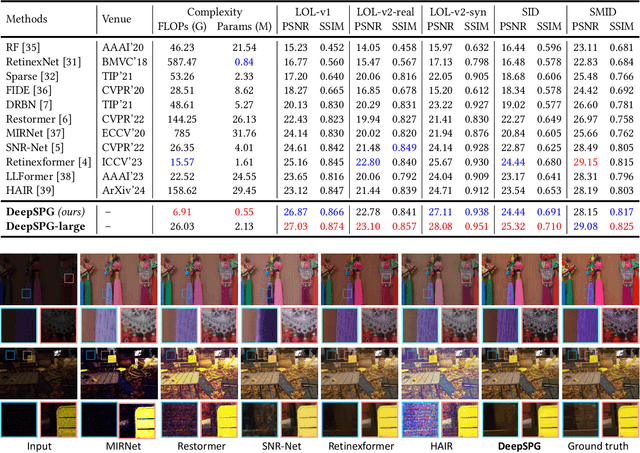
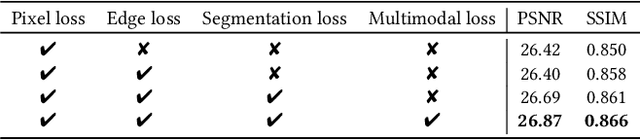
There has long been a belief that high-level semantics learning can benefit various downstream computer vision tasks. However, in the low-light image enhancement (LLIE) community, existing methods learn a brutal mapping between low-light and normal-light domains without considering the semantic information of different regions, especially in those extremely dark regions that suffer from severe information loss. To address this issue, we propose a new deep semantic prior-guided framework (DeepSPG) based on Retinex image decomposition for LLIE to explore informative semantic knowledge via a pre-trained semantic segmentation model and multimodal learning. Notably, we incorporate both image-level semantic prior and text-level semantic prior and thus formulate a multimodal learning framework with combinatorial deep semantic prior guidance for LLIE. Specifically, we incorporate semantic knowledge to guide the enhancement process via three designs: an image-level semantic prior guidance by leveraging hierarchical semantic features from a pre-trained semantic segmentation model; a text-level semantic prior guidance by integrating natural language semantic constraints via a pre-trained vision-language model; a multi-scale semantic-aware structure that facilitates effective semantic feature incorporation. Eventually, our proposed DeepSPG demonstrates superior performance compared to state-of-the-art methods across five benchmark datasets. The implementation details and code are publicly available at https://github.com/Wenyuzhy/DeepSPG.