 Add to Chrome
 Add to Firefox
 Add to Edge
A Unified Framework for Trajectory Prediction with Explicit Planning and Reaction Decomposition
Aug 06, 2026
Trajectory prediction has shifted toward structured formulations with explicit social modeling. However, existing methods inadequately distinguish the functional roles of social influence in trajectory planning. Observing that agents typically form motion plans by anticipating others' future behaviors before making local reactive adjustments, we identify social interactions as playing staged roles, namely planning precedes reaction. We propose INTraJ, a unified framework that decomposes social influence into two stages: a planning stage constructs reference trajectories using future social information, and a reaction stage recovers local adjustments from the residual between full-context prediction and the reference. INTraJ supports both multi-target and single-target paradigms. Extensive experiments on four standard benchmarks, including Argoverse 2, Argoverse 2-ped, ETH/UCY, and SDD, demonstrate consistent improvements, particularly in FDE and long-horizon consistency, with state-of-the-art performance achieved in several settings. INTraJ reframes trajectory prediction as a planning-driven two-stage process, validating that staged social modeling is critical for stable predictions. The code is publicly available at https://github.com/11isnotavailable/INTraJ.

NodeJEPA: Structure-Conditioned Latent Prediction for Node-Level Graph Self-Supervised Learning
Aug 05, 2026Self-supervised learning on graphs is largely shaped by contrastive methods that depend on carefully designed augmentations, and by generative methods that reconstruct node attributes in the input space. Both paradigms can entangle representations with low-level input statistics rather than with relational structure. Joint-embedding predictive architectures (JEPA) instead learn by predicting latent targets rather than reconstructing inputs. Recent work has explored this idea for graph-level representation learning, but how to design JEPA-style objectives for node-level tasks, and which structural signals the predictor should condition on, remains less clear. We present NodeJEPA, a joint-embedding predictive architecture for node-level graph self-supervised learning. NodeJEPA masks structure-aware k-hop ego-subgraphs and trains a context encoder to predict the latent representations of the masked nodes. These targets come from an EMA-updated target encoder with stop-gradient. A structure-conditioned predictor integrates spectral and centrality descriptors through cross-attention. Variance, covariance, and Laplacian spectral regularizers help stabilize the embedding geometry, and an optional curriculum gradually increases masking difficulty during training. Because prediction occurs in latent space, NodeJEPA does not rely on input reconstruction or hand-crafted graph augmentations. We evaluate NodeJEPA on standard node classification benchmarks under linear probing and fine-tuning protocols, and conduct ablations on masking, prediction, and regularization design choices. Our study offers a practical recipe for node-level JEPA-style latent prediction on graphs, and clarifies when structural conditioning helps representation learning. Code, configurations, and evaluation scripts are publicly available at https://github.com/OliverZ-dot/Node-Jepa.
Optimal Multiscale Learning of Linear Operators
Jun 15, 2026We study the statistical and computational limits of learning bounded linear operators between Sobolev spaces from noisy input-output data. In wavelet coordinates, the problem is recast as an infinite-dimensional matrix regression problem with a heterogeneous two-sided multiscale structure. We establish minimax rates under Sobolev operator-norm loss and construct a finite-resolution blockwise least-squares estimator attaining these rates. The analysis reveals a nonuniform local estimation difficulty across scales, which can be exploited algorithmically: by assigning scale-adaptive sample sizes, the estimator achieves the optimal computational cost among dense least-squares implementations.
ATM: Action-Consistency Transfer Matrix for Diagnosing and Improving Latent World Models
Jun 08, 2026Latent world models are increasingly used for control and goal-conditioned planning, yet assessing whether their learned representations are useful for planning usually requires slow, planner-coupled simulator evaluation with CEM or similar planners. Such evaluation is black-box and model-complexity-dependent: under the same protocol, different world models may require minutes to hours per checkpoint. In this work, we propose ATM, an Action-Consistency Transfer Matrix for diagnosing whether latent transitions preserve action semantics relevant to planning. ATM compares action information in real encoded transitions and model-predicted transitions through lightweight post-hoc probes, producing an interpretable matrix that reveals representation quality, transition-domain inconsistency, and failure modes without simulator rollout. It can also be collapsed into a simple screening score for within-task ranking across checkpoints, variants, and world models. When the true success gap is non-trivial, ATM achieves highly reliable pairwise ranking, while reducing minutes-to-hours CEM evaluation to seconds-level transition analysis, yielding more than 100x speedup in our setup. We further introduce AITS, showing that action-identifiability is not only diagnostic but also a useful training signal for improving downstream planning without changing the planner.
Convergence Rates for Learning Pseudo-Differential Operators
Jan 08, 2026This paper establishes convergence rates for learning elliptic pseudo-differential operators, a fundamental operator class in partial differential equations and mathematical physics. In a wavelet-Galerkin framework, we formulate learning over this class as a structured infinite-dimensional regression problem with multiscale sparsity. Building on this structure, we propose a sparse, data- and computation-efficient estimator, which leverages a novel matrix compression scheme tailored to the learning task and a nested-support strategy to balance approximation and estimation errors. In addition to obtaining convergence rates for the estimator, we show that the learned operator induces an efficient and stable Galerkin solver whose numerical error matches its statistical accuracy. Our results therefore contribute to bringing together operator learning, data-driven solvers, and wavelet methods in scientific computing.
A deep learning framework for geodesics under spherical Wasserstein-Fisher-Rao metric and its application for weighted sample generation
Aug 25, 2022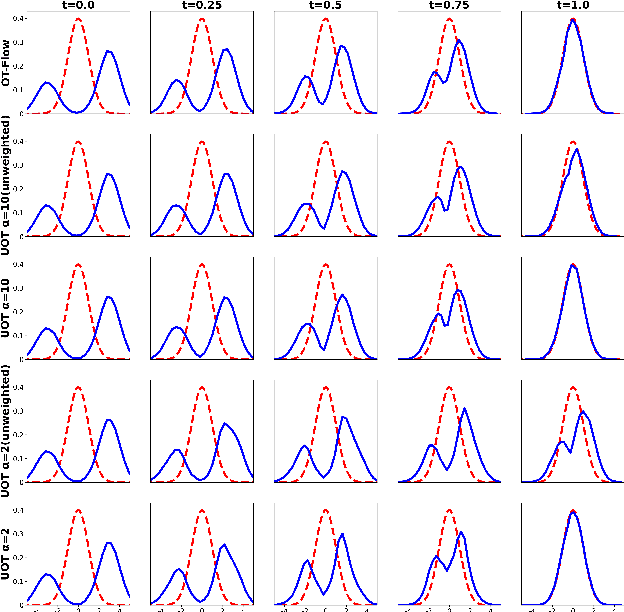
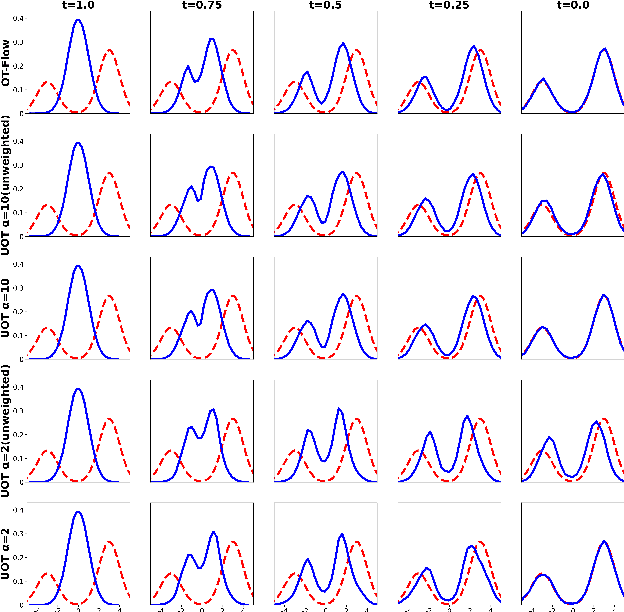
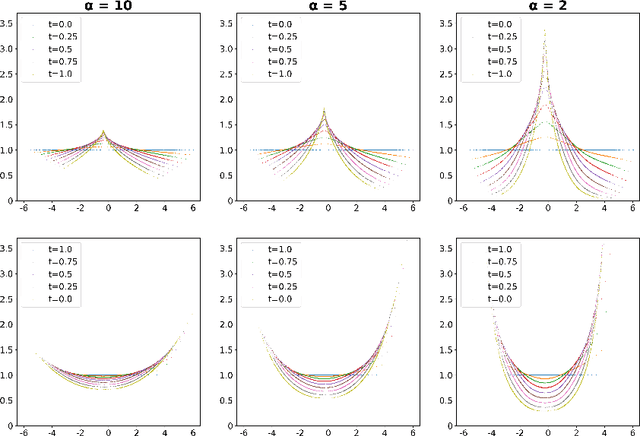
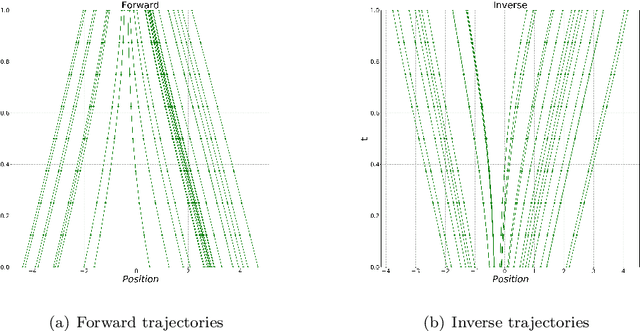
Wasserstein-Fisher-Rao (WFR) distance is a family of metrics to gauge the discrepancy of two Radon measures, which takes into account both transportation and weight change. Spherical WFR distance is a projected version of WFR distance for probability measures so that the space of Radon measures equipped with WFR can be viewed as metric cone over the space of probability measures with spherical WFR. Compared to the case for Wasserstein distance, the understanding of geodesics under the spherical WFR is less clear and still an ongoing research focus. In this paper, we develop a deep learning framework to compute the geodesics under the spherical WFR metric, and the learned geodesics can be adopted to generate weighted samples. Our approach is based on a Benamou-Brenier type dynamic formulation for spherical WFR. To overcome the difficulty in enforcing the boundary constraint brought by the weight change, a Kullback-Leibler (KL) divergence term based on the inverse map is introduced into the cost function. Moreover, a new regularization term using the particle velocity is introduced as a substitute for the Hamilton-Jacobi equation for the potential in dynamic formula. When used for sample generation, our framework can be beneficial for applications with given weighted samples, especially in the Bayesian inference, compared to sample generation with previous flow models.