 Add to Chrome
 Add to Firefox
 Add to Edge
UNICA: A Unified Neural Framework for Controllable 3D Avatars
Apr 03, 2026
Controllable 3D human avatars have found widespread applications in 3D games, the metaverse, and AR/VR scenarios. The conventional approach to creating such a 3D avatar requires a lengthy, intricate pipeline encompassing appearance modeling, motion planning, rigging, and physical simulation. In this paper, we introduce UNICA (UNIfied neural Controllable Avatar), a skeleton-free generative model that unifies all avatar control components into a single neural framework. Given keyboard inputs akin to video game controls, UNICA generates the next frame of a 3D avatar's geometry through an action-conditioned diffusion model operating on 2D position maps. A point transformer then maps the resulting geometry to 3D Gaussian Splatting for high-fidelity free-view rendering. Our approach naturally captures hair and loose clothing dynamics without manually designed physical simulation, and supports extra-long autoregressive generation. To the best of our knowledge, UNICA is the first model to unify the workflow of "motion planning, rigging, physical simulation, and rendering". Code is released at https://github.com/zjh21/UNICA.

CrowdGaussian: Reconstructing High-Fidelity 3D Gaussians for Human Crowd from a Single Image
Mar 18, 2026Single-view 3D human reconstruction has garnered significant attention in recent years. Despite numerous advancements, prior research has concentrated on reconstructing 3D models from clear, close-up images of individual subjects, often yielding subpar results in the more prevalent multi-person scenarios. Reconstructing 3D human crowd models is a highly intricate task, laden with challenges such as: 1) extensive occlusions, 2) low clarity, and 3) numerous and various appearances. To address this task, we propose CrowdGaussian, a unified framework that directly reconstructs multi-person 3D Gaussian Splatting (3DGS) representations from single-image inputs. To handle occlusions, we devise a self-supervised adaptation pipeline that enables the pretrained large human model to reconstruct complete 3D humans with plausible geometry and appearance from heavily occluded inputs. Furthermore, we introduce Self-Calibrated Learning (SCL). This training strategy enables single-step diffusion models to adaptively refine coarse renderings to optimal quality by blending identity-preserving samples with clean/corrupted image pairs. The outputs can be distilled back to enhance the quality of multi-person 3DGS representations. Extensive experiments demonstrate that CrowdGaussian generates photorealistic, geometrically coherent reconstructions of multi-person scenes.
Towards Native Generative Model for 3D Head Avatar
Oct 02, 2024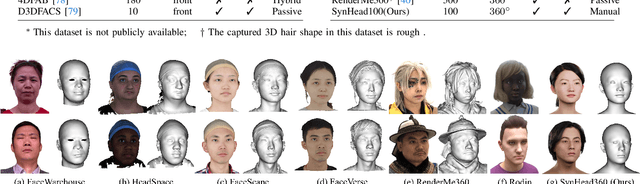
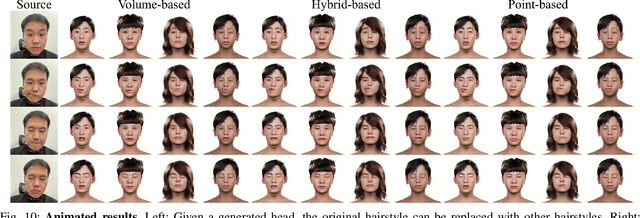
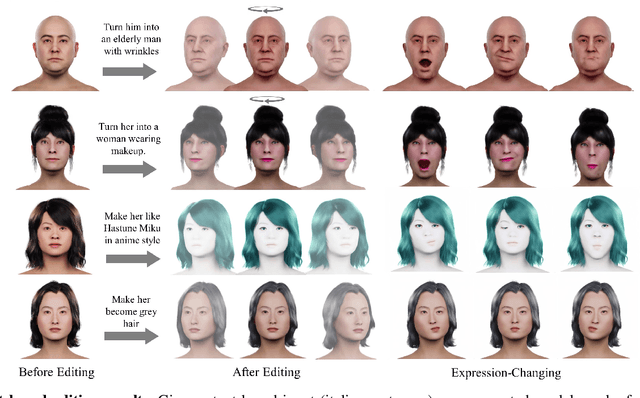
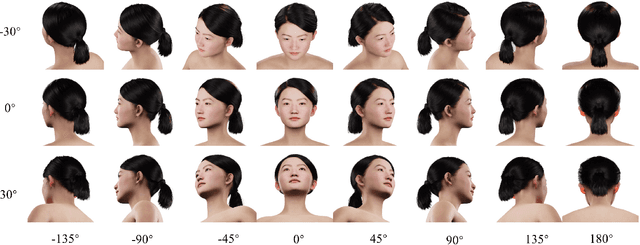
Creating 3D head avatars is a significant yet challenging task for many applicated scenarios. Previous studies have set out to learn 3D human head generative models using massive 2D image data. Although these models are highly generalizable for human appearance, their result models are not 360$^\circ$-renderable, and the predicted 3D geometry is unreliable. Therefore, such results cannot be used in VR, game modeling, and other scenarios that require 360$^\circ$-renderable 3D head models. An intuitive idea is that 3D head models with limited amount but high 3D accuracy are more reliable training data for a high-quality 3D generative model. In this vein, we delve into how to learn a native generative model for 360$^\circ$ full head from a limited 3D head dataset. Specifically, three major problems are studied: 1) how to effectively utilize various representations for generating the 360$^\circ$-renderable human head; 2) how to disentangle the appearance, shape, and motion of human faces to generate a 3D head model that can be edited by appearance and driven by motion; 3) and how to extend the generalization capability of the generative model to support downstream tasks. Comprehensive experiments are conducted to verify the effectiveness of the proposed model. We hope the proposed models and artist-designed dataset can inspire future research on learning native generative 3D head models from limited 3D datasets.