 Add to Chrome
 Add to Firefox
 Add to Edge
Long-term User Engagement Optimization through Model-agnostic Downstream Rewards Learning
Jul 15, 2026
As recommender systems mature in the past few years, their optimization objectives have evolved from a primary focusing on short-term behavioral signals to a broader emphasis on long-term user engagement and retention. However, directly optimizing retention is difficult because return signals are sparse, delayed, and only partially attributable to earlier recommendations. Prior work has addressed this challenge with sequential modeling and reinforcement learning, but these approaches typically require task specific reward engineering, substantial computational overhead, and surface specific implementations that are difficult to generalize. In this paper, we present a unified, model-agnostic downstream reward framework for optimizing long-term user value in large-scale recommendation systems. First, we formulate the downstream reward learning problem and develop an offline screening framework to identify session level behaviors that are both observable early and predictive of future retention. We then propose several model-agnostic downstream rewards signals derived from observed user action patterns across multiple sources. We further discuss the engineering effort to productionize the proposed rewards derivations and challenges we faced when adding them to our ranking models. Online A/B experiments demonstrate consistent improvements in engagement and retention-related metrics, and the framework has been deployed across multiple Pinterest surfaces, including Homefeed, Related Pins, Search, and Notifications.

Mapping Natural Language Instructions to Mobile UI Action Sequences
Jun 05, 2020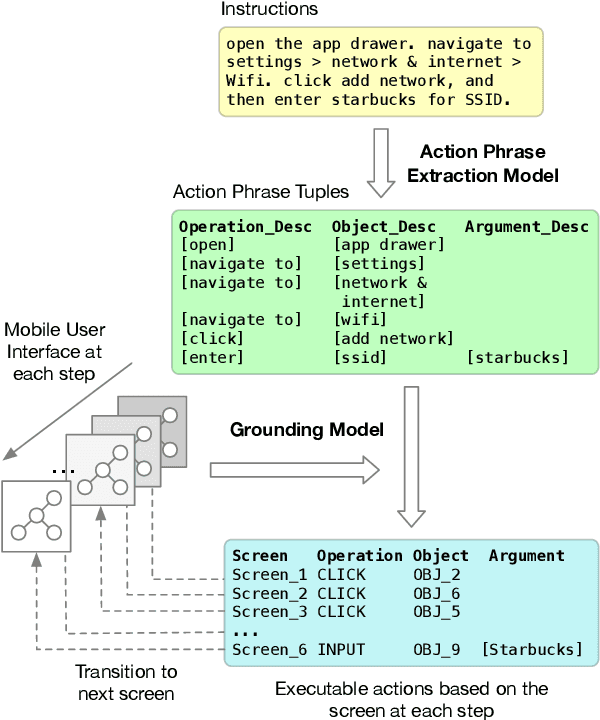
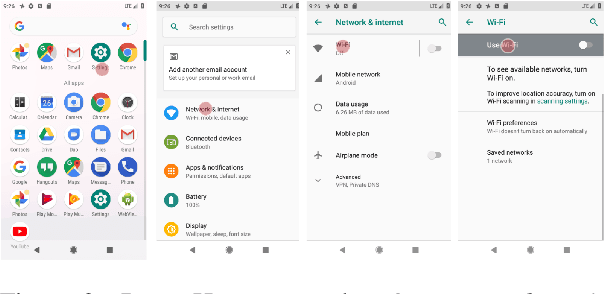
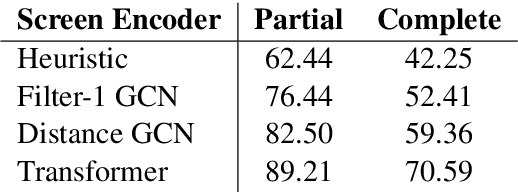
We present a new problem: grounding natural language instructions to mobile user interface actions, and create three new datasets for it. For full task evaluation, we create PIXELHELP, a corpus that pairs English instructions with actions performed by people on a mobile UI emulator. To scale training, we decouple the language and action data by (a) annotating action phrase spans in HowTo instructions and (b) synthesizing grounded descriptions of actions for mobile user interfaces. We use a Transformer to extract action phrase tuples from long-range natural language instructions. A grounding Transformer then contextually represents UI objects using both their content and screen position and connects them to object descriptions. Given a starting screen and instruction, our model achieves 70.59% accuracy on predicting complete ground-truth action sequences in PIXELHELP.