 Add to Chrome
 Add to Firefox
 Add to Edge
Ontology-Grounded World Models for Failure Diagnosis and Closed-Loop Repair in Physical AI Systems
Aug 14, 2026
EV-WM represents candidate quality with feature and event scores, but these scores do not explicitly record an unmet task predicate, a route label for an available correction mechanism, or a post-correction acceptance result. We present Onto-EV-WM, an ontology-grounded diagnosis and verification-gated correction interface layered above EV-WM rather than a replacement world-model architecture. The implemented task-local TBox defines entity types, predicate signatures, and constraints; source-specific grounding maps predicted or simulator-observed states to task ABoxes; and deterministic rules retain each missing predicate and its arguments when assigning a route label. Learned or heuristic proposers remain separate from this symbolic interface; native task predicates determine acceptance, and the bounded protocol determines whether a failed verification is retried. In the aligned PointMaze evaluation, EV-WM and Onto-EV-WM both report 94% success, with mean final-state distances of 0.90573 and 0.61177, respectively; the separately budgeted search reaches 100% success. On LIBERO-Goal, the ontology represents failed task conditions as typed records, retains their predicate arguments, and associates them with the declared source/joint correction route and predicate-gated acceptance; the complete configuration reports 93.8% corrected-window success on seed 0 and 94.05 +- 0.30% across four evaluation-sampling seeds. On the fixed 10,030-task LIBERO-Plus registry, Onto-EV-WM succeeds on 8,526 tasks (85.00%), with suite-level success rates of 65.98% for LIBERO-10, 91.39% for LIBERO-Goal, and 91.38% for both LIBERO-Object and LIBERO-Spatial. These numbers report the performance of the complete ontology-grounded configurations under the tested simulator protocols; an ontology-only causal share is not measured separately, and real-robot recovery is not evaluated.

QuantWAMs: Calibrating at the Right Granularity for World Action Models
Jul 30, 2026World Action Models (WAMs) jointly predict future observations and actions, but their iterative denoising and closed-loop execution make efficient deployment costly. Existing post-training quantization (PTQ) methods are poorly suited to WAMs because they rely on open-loop objectives, homogeneous model assumptions, and calibration distributions that do not reflect deployment. We present QuantWAMs, a PTQ framework that aligns quantization decisions with the calibration context defined by model structure, rollout distribution, and task objective. QuantWAMs introduces three strategies: shared-basis outlier calibration, which pools activation evidence only across coordinate-compatible modules; co-training-objective saliency, which computes empirical-Fisher scores from the joint video--action gradient and assigns weight precision at a calibration-stable layer granularity; and fixed-intervention rollout auditing, which revises denoising-step protection schedules using reachable closed-loop states without changing the precision budget. We evaluate QuantWAMs on Fast-WAM and LingBot-VA across RoboTwin 2.0, LIBERO, and real-robot manipulation with an AgiBot G2. Under a W4A4-dominant setting, the reported simulation means differ from FP16 by 0.2--0.7 percentage points. Real-robot trials further establish deployment feasibility on three manipulation tasks. For the targeted video and action blocks, QuantWAMs reduces peak weight-and-activation memory to about 29\% of FP16 and provides 1.4--1.6$\times$ block-level speedups.
EV-WM: Event-Verified World Models for Long-Horizon Robotic Manipulation
Jun 15, 2026Pretrained-feature world models provide a useful substrate for robot imagination, but visual or latent prediction alone does not determine whether an imagined future satisfies task-relevant predicates. Long-horizon manipulation requires progress signals that are relational, predicate-level, and physically grounded: whether an object has moved, whether a drawer or contact state has changed, whether a placement predicate is satisfied, and whether a candidate future is reliable enough for execution. We introduce \textbf{EV-WM}, a predicate-grounded verification framework for world-model planning. EV-WM rolls out candidate futures in pretrained visual-feature space, decodes them into structured event states, and scores them using task-progress, semantic-consistency, physical-feasibility, and uncertainty terms. The verifier guides sampling-based planning, gates candidate actions, and, in the contact-sensitive LIBERO wine-rack setting, selects among PPO-generated proposals. Across navigation, deformable-object, wall-constrained, and language-described manipulation studies, EV-WM shows that predicate-grounded verification can make feature-space world-model planning more interpretable and better aligned with task progress.
EA-WM: Event-Aware World Models with Task-Specification Grounding for Long-Horizon Manipulation
Jun 11, 2026Pretrained-feature world models provide a useful substrate for robot imagination, but visual or latent prediction alone does not determine whether an imagined future satisfies task-relevant events. Long-horizon manipulation requires progress signals that are relational, predicate-level, and physically grounded: whether an object has moved, whether a drawer or contact state has changed, whether a placement predicate is satisfied, and whether a candidate future is reliable enough for execution. We introduce EA-WM, an event-aware world-model framework that augments frozen visual-feature dynamics with task-specification-grounded event prediction and verification. EA-WM rolls out candidate futures in pretrained visual-feature space, decodes them into structured event states, and scores them using task-progress, semantic-consistency, physical-feasibility, and uncertainty terms. The verifier guides sampling-based planning, gates candidate actions, and, in the contact-sensitive LIBERO wine-rack setting, selects among PPOgenerated proposals. Across navigation, deformable-object, wall-constrained, and languagedescribed manipulation studies, EA-WM shows that event-aware verification can make featurespace world models more interpretable and better aligned with task progress.
MAexp: A Generic Platform for RL-based Multi-Agent Exploration
Apr 19, 2024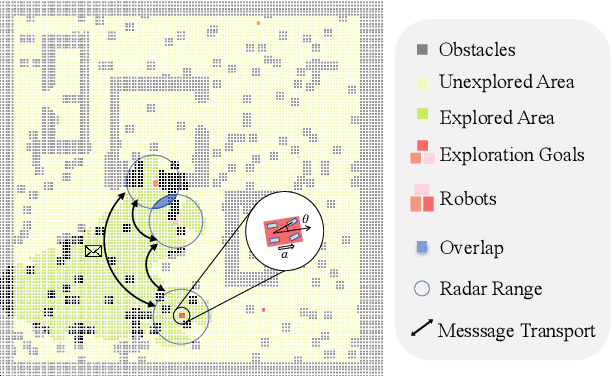
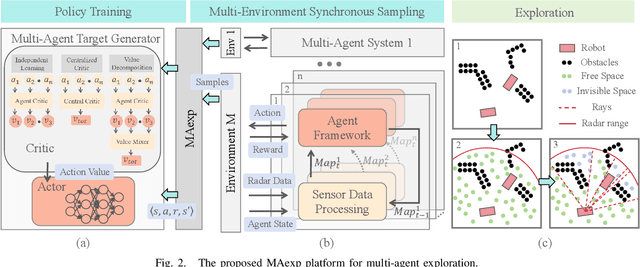
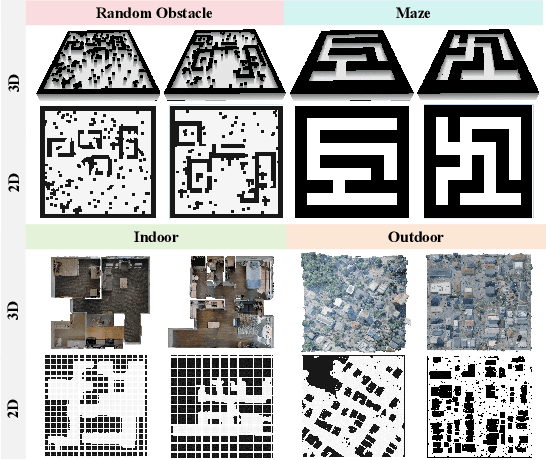
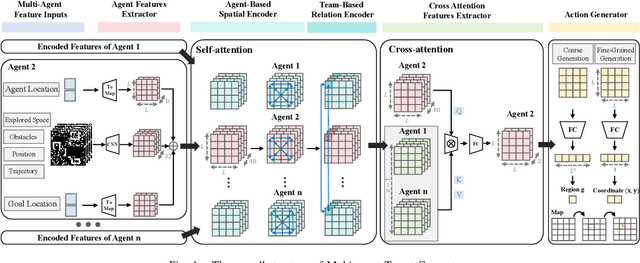
The sim-to-real gap poses a significant challenge in RL-based multi-agent exploration due to scene quantization and action discretization. Existing platforms suffer from the inefficiency in sampling and the lack of diversity in Multi-Agent Reinforcement Learning (MARL) algorithms across different scenarios, restraining their widespread applications. To fill these gaps, we propose MAexp, a generic platform for multi-agent exploration that integrates a broad range of state-of-the-art MARL algorithms and representative scenarios. Moreover, we employ point clouds to represent our exploration scenarios, leading to high-fidelity environment mapping and a sampling speed approximately 40 times faster than existing platforms. Furthermore, equipped with an attention-based Multi-Agent Target Generator and a Single-Agent Motion Planner, MAexp can work with arbitrary numbers of agents and accommodate various types of robots. Extensive experiments are conducted to establish the first benchmark featuring several high-performance MARL algorithms across typical scenarios for robots with continuous actions, which highlights the distinct strengths of each algorithm in different scenarios.