 Add to Chrome
 Add to Firefox
 Add to Edge
Towards Any-Quality Image Segmentation via Generative and Adaptive Latent Space Enhancement
Jan 05, 2026
Segment Anything Models (SAMs), known for their exceptional zero-shot segmentation performance, have garnered significant attention in the research community. Nevertheless, their performance drops significantly on severely degraded, low-quality images, limiting their effectiveness in real-world scenarios. To address this, we propose GleSAM++, which utilizes Generative Latent space Enhancement to boost robustness on low-quality images, thus enabling generalization across various image qualities. Additionally, to improve compatibility between the pre-trained diffusion model and the segmentation framework, we introduce two techniques, i.e., Feature Distribution Alignment (FDA) and Channel Replication and Expansion (CRE). However, the above components lack explicit guidance regarding the degree of degradation. The model is forced to implicitly fit a complex noise distribution that spans conditions from mild noise to severe artifacts, which substantially increases the learning burden and leads to suboptimal reconstructions. To address this issue, we further introduce a Degradation-aware Adaptive Enhancement (DAE) mechanism. The key principle of DAE is to decouple the reconstruction process for arbitrary-quality features into two stages: degradation-level prediction and degradation-aware reconstruction. Our method can be applied to pre-trained SAM and SAM2 with only minimal additional learnable parameters, allowing for efficient optimization. Extensive experiments demonstrate that GleSAM++ significantly improves segmentation robustness on complex degradations while maintaining generalization to clear images. Furthermore, GleSAM++ also performs well on unseen degradations, underscoring the versatility of our approach and dataset.

HTD-Mamba: Efficient Hyperspectral Target Detection with Pyramid State Space Model
Jul 09, 2024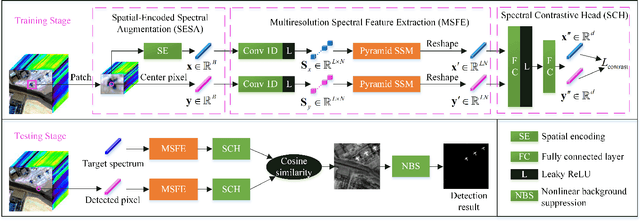
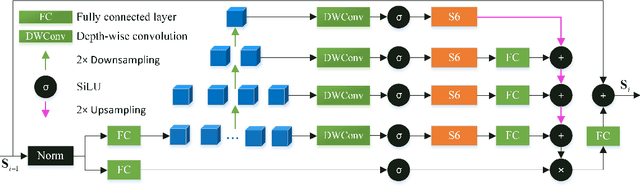
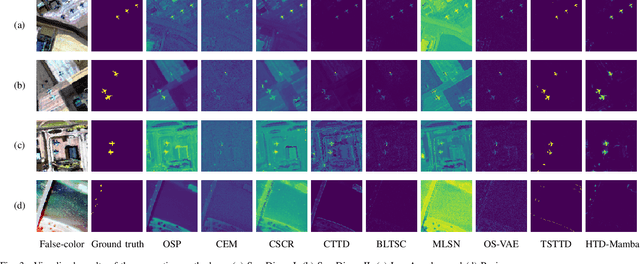
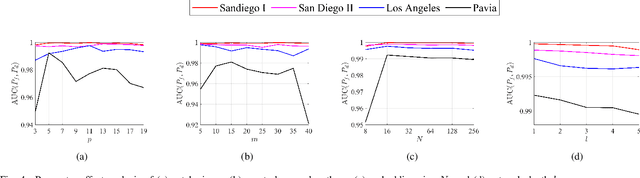
Hyperspectral target detection (HTD) identifies objects of interest from complex backgrounds at the pixel level, playing a vital role in Earth observation. However, HTD faces challenges due to limited prior knowledge and spectral variations, leading to underfitting models and unreliable performance. To address these challenges, this paper proposes an efficient self-supervised HTD method with a pyramid state space model (SSM), named HTD-Mamba, which employs spectrally contrastive learning to distinguish between target and background based on the similarity measurement of intrinsic features. Specifically, to obtain sufficient training samples and leverage spatial contextual information, we propose a spatial-encoded spectral augmentation technique that encodes all surrounding pixels within a patch into a transformed view of the central pixel. Additionally, to explore global band correlations, we divide pixels into continuous group-wise spectral embeddings and introduce Mamba to HTD for the first time to model long-range dependencies of the spectral sequence with linear complexity. Furthermore, to alleviate spectral variation and enhance robust representation, we propose a pyramid SSM as a backbone to capture and fuse multiresolution spectral-wise intrinsic features. Extensive experiments conducted on four public datasets demonstrate that the proposed method outperforms state-of-the-art methods in both quantitative and qualitative evaluations. Code is available at \url{https://github.com/shendb2022/HTD-Mamba}.
Hyperspectral Target Detection Based on Low-Rank Background Subspace Learning and Graph Laplacian Regularization
Jun 01, 2023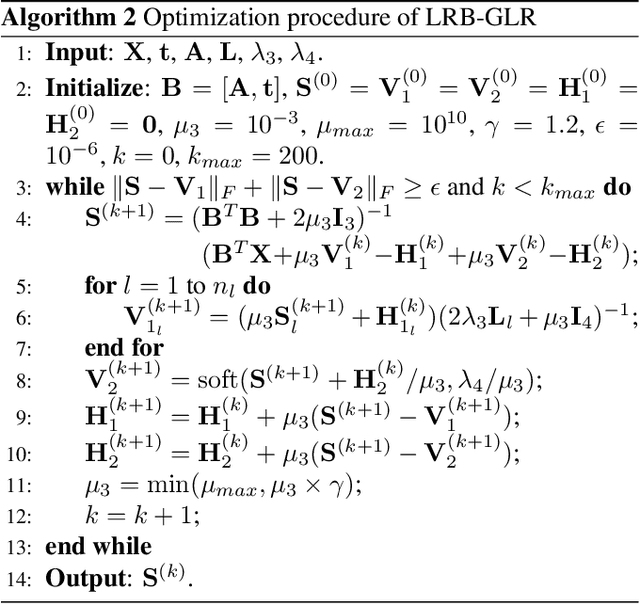
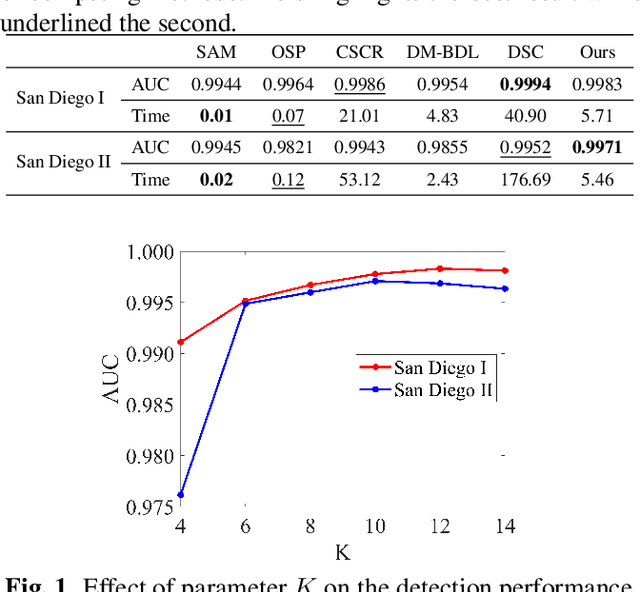
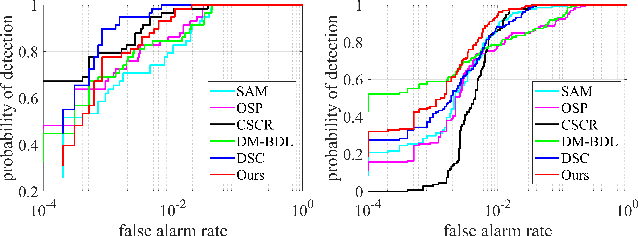
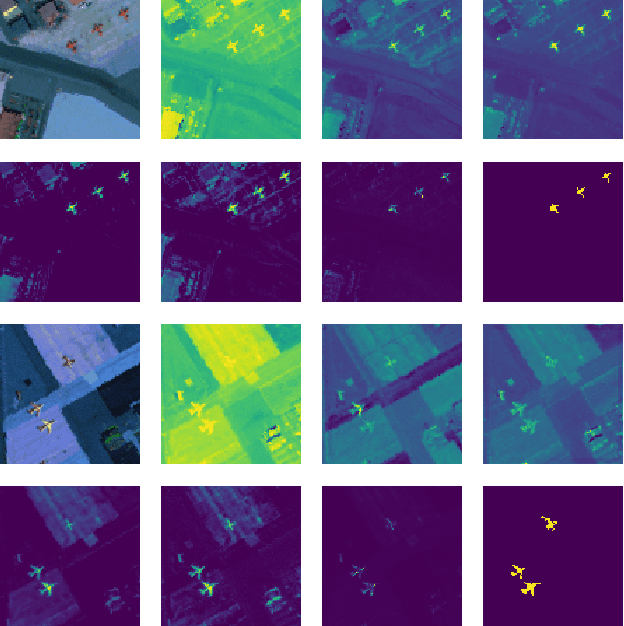
Hyperspectral target detection is good at finding dim and small objects based on spectral characteristics. However, existing representation-based methods are hindered by the problem of the unknown background dictionary and insufficient utilization of spatial information. To address these issues, this paper proposes an efficient optimizing approach based on low-rank representation (LRR) and graph Laplacian regularization (GLR). Firstly, to obtain a complete and pure background dictionary, we propose a LRR-based background subspace learning method by jointly mining the low-dimensional structure of all pixels. Secondly, to fully exploit local spatial relationships and capture the underlying geometric structure, a local region-based GLR is employed to estimate the coefficients. Finally, the desired detection map is generated by computing the ratio of representation errors from binary hypothesis testing. The experiments conducted on two benchmark datasets validate the effectiveness and superiority of the approach. For reproduction, the accompanying code is available at https://github.com/shendb2022/LRBSL-GLR.