 Add to Chrome
 Add to Firefox
 Add to Edge
Customizing Large Vision Model-Guided Low-Rank Approximation for Ground-Roll Denoise
Apr 01, 2026
Ground-roll is a dominant source of coherent noise in land and vertical seismic profiling (VSP) data, severely masking reflection events and degrading subsequent imaging and interpretation. Conventional attenuation methods, including transform-domain filtering, sparse representation, and deep learning, often suffer from limited adaptability, signal leakage, or dependence on labeled training data, especially under strong signal-noise overlap. To address these challenges, we propose a training-free framework that reformulates ground-roll attenuation as a semantic-guided signal separation problem. Specifically, a promptable large vision model is employed to extract high-level semantic priors by converting seismic gathers into visual representations and localizing ground-roll-dominant regions via text or image prompts. The resulting semantic response is transformed into a continuous soft mask, which is embedded into a mask-conditioned low-rank inverse formulation to enable spatially adaptive suppression and reflection-preserving reconstruction. An efficient alternating direction method of multipliers (ADMM)-based solver is further developed to solve the proposed inverse problem, enabling stable and physically consistent signal recovery without requiring task-specific training or manual annotation. Extensive experiments on both synthetic and field VSP datasets demonstrate that the proposed method achieves superior ground-roll attenuation while preserving reflection continuity and waveform fidelity, consistently outperforming representative transform-domain filtering and implicit neural representation methods.

TinyFormer: Efficient Transformer Design and Deployment on Tiny Devices
Nov 03, 2023
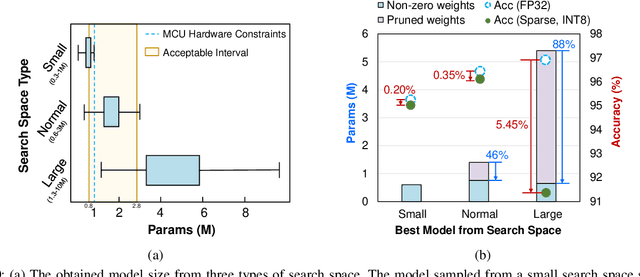


Developing deep learning models on tiny devices (e.g. Microcontroller units, MCUs) has attracted much attention in various embedded IoT applications. However, it is challenging to efficiently design and deploy recent advanced models (e.g. transformers) on tiny devices due to their severe hardware resource constraints. In this work, we propose TinyFormer, a framework specifically designed to develop and deploy resource-efficient transformers on MCUs. TinyFormer mainly consists of SuperNAS, SparseNAS and SparseEngine. Separately, SuperNAS aims to search for an appropriate supernet from a vast search space. SparseNAS evaluates the best sparse single-path model including transformer architecture from the identified supernet. Finally, SparseEngine efficiently deploys the searched sparse models onto MCUs. To the best of our knowledge, SparseEngine is the first deployment framework capable of performing inference of sparse models with transformer on MCUs. Evaluation results on the CIFAR-10 dataset demonstrate that TinyFormer can develop efficient transformers with an accuracy of $96.1\%$ while adhering to hardware constraints of $1$MB storage and $320$KB memory. Additionally, TinyFormer achieves significant speedups in sparse inference, up to $12.2\times$, when compared to the CMSIS-NN library. TinyFormer is believed to bring powerful transformers into TinyML scenarios and greatly expand the scope of deep learning applications.