 Add to Chrome
 Add to Firefox
 Add to Edge
Anatomy of a failure: When, how, and why deep vision fails in scientific domains
May 05, 2026
Mirroring its ubiquity in popular media and all human activities, the use of deep learning (DL) is rapidly growing in scientific imaging modalities. However, unlike everyday RGB pictures, pixels encode precise physicochemical properties in scientific imaging across potentially thousands of channels. While DL is well validated on human-centric RGB perceptual tasks, its effectiveness for scientific imaging remains uncertain. Here, we show that the naive application of DL frameworks to scientific images can lead to critical failures. We evaluate the use of DL for pathology, comparing RGB images of stained tissue with the quantitative and information-rich biochemical signatures of infrared (IR) imaging. Despite this informational advantage, DL models trained on IR data paradoxically underperform. We investigate this discrepancy to find that IR data priors interact poorly with the simplicity bias of DL, causing models to collapse to one-dimensional predictions. This constitutes a catastrophic DL failure because the model's representational capacity remains largely unused, while furthermore raising AI safety concerns and undermining the advantages of such scientific modalities. Notably, this problem persists even with state-of-the-art DL robustification strategies, which are primarily designed and validated for RGB imagery and thus inherit the same prior-bias mismatch. This work establishes a framework for understanding the limitations of generic DL in science and advocates for the study of modality-specific failure modes to guide the development of specialized, safe AI algorithms.

Finer Disentanglement of Aleatoric Uncertainty Can Accelerate Chemical Histopathology Imaging
Feb 27, 2025Label-free chemical imaging holds significant promise for improving digital pathology workflows. However, data acquisition speed remains a limiting factor for smooth clinical transition. To address this gap, we propose an adaptive strategy: initially scan the low information (LI) content of the entire tissue quickly, identify regions with high aleatoric uncertainty (AU), and selectively re-image them at better quality to capture higher information (HI) details. The primary challenge lies in distinguishing between high-AU regions that can be mitigated through HI imaging and those that cannot. However, since existing uncertainty frameworks cannot separate such AU subcategories, we propose a fine-grained disentanglement method based on post-hoc latent space analysis to unmix resolvable from irresolvable high-AU regions. We apply our approach to efficiently image infrared spectroscopic data of breast tissues, achieving superior segmentation performance using the acquired HI data compared to a random baseline. This represents the first algorithmic study focused on fine-grained AU disentanglement within dynamic image spaces (LI-to-HI), with novel application to streamline histopathology.
Detecting Hallucinations in Virtual Histology with Neural Precursors
Nov 22, 2024
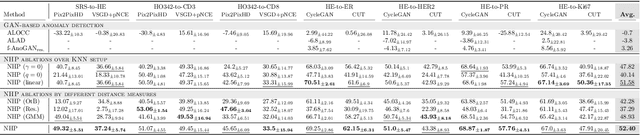
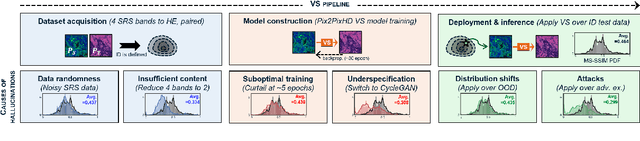

Significant biomedical research and clinical care rely on the histopathologic examination of tissue structure using microscopy of stained tissue. Virtual staining (VS) offers a promising alternative with the potential to reduce cost and eliminate the use of toxic reagents. However, the critical challenge of hallucinations limits confidence in its use, necessitating a VS co-pilot to detect these hallucinations. Here, we first formally establish the problem of hallucination detection in VS. Next, we introduce a scalable, post-hoc hallucination detection method that identifies a Neural Hallucination Precursor (NHP) from VS model embeddings for test-time detection. We report extensive validation across diverse and challenging VS settings to demonstrate NHP's effectiveness and robustness. Furthermore, we show that VS models with fewer hallucinations do not necessarily disclose them better, risking a false sense of security when reporting just the former metric. This highlights the need for a reassessment of current VS evaluation practices.
Are We Ready for Out-of-Distribution Detection in Digital Pathology?
Jul 18, 2024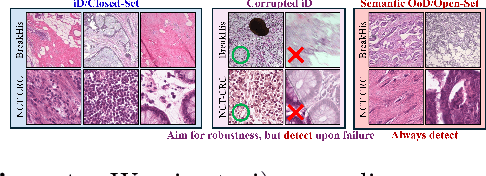
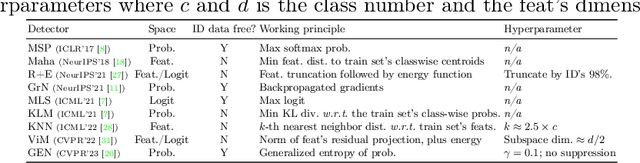
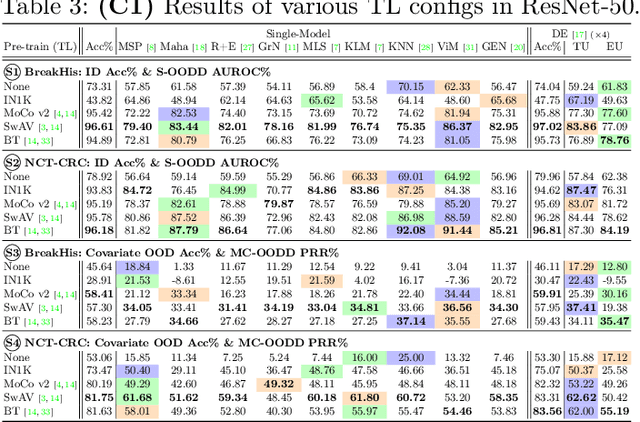
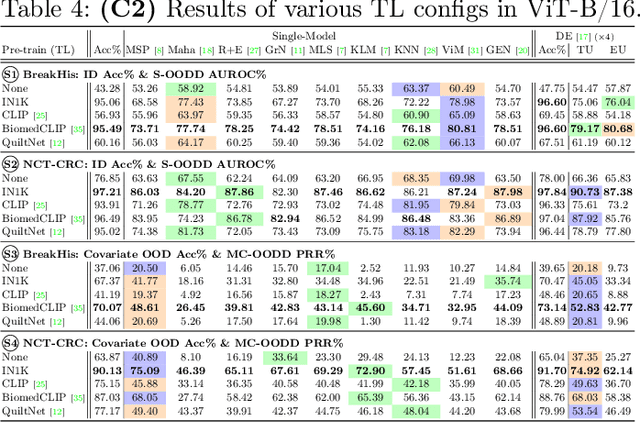
The detection of semantic and covariate out-of-distribution (OOD) examples is a critical yet overlooked challenge in digital pathology (DP). Recently, substantial insight and methods on OOD detection were presented by the ML community, but how do they fare in DP applications? To this end, we establish a benchmark study, our highlights being: 1) the adoption of proper evaluation protocols, 2) the comparison of diverse detectors in both a single and multi-model setting, and 3) the exploration into advanced ML settings like transfer learning (ImageNet vs. DP pre-training) and choice of architecture (CNNs vs. transformers). Through our comprehensive experiments, we contribute new insights and guidelines, paving the way for future research and discussion.