 Add to Chrome
 Add to Firefox
 Add to Edge
Anatomy of a failure: When, how, and why deep vision fails in scientific domains
May 05, 2026
Mirroring its ubiquity in popular media and all human activities, the use of deep learning (DL) is rapidly growing in scientific imaging modalities. However, unlike everyday RGB pictures, pixels encode precise physicochemical properties in scientific imaging across potentially thousands of channels. While DL is well validated on human-centric RGB perceptual tasks, its effectiveness for scientific imaging remains uncertain. Here, we show that the naive application of DL frameworks to scientific images can lead to critical failures. We evaluate the use of DL for pathology, comparing RGB images of stained tissue with the quantitative and information-rich biochemical signatures of infrared (IR) imaging. Despite this informational advantage, DL models trained on IR data paradoxically underperform. We investigate this discrepancy to find that IR data priors interact poorly with the simplicity bias of DL, causing models to collapse to one-dimensional predictions. This constitutes a catastrophic DL failure because the model's representational capacity remains largely unused, while furthermore raising AI safety concerns and undermining the advantages of such scientific modalities. Notably, this problem persists even with state-of-the-art DL robustification strategies, which are primarily designed and validated for RGB imagery and thus inherit the same prior-bias mismatch. This work establishes a framework for understanding the limitations of generic DL in science and advocates for the study of modality-specific failure modes to guide the development of specialized, safe AI algorithms.

Hierarchical Diffusion Framework for Pseudo-Healthy Brain MRI Inpainting with Enhanced 3D Consistency
Jul 23, 2025Pseudo-healthy image inpainting is an essential preprocessing step for analyzing pathological brain MRI scans. Most current inpainting methods favor slice-wise 2D models for their high in-plane fidelity, but their independence across slices produces discontinuities in the volume. Fully 3D models alleviate this issue, but their high model capacity demands extensive training data for reliable, high-fidelity synthesis -- often impractical in medical settings. We address these limitations with a hierarchical diffusion framework by replacing direct 3D modeling with two perpendicular coarse-to-fine 2D stages. An axial diffusion model first yields a coarse, globally consistent inpainting; a coronal diffusion model then refines anatomical details. By combining perpendicular spatial views with adaptive resampling, our method balances data efficiency and volumetric consistency. Our experiments show our approach outperforms state-of-the-art baselines in both realism and volumetric consistency, making it a promising solution for pseudo-healthy image inpainting. Code is available at https://github.com/dou0000/3dMRI-Consistent-Inpaint.
Diff-Ensembler: Learning to Ensemble 2D Diffusion Models for Volume-to-Volume Medical Image Translation
Jan 13, 2025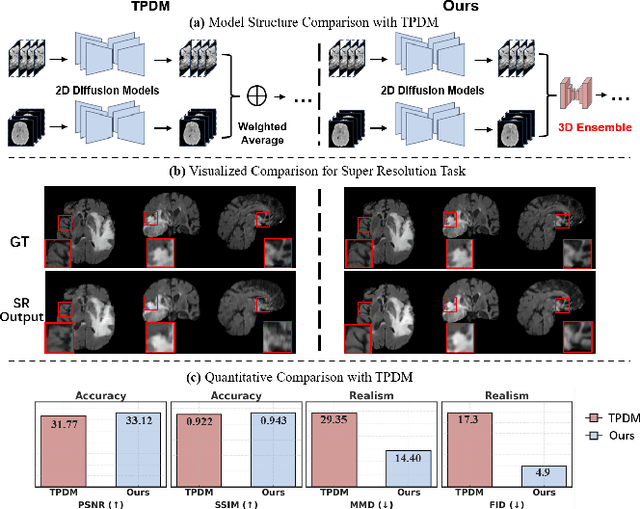
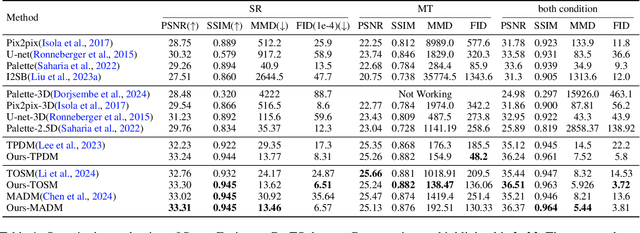
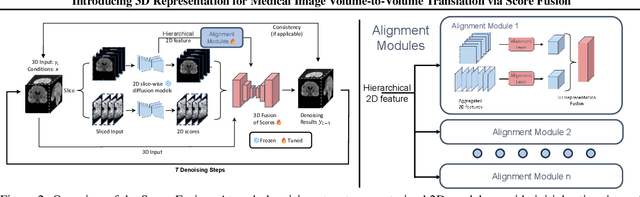
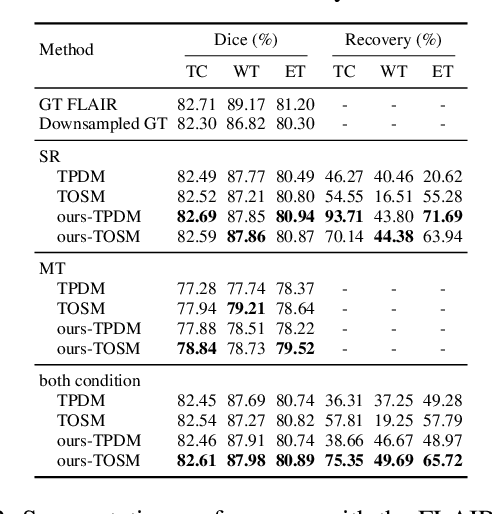
Despite success in volume-to-volume translations in medical images, most existing models struggle to effectively capture the inherent volumetric distribution using 3D representations. The current state-of-the-art approach combines multiple 2D-based networks through weighted averaging, thereby neglecting the 3D spatial structures. Directly training 3D models in medical imaging presents significant challenges due to high computational demands and the need for large-scale datasets. To address these challenges, we introduce Diff-Ensembler, a novel hybrid 2D-3D model for efficient and effective volumetric translations by ensembling perpendicularly trained 2D diffusion models with a 3D network in each diffusion step. Moreover, our model can naturally be used to ensemble diffusion models conditioned on different modalities, allowing flexible and accurate fusion of input conditions. Extensive experiments demonstrate that Diff-Ensembler attains superior accuracy and volumetric realism in 3D medical image super-resolution and modality translation. We further demonstrate the strength of our model's volumetric realism using tumor segmentation as a downstream task.