 Add to Chrome
 Add to Firefox
 Add to Edge
An LLM-powered Agentic Recommendation System for Connected TV Content Discovery
Jul 10, 2026
Recommendation systems, from traditional multi-stage to recent unified generative architectures, face challenges in incorporating diverse contextual signals, such as trending topics, breaking news, cultural events, and cross-surface user activities, into their ranking pipelines. These systems are designed to consume structured behavioral signals with consistent schemas, and lack the reasoning capability to naturally process unstructured or heterogeneously formatted contextual information. Incorporating such signals typically requires feature engineering, bespoke data pipelines, and carefully tuned heuristics. In this paper, we present an LLM-powered agentic recommendation system designed for Connected TV (CTV) content discovery that addresses these limitations. Our system leverages the reasoning capabilities of large language models to naturally process and synthesize diverse signals across varying schemas and structures, eliminating much of the manual integration inherent in traditional ranking and retrieval systems. Recognizing that current LLM-based solutions still fall short of traditional machine learning models in several recommendation tasks, including retrieval efficiency, personalization precision, and scalability, we adopt an agentic architecture that orchestrates specialized components, allowing each sub-task to be handled by the most suitable method, whether LLM-based or traditional ML. The main contribution of this work is our engineering approach to successfully overcoming the practical limitations of enabling LLM for recommendation, particularly inference latency. We share insights from our work and discuss the trade-offs and lessons learned in building a hybrid system that combines the flexibility of LLMs with the performance of established recommendation techniques.

End-to-end Multi-Modal Multi-Task Vehicle Control for Self-Driving Cars with Visual Perception
Feb 02, 2018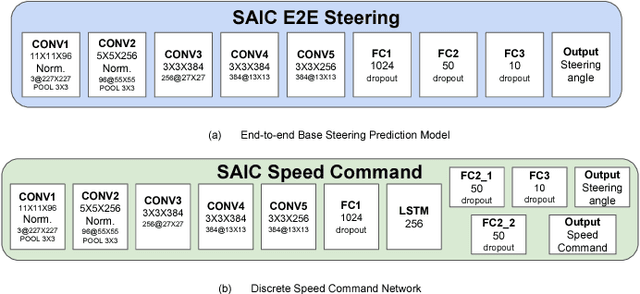
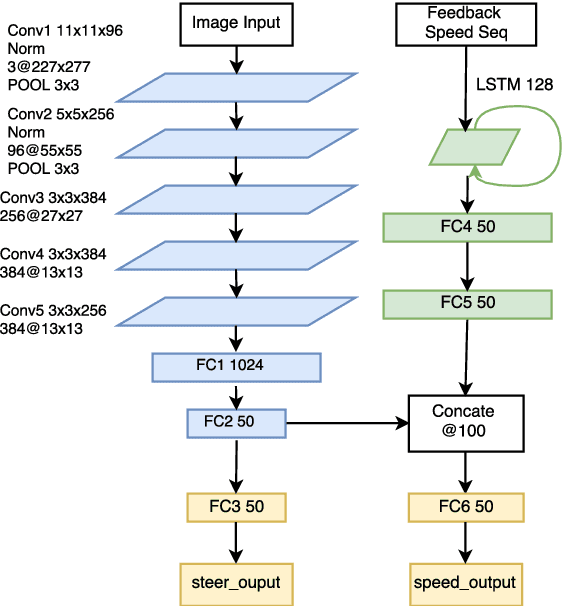
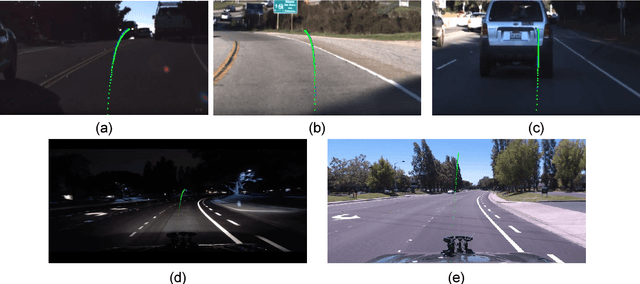
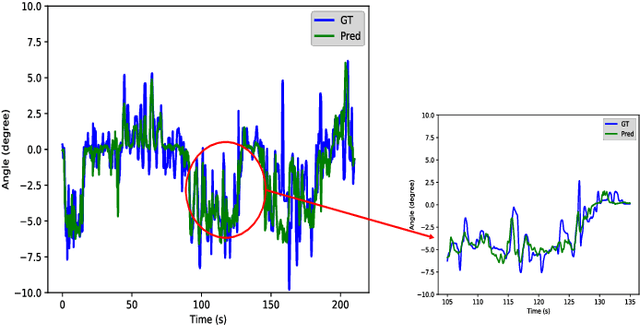
Convolutional Neural Networks (CNN) have been successfully applied to autonomous driving tasks, many in an end-to-end manner. Previous end-to-end steering control methods take an image or an image sequence as the input and directly predict the steering angle with CNN. Although single task learning on steering angles has reported good performances, the steering angle alone is not sufficient for vehicle control. In this work, we propose a multi-task learning framework to predict the steering angle and speed control simultaneously in an end-to-end manner. Since it is nontrivial to predict accurate speed values with only visual inputs, we first propose a network to predict discrete speed commands and steering angles with image sequences. Moreover, we propose a multi-modal multi-task network to predict speed values and steering angles by taking previous feedback speeds and visual recordings as inputs. Experiments are conducted on the public Udacity dataset and a newly collected SAIC dataset. Results show that the proposed model predicts steering angles and speed values accurately. Furthermore, we improve the failure data synthesis methods to solve the problem of error accumulation in real road tests.