 Add to Chrome
 Add to Firefox
 Add to Edge
AI+HW 2035: Shaping the Next Decade
Mar 05, 2026
Artificial intelligence (AI) and hardware (HW) are advancing at unprecedented rates, yet their trajectories have become inseparably intertwined. The global research community lacks a cohesive, long-term vision to strategically coordinate the development of AI and HW. This fragmentation constrains progress toward holistic, sustainable, and adaptive AI systems capable of learning, reasoning, and operating efficiently across cloud, edge, and physical environments. The future of AI depends not only on scaling intelligence, but on scaling efficiency, achieving exponential gains in intelligence per joule, rather than unbounded compute consumption. Addressing this grand challenge requires rethinking the entire computing stack. This vision paper lays out a 10-year roadmap for AI+HW co-design and co-development, spanning algorithms, architectures, systems, and sustainability. We articulate key insights that redefine scaling around energy efficiency, system-level integration, and cross-layer optimization. We identify key challenges and opportunities, candidly assess potential obstacles and pitfalls, and propose integrated solutions grounded in algorithmic innovation, hardware advances, and software abstraction. Looking ahead, we define what success means in 10 years: achieving a 1000x improvement in efficiency for AI training and inference; enabling energy-aware, self-optimizing systems that seamlessly span cloud, edge, and physical AI; democratizing access to advanced AI infrastructure; and embedding human-centric principles into the design of intelligent systems. Finally, we outline concrete action items for academia, industry, government, and the broader community, calling for coordinated national initiatives, shared infrastructure, workforce development, cross-agency collaboration, and sustained public-private partnerships to ensure that AI+HW co-design becomes a unifying long-term mission.

Supervised learning with quantum enhanced feature spaces
Jun 05, 2018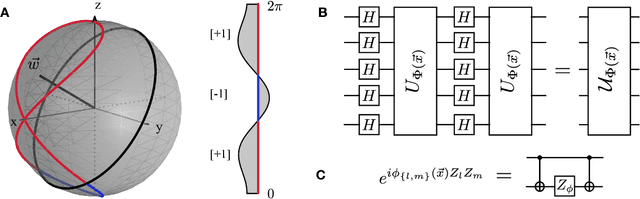
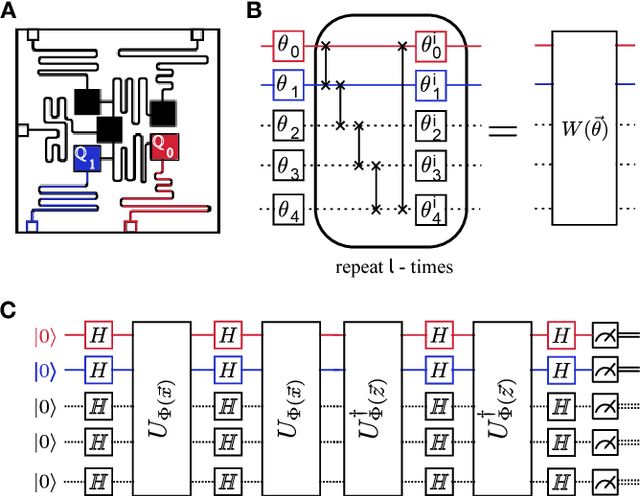
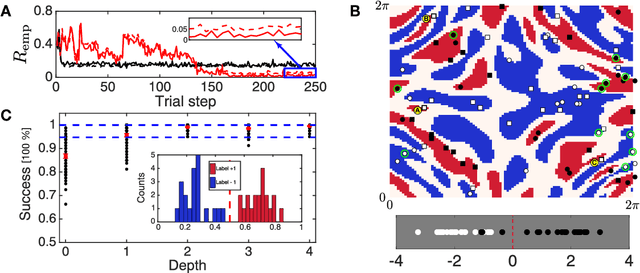
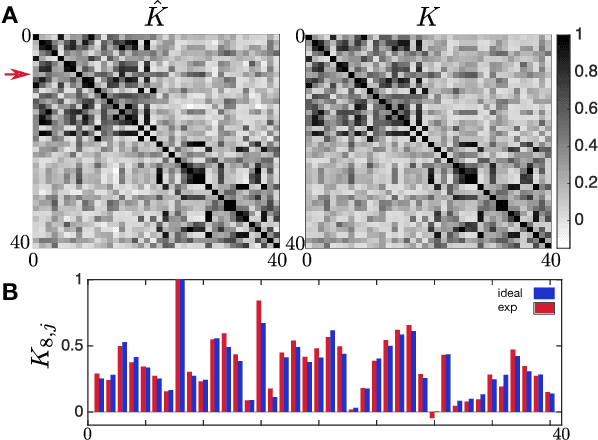
Machine learning and quantum computing are two technologies each with the potential for altering how computation is performed to address previously untenable problems. Kernel methods for machine learning are ubiquitous for pattern recognition, with support vector machines (SVMs) being the most well-known method for classification problems. However, there are limitations to the successful solution to such problems when the feature space becomes large, and the kernel functions become computationally expensive to estimate. A core element to computational speed-ups afforded by quantum algorithms is the exploitation of an exponentially large quantum state space through controllable entanglement and interference. Here, we propose and experimentally implement two novel methods on a superconducting processor. Both methods represent the feature space of a classification problem by a quantum state, taking advantage of the large dimensionality of quantum Hilbert space to obtain an enhanced solution. One method, the quantum variational classifier builds on [1,2] and operates through using a variational quantum circuit to classify a training set in direct analogy to conventional SVMs. In the second, a quantum kernel estimator, we estimate the kernel function and optimize the classifier directly. The two methods present a new class of tools for exploring the applications of noisy intermediate scale quantum computers [3] to machine learning.