 Add to Chrome
 Add to Firefox
 Add to Edge
SQL-Trail: Multi-Turn Reinforcement Learning with Interleaved Feedback for Text-to-SQL
Jan 25, 2026
While large language models (LLMs) have substantially improved Text-to-SQL generation, a pronounced gap remains between AI systems and human experts on challenging benchmarks such as BIRD-SQL. We argue this gap stems largely from the prevailing single-pass paradigm, which lacks the iterative reasoning, schema exploration, and error-correction behaviors that humans naturally employ. To address this limitation, we introduce SQL-Trail, a multi-turn reinforcement learning (RL) agentic framework for Text-to-SQL. Rather than producing a query in one shot, SQL-Trail interacts with the database environment and uses execution feedback to iteratively refine its predictions. Our approach centers on two key ideas: (i) an adaptive turn-budget allocation mechanism that scales the agent's interaction depth to match question difficulty, and (ii) a composite reward panel that jointly incentivizes SQL correctness and efficient exploration. Across benchmarks, SQL-Trail sets a new state of the art and delivers strong data efficiency--up to 18x higher than prior single-pass RL state-of-the-art methods. Notably, our 7B and 14B models outperform substantially larger proprietary systems by 5% on average, underscoring the effectiveness of interactive, agentic workflows for robust Text-to-SQL generation.

Squiggle - A Glyph Recognizer for Gesture Input
Sep 25, 2011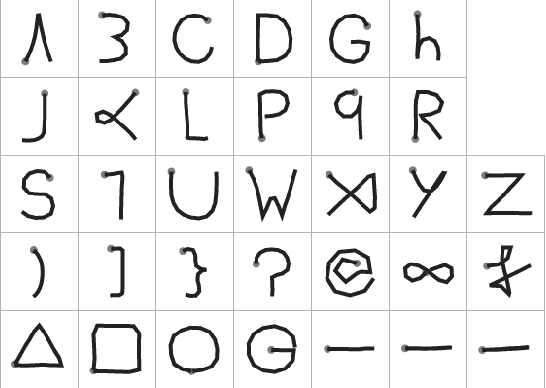


Squiggle is a template-based glyph recognizer in the lineage of `$1 Recognizer' and `Protractor'. It seeks a good fit linear affine mapping between the input and template glyphs which are represented as a list of milestone points along the glyph path. The algorithm can recognize input glyphs invariant of rotation, scaling, skew, and reflection symmetries. In practice the algorithm is fast and robust enough to recognize user-generated glyphs as they are being drawn in real time, and to project `shadows' of the matching templates as feedback.