 Add to Chrome
 Add to Firefox
 Add to Edge
Learning Action-Conditional and Object-Centric Gaussian Splatting World Models for Rigid Objects
Jun 01, 2026
World models enable intelligent agents to predict the consequences of their actions on the environment. In this paper, we propose Multi Rigid Object Gaussian World Model (MRO-GWM), a novel model that learns action-conditional dynamics of rigid objects in 3D. By representing the scene by object-centric Gaussians, we can represent arbitrary object shapes and multi-object scenes. We develop a novel spatio-temporal transformer architecture that predicts future rigid body motion from a history of object Gaussians and future actions. Objects are represented by their Gaussians in a canonical frame, which allows for describing object motion as rigid body transformation. Our model is trained on reconstructions from multiple viewpoints, which requires the model to handle partial observations of objects due to occlusions. We analyze prediction performance of our approach on synthetic datasets composed of typical household objects with multi-object dynamics and interactions by a robot end effector. We also evaluate our model in model-predictive control for non-prehensile manipulation in simulation.

Guided Diffusion by Optimized Loss Functions on Relaxed Parameters for Inverse Material Design
Feb 17, 2026Inverse design problems are common in engineering and materials science. The forward direction, i.e., computing output quantities from design parameters, typically requires running a numerical simulation, such as a FEM, as an intermediate step, which is an optimization problem by itself. In many scenarios, several design parameters can lead to the same or similar output values. For such cases, multi-modal probabilistic approaches are advantageous to obtain diverse solutions. A major difficulty in inverse design stems from the structure of the design space, since discrete parameters or further constraints disallow the direct use of gradient-based optimization. To tackle this problem, we propose a novel inverse design method based on diffusion models. Our approach relaxes the original design space into a continuous grid representation, where gradients can be computed by implicit differentiation in the forward simulation. A diffusion model is trained on this relaxed parameter space in order to serve as a prior for plausible relaxed designs. Parameters are sampled by guided diffusion using gradients that are propagated from an objective function specified at inference time through the differentiable simulation. A design sample is obtained by backprojection into the original parameter space. We develop our approach for a composite material design problem where the forward process is modeled as a linear FEM problem. We evaluate the performance of our approach in finding designs that match a specified bulk modulus. We demonstrate that our method can propose diverse designs within 1% relative error margin from medium to high target bulk moduli in 2D and 3D settings. We also demonstrate that the material density of generated samples can be minimized simultaneously by using a multi-objective loss function.
Learning a Terrain- and Robot-Aware Dynamics Model for Autonomous Mobile Robot Navigation
Sep 17, 2024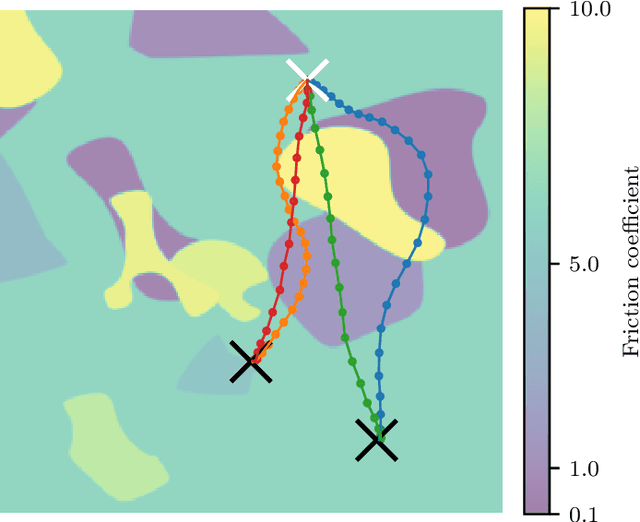
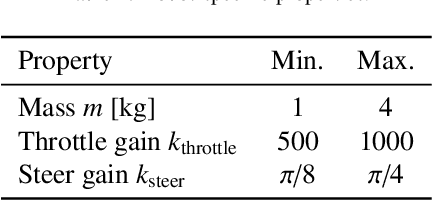
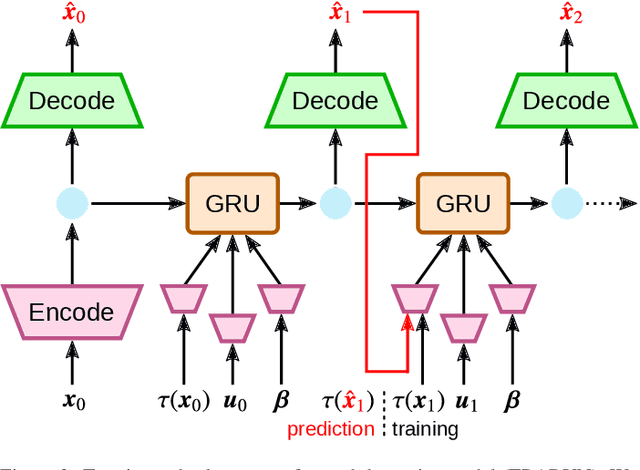
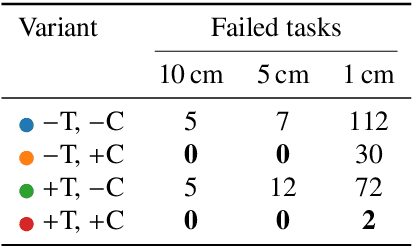
Mobile robots should be capable of planning cost-efficient paths for autonomous navigation. Typically, the terrain and robot properties are subject to variations. For instance, properties of the terrain such as friction may vary across different locations. Also, properties of the robot may change such as payloads or wear and tear, e.g., causing changing actuator gains or joint friction. Autonomous navigation approaches should thus be able to adapt to such variations. In this article, we propose a novel approach for learning a probabilistic, terrain- and robot-aware forward dynamics model (TRADYN) which can adapt to such variations and demonstrate its use for navigation. Our learning approach extends recent advances in meta-learning forward dynamics models based on Neural Processes for mobile robot navigation. We evaluate our method in simulation for 2D navigation of a robot with uni-cycle dynamics with varying properties on terrain with spatially varying friction coefficients. In our experiments, we demonstrate that TRADYN has lower prediction error over long time horizons than model ablations which do not adapt to robot or terrain variations. We also evaluate our model for navigation planning in a model-predictive control framework and under various sources of noise. We demonstrate that our approach yields improved performance in planning control-efficient paths by taking robot and terrain properties into account.
Generating Symbolic Reasoning Problems with Transformer GANs
Oct 19, 2021



Constructing training data for symbolic reasoning domains is challenging: Existing instances are typically hand-crafted and too few to be trained on directly and synthetically generated instances are often hard to evaluate in terms of their meaningfulness. We study the capabilities of GANs and Wasserstein GANs equipped with Transformer encoders to generate sensible and challenging training data for symbolic reasoning domains. We conduct experiments on two problem domains where Transformers have been successfully applied recently: symbolic mathematics and temporal specifications in verification. Even without autoregression, our GAN models produce syntactically correct instances. We show that the generated data can be used as a substitute for real training data when training a classifier, and, especially, that training data can be generated from a real dataset that is too small to be trained on directly. Using a GAN setting also allows us to alter the target distribution: We show that by adding a classifier uncertainty part to the generator objective, we obtain a dataset that is even harder to solve for a classifier than our original dataset.