 Add to Chrome
 Add to Firefox
 Add to Edge
Automated Batch Distillation Process Simulation for a Large Hybrid Dataset for Deep Anomaly Detection
Apr 14, 2026
Anomaly detection (AD) in chemical processes based on deep learning offers significant opportunities but requires large, diverse, and well-annotated training datasets that are rarely available from industrial operations. In a recent work, we introduced a large, fully annotated experimental dataset for batch distillation under normal and anomalous operating conditions. In the present study, we augment this dataset with a corresponding simulation dataset, creating a novel hybrid dataset. The simulation data is generated in an automated workflow with a novel Python-based process simulator that employs a tailored index-reduction strategy for the underlying differential-algebraic equations. Leveraging the rich metadata and structured anomaly annotations of the experimental database, experimental records are automatically translated into simulation scenarios. After calibration to a single reference experiment, the dynamics of the other experiments are well predicted. This enabled the fully automated, consistent generation of time-series data for a large number of experimental runs, covering both normal operation and a wide range of actuator- and control-related anomalies. The resulting hybrid dataset is released openly. From a process simulation perspective, this work demonstrates the automated, consistent simulation of large-scale experimental campaigns, using batch distillation as an example. From a data-driven AD perspective, the hybrid dataset provides a unique basis for simulation-to-experiment style transfer, the generation of pseudo-experimental data, and future research on deep AD methods in chemical process monitoring.

Automatic Facial Skin Feature Detection for Everyone
Mar 30, 2022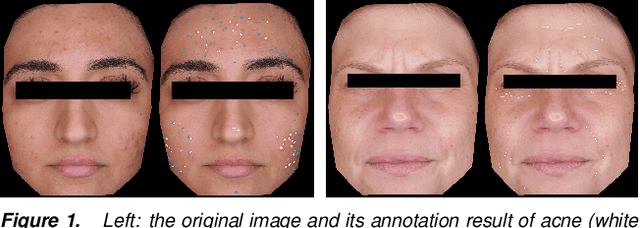
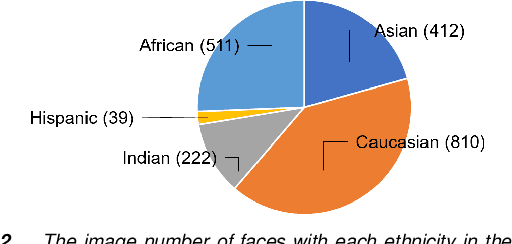
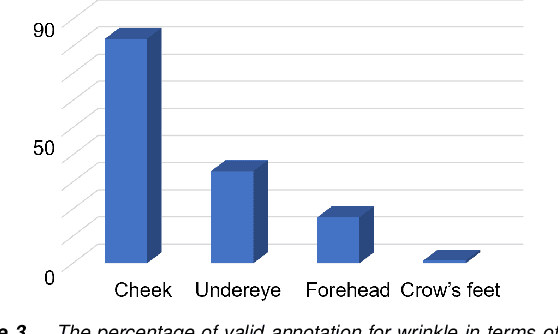
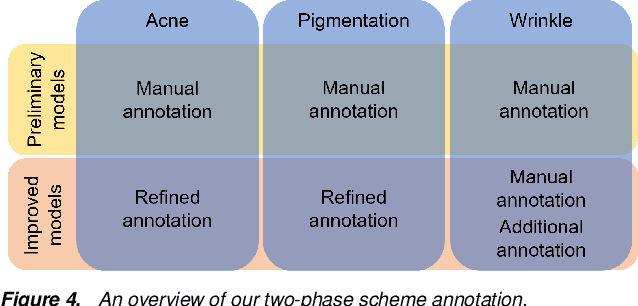
Automatic assessment and understanding of facial skin condition have several applications, including the early detection of underlying health problems, lifestyle and dietary treatment, skin-care product recommendation, etc. Selfies in the wild serve as an excellent data resource to democratize skin quality assessment, but suffer from several data collection challenges.The key to guaranteeing an accurate assessment is accurate detection of different skin features. We present an automatic facial skin feature detection method that works across a variety of skin tones and age groups for selfies in the wild. To be specific, we annotate the locations of acne, pigmentation, and wrinkle for selfie images with different skin tone colors, severity levels, and lighting conditions. The annotation is conducted in a two-phase scheme with the help of a dermatologist to train volunteers for annotation. We employ Unet++ as the network architecture for feature detection. This work shows that the two-phase annotation scheme can robustly detect the accurate locations of acne, pigmentation, and wrinkle for selfie images with different ethnicities, skin tone colors, severity levels, age groups, and lighting conditions.