 Add to Chrome
 Add to Firefox
 Add to Edge
PeerMathDial: A Middle School Dialogue Dataset for Student Collaborative Math Problem Solving
Jun 19, 2026
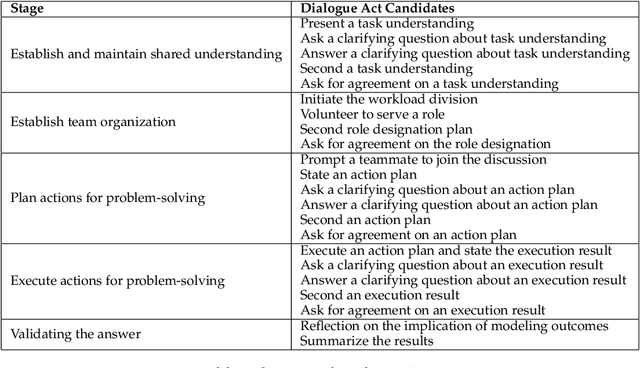
Collaborative Problem Solving (CPS) is a core skill in education, where the process of peer interaction is highly important. However, existing educational dialogue datasets mostly focus on classroom instruction or tutoring (i.e., teacher/tutor-student interaction), yet datasets centering small-group, student-student interaction are limited. This thus leaves research with limited resources for studying how students interact, coordinate, and solve problems together in real educational settings. To address this, we introduce PeerMathDial, the first dataset of peer CPS dialogues collected from authentic middle school math classrooms. It contains 55 dialogues from 27 students, totaling 6,406 turns. To facilitate research on CPS discourse analysis, we further build a corpus-grounded dialogue act taxonomy assisted by LLMs. Using the dataset and the dialogue act taxonomy, we demonstrate the practical applications of PeerMathDial across three use cases. First, we track how dialogues evolve over time and measure the impact of teacher interventions. Second, we align dialogue actions with student surveys to reveal the connection between students' traits (e.g., confidence, leadership) and their actual behaviors. Third, by evaluating LLMs on dialogue act prediction, we glimpse at the potential of LLMs for student simulation in educational applications. Our dataset and source code will be released to the community.

MathVC: An LLM-Simulated Multi-Character Virtual Classroom for Mathematics Education
Apr 10, 2024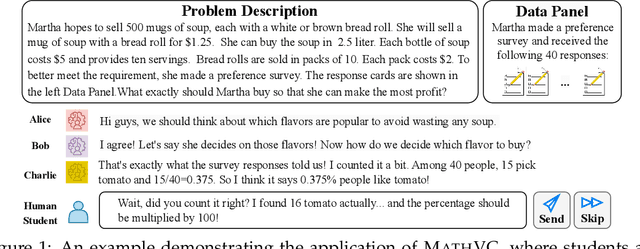

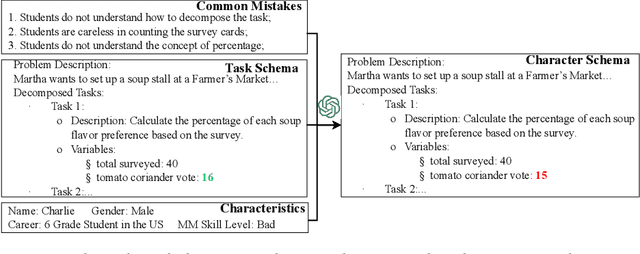
Mathematical modeling (MM) is considered a fundamental skill for students in STEM disciplines. Practicing the MM skill is often the most effective when students can engage in group discussion and collaborative problem-solving. However, due to unevenly distributed teachers and educational resources needed to monitor such group activities, students do not always receive equal opportunities for this practice. Excitingly, large language models (LLMs) have recently demonstrated strong capability in both modeling mathematical problems and simulating characters with different traits and properties. Drawing inspiration from the advancement of LLMs, in this work, we present MATHVC, the very first LLM-powered virtual classroom containing multiple LLM-simulated student characters, with whom a human student can practice their MM skill. To encourage each LLM character's behaviors to be aligned with their specified math-relevant properties (termed "characteristics alignment") and the overall conversational procedure to be close to an authentic student MM discussion (termed "conversational procedural alignment"), we proposed three innovations: integrating MM domain knowledge into the simulation, defining a symbolic schema as the ground for character simulation, and designing a meta planner at the platform level to drive the conversational procedure. Through experiments and ablation studies, we confirmed the effectiveness of our simulation approach and showed the promise for MATHVC to benefit real-life students in the future.