 Add to Chrome
 Add to Firefox
 Add to Edge
CARE: A Conformal Safety Layer for Medical Summarization
Jun 08, 2026
Large language models (LLMs) are increasingly used for medical summarization, but their outputs can omit medically important information and introduce unsupported claims. Existing error-detection methods produce heuristic or uncalibrated scores, providing no formal control over missed errors and no principled way to trade off safety against clinician review burden. We introduce Conformal Assessment for Risk Evaluation (CARE), a post-hoc, model-agnostic safety layer that uses conformal risk control to overlay calibrated omission and hallucination flags onto summaries from any LLM without retraining. CARE provides finite-sample, distribution-free guarantees through two controllers: a hallucination controller that bounds the probability of a document containing any unflagged hallucinated sentence, and an omission controller that bounds the expected fraction of important omissions not surfaced for review. Unlike hallucination detection, omissions depend jointly on whether a source sentence is important and whether it is covered by the summary. We show that calibrating only one dimension can violate the target risk bound, while marginal decompositions remain valid but overly conservative. By jointly calibrating over the full $(τ,γ)$ threshold space, CARE preserves formal guarantees while surfacing up to 5$\times$ fewer sentences than alternative calibrated baselines. Across five medical summarization tasks, CARE satisfies the target risk bound at $α= 0.15$ with 95% confidence across 100 calibration/test resplits, using only ~100 labeled documents per domain. In a preliminary clinician study (75 document reviews), calibrated flags improved omission detection by 28.6 percentage points on average. These results show that sentence-level safety guarantees are feasible for LLM-assisted medical summarization and offer a tunable mechanism for balancing residual risk and review effort.

Ten Headache Specialists versus Artificial Intelligence for Clinical Literature Summarization: A Critical Evaluation and Comparison
Jun 03, 2026Summarizing the latest medical literature to guide clinical decision-making is essential for evidence-based medicine and high-quality patient care. Yet clinicians face increasing challenges due to limited time with patients and a rapidly growing volume of published articles. Although retrieval-augmented large language models (LLMs) have shown promise in clinical summarization, human evaluations of their effectiveness in synthesizing broader scientific literature and direct comparisons to expert-written syntheses remain scarce. We constructed a RAG-based agentic AI framework using three state-of-the-art LLMs: Sonnet, GPT-4o, and Llama 3.1. A headache specialist created 13 questions, three for prompt optimization and ten for evaluation. Ten headache specialists across the United States and Canada each wrote a summary for one question, yielding four summaries per question (expert, Sonnet, GPT-4o, and Llama). The experts, blinded to authorship, critically evaluated the summaries, excluding the topic for which they wrote a summary, based on correctness, completeness, conciseness, and clinical utility, scoring each from 1 to 10 using standardized rubrics. They also ranked the summaries by preference and indicated whether they believed each summary was written by an expert or an LLM. Our study, comparing LLM- and expert-written literature summaries evaluated by headache specialists, showed that expert-written summaries were preferred, although experts sometimes found it challenging to distinguish between human- and AI-generated summaries. We also identified key expert-valued features beyond standard evaluation metrics that can guide future refinement of both human and AI literature summarization pipelines.
MedAlign: A Clinician-Generated Dataset for Instruction Following with Electronic Medical Records
Aug 27, 2023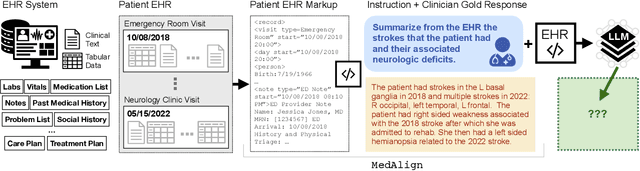
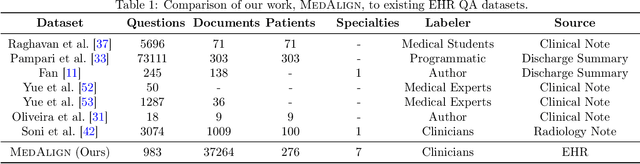
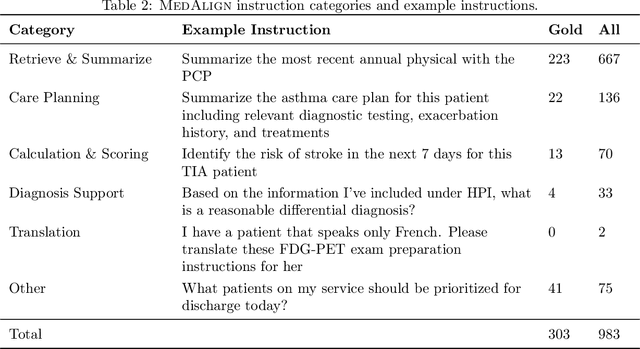
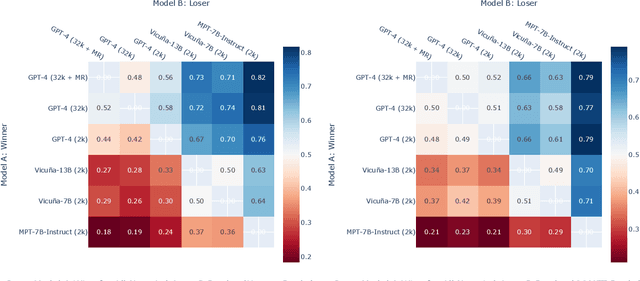
The ability of large language models (LLMs) to follow natural language instructions with human-level fluency suggests many opportunities in healthcare to reduce administrative burden and improve quality of care. However, evaluating LLMs on realistic text generation tasks for healthcare remains challenging. Existing question answering datasets for electronic health record (EHR) data fail to capture the complexity of information needs and documentation burdens experienced by clinicians. To address these challenges, we introduce MedAlign, a benchmark dataset of 983 natural language instructions for EHR data. MedAlign is curated by 15 clinicians (7 specialities), includes clinician-written reference responses for 303 instructions, and provides 276 longitudinal EHRs for grounding instruction-response pairs. We used MedAlign to evaluate 6 general domain LLMs, having clinicians rank the accuracy and quality of each LLM response. We found high error rates, ranging from 35% (GPT-4) to 68% (MPT-7B-Instruct), and an 8.3% drop in accuracy moving from 32k to 2k context lengths for GPT-4. Finally, we report correlations between clinician rankings and automated natural language generation metrics as a way to rank LLMs without human review. We make MedAlign available under a research data use agreement to enable LLM evaluations on tasks aligned with clinician needs and preferences.