 Add to Chrome
 Add to Firefox
 Add to Edge
PanCanBench: A Comprehensive Benchmark for Evaluating Large Language Models in Pancreatic Oncology
Mar 02, 2026
Large language models (LLMs) have achieved expert-level performance on standardized examinations, yet multiple-choice accuracy poorly reflects real-world clinical utility and safety. As patients and clinicians increasingly use LLMs for guidance on complex conditions such as pancreatic cancer, evaluation must extend beyond general medical knowledge. Existing frameworks, such as HealthBench, rely on simulated queries and lack disease-specific depth. Moreover, high rubric-based scores do not ensure factual correctness, underscoring the need to assess hallucinations. We developed a human-in-the-loop pipeline to create expert rubrics for de-identified patient questions from the Pancreatic Cancer Action Network (PanCAN). The resulting benchmark, PanCanBench, includes 3,130 question-specific criteria across 282 authentic patient questions. We evaluated 22 proprietary and open-source LLMs using an LLM-as-a-judge framework, measuring clinical completeness, factual accuracy, and web-search integration. Models showed substantial variation in rubric-based completeness, with scores ranging from 46.5% to 82.3%. Factual errors were common, with hallucination rates (the percentages of responses containing at least one factual error) ranging from 6.0% for Gemini-2.5 Pro and GPT-4o to 53.8% for Llama-3.1-8B. Importantly, newer reasoning-optimized models did not consistently improve factuality: although o3 achieved the highest rubric score, it produced inaccuracies more frequently than other GPT-family models. Web-search integration did not inherently guarantee better responses. The average score changed from 66.8% to 63.9% for Gemini-2.5 Pro and from 73.8% to 72.8% for GPT-5 when web search was enabled. Synthetic AI-generated rubrics inflated absolute scores by 17.9 points on average while generally maintaining similar relative ranking.

From Narratives to Numbers: Valid Inference Using Language Model Predictions from Verbal Autopsy Narratives
Apr 03, 2024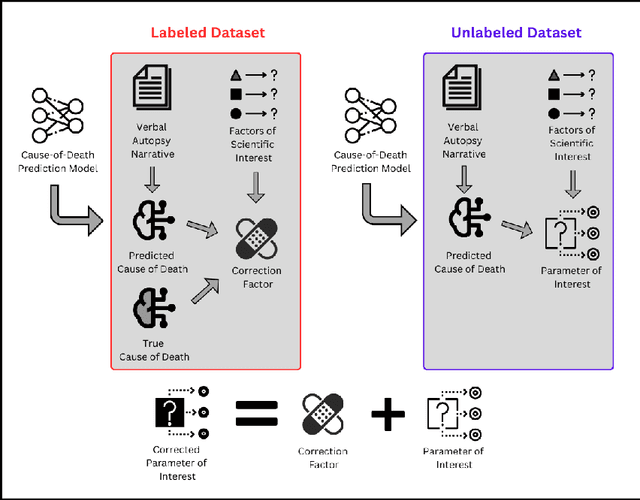

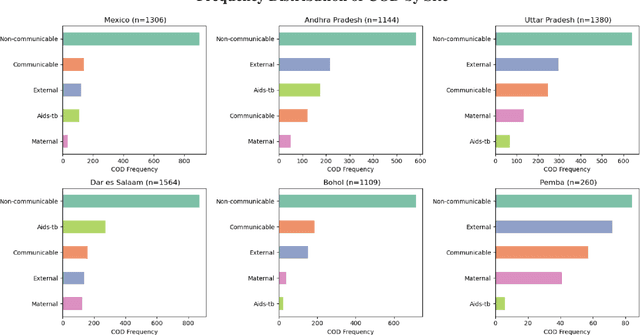
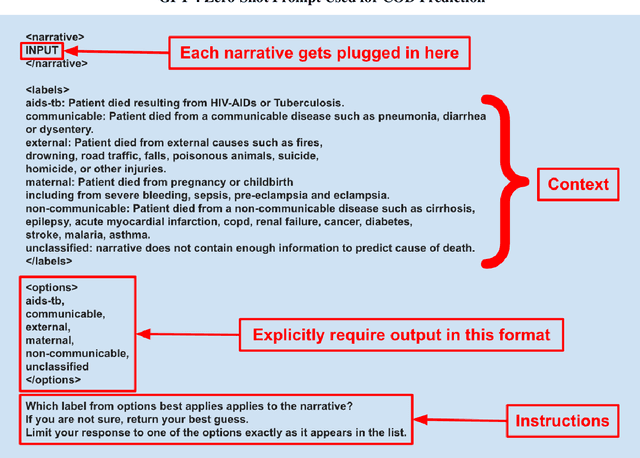
In settings where most deaths occur outside the healthcare system, verbal autopsies (VAs) are a common tool to monitor trends in causes of death (COD). VAs are interviews with a surviving caregiver or relative that are used to predict the decedent's COD. Turning VAs into actionable insights for researchers and policymakers requires two steps (i) predicting likely COD using the VA interview and (ii) performing inference with predicted CODs (e.g. modeling the breakdown of causes by demographic factors using a sample of deaths). In this paper, we develop a method for valid inference using outcomes (in our case COD) predicted from free-form text using state-of-the-art NLP techniques. This method, which we call multiPPI++, extends recent work in "prediction-powered inference" to multinomial classification. We leverage a suite of NLP techniques for COD prediction and, through empirical analysis of VA data, demonstrate the effectiveness of our approach in handling transportability issues. multiPPI++ recovers ground truth estimates, regardless of which NLP model produced predictions and regardless of whether they were produced by a more accurate predictor like GPT-4-32k or a less accurate predictor like KNN. Our findings demonstrate the practical importance of inference correction for public health decision-making and suggests that if inference tasks are the end goal, having a small amount of contextually relevant, high quality labeled data is essential regardless of the NLP algorithm.
Do We Really Even Need Data?
Feb 02, 2024As artificial intelligence and machine learning tools become more accessible, and scientists face new obstacles to data collection (e.g. rising costs, declining survey response rates), researchers increasingly use predictions from pre-trained algorithms as outcome variables. Though appealing for financial and logistical reasons, using standard tools for inference can misrepresent the association between independent variables and the outcome of interest when the true, unobserved outcome is replaced by a predicted value. In this paper, we characterize the statistical challenges inherent to this so-called ``inference with predicted data'' problem and elucidate three potential sources of error: (i) the relationship between predicted outcomes and their true, unobserved counterparts, (ii) robustness of the machine learning model to resampling or uncertainty about the training data, and (iii) appropriately propagating not just bias but also uncertainty from predictions into the ultimate inference procedure.