 Add to Chrome
 Add to Firefox
 Add to Edge
An Irreducible Quantum Advantage in Aligning World Models with Reality
Aug 20, 2026
World models provide digital simulacra of the true world, allowing agents to be trained and tested before costly real-world deployment. At each time step, they receive an action and generate an observation and reward matching the statistics of the true world. In complex environments where present outcomes depend on events far in the past, this requires memory. One might expect that, by increasing memory, we can always build a model accurately enough to align the optimal agent policies of the real and virtual worlds. We show that this is false for classical world models, even when the true world itself is classical. We construct true worlds for which every finite classical model fails along the same possible trajectory: it either loses the ability to distinguish actions when the true world clearly prefers one, or repeatedly assigns the highest expected reward to suboptimal actions. Its expected-reward estimates also retain a nonvanishing average error. In contrast, each such true world admits a quantum world model using a single qutrit that reproduces it exactly: its reward estimates and preferred actions always match those of the true world, ensuring that the optimal policies of the real and virtual worlds remain perfectly aligned.

Quantum enhanced rare event discovery and sampling
Jun 04, 2026Financial crashes, cascading failures in infrastructure, and critical errors in AI systems are frequently triggered by events that occur with extremely small probability. Efficiently discovering and sampling events with probability below a threshold is therefore of critical interest. Yet this task is highly non-trivial using existing classical or quantum methods. Being rare, such events require an immense sampling overhead to collect sufficient data samples. Moreover, because the rare events are not known in advance, they cannot be flagged for amplification using standard techniques. Here, we introduce a quantum algorithm for rare-event discovery and sampling without first learning which events are rare. The algorithm achieves the optimal quantum scaling with the rarity threshold. We further demonstrate that this can achieve a quadratic speedup for heavy-tailed systems whose tail has nonvanishing total mass, and translates into a robust polynomial speedup for stationary stochastic processes, with the exponent determined by its entropy-rate structure.
QuLTSF: Long-Term Time Series Forecasting with Quantum Machine Learning
Dec 18, 2024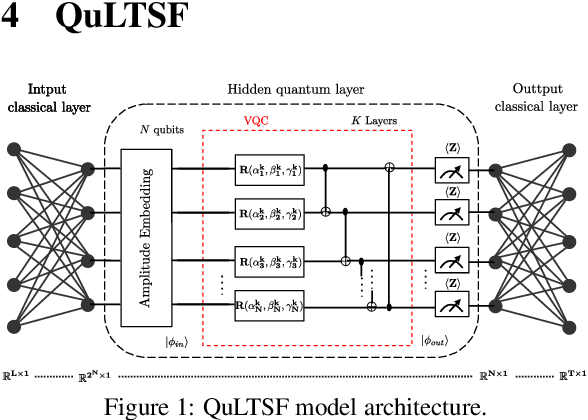
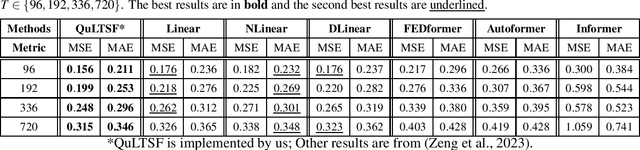

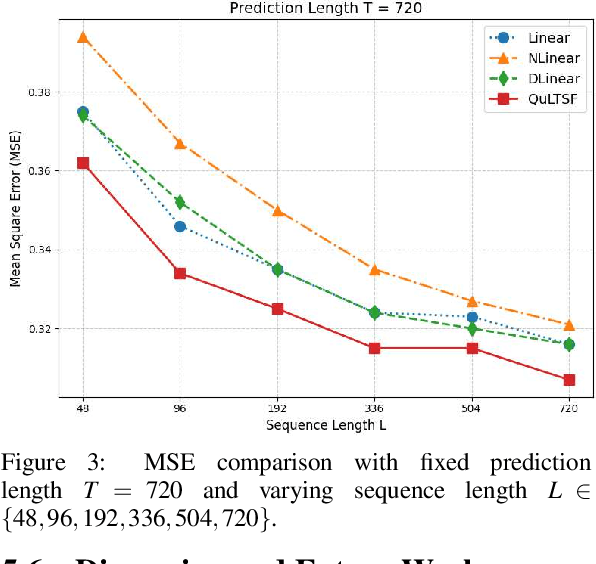
Long-term time series forecasting (LTSF) involves predicting a large number of future values of a time series based on the past values and is an essential task in a wide range of domains including weather forecasting, stock market analysis, disease outbreak prediction. Over the decades LTSF algorithms have transitioned from statistical models to deep learning models like transformer models. Despite the complex architecture of transformer based LTSF models `Are Transformers Effective for Time Series Forecasting? (Zeng et al., 2023)' showed that simple linear models can outperform the state-of-the-art transformer based LTSF models. Recently, quantum machine learning (QML) is evolving as a domain to enhance the capabilities of classical machine learning models. In this paper we initiate the application of QML to LTSF problems by proposing QuLTSF, a simple hybrid QML model for multivariate LTSF. Through extensive experiments on a widely used weather dataset we show the advantages of QuLTSF over the state-of-the-art classical linear models, in terms of reduced mean squared error and mean absolute error.
Quantum Policy Gradient in Reproducing Kernel Hilbert Space
Nov 21, 2024Parametrised quantum circuits offer expressive and data-efficient representations for machine learning. Due to quantum states residing in a high-dimensional Hilbert space, parametrised quantum circuits have a natural interpretation in terms of kernel methods. The representation of quantum circuits in terms of quantum kernels has been studied widely in quantum supervised learning, but has been overlooked in the context of quantum reinforcement learning. This paper proposes parametric and non-parametric policy gradient and actor-critic algorithms with quantum kernel policies in quantum environments. This approach, implemented with both numerical and analytical quantum policy gradient techniques, allows exploiting the many advantages of kernel methods, including available analytic forms for the gradient of the policy and tunable expressiveness. The proposed approach is suitable for vector-valued action spaces and each of the formulations demonstrates a quadratic reduction in query complexity compared to their classical counterparts. Two actor-critic algorithms, one based on stochastic policy gradient and one based on deterministic policy gradient (comparable to the popular DDPG algorithm), demonstrate additional query complexity reductions compared to quantum policy gradient algorithms under favourable conditions.
Quantum adaptive agents with efficient long-term memories
Aug 24, 2021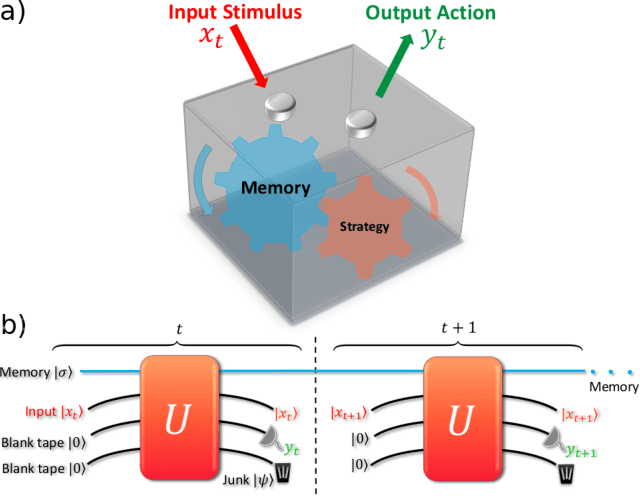
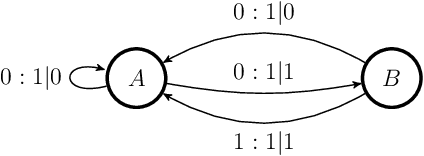
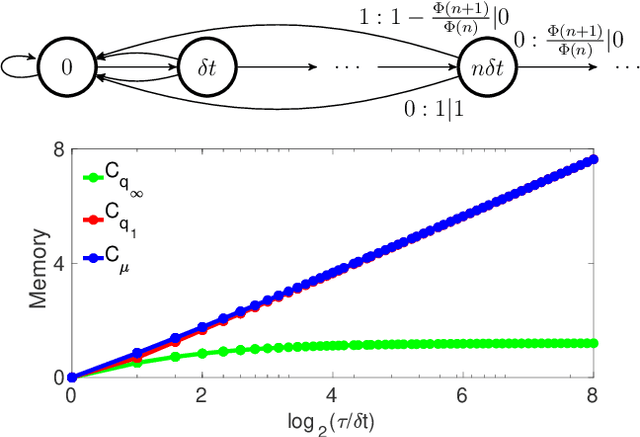
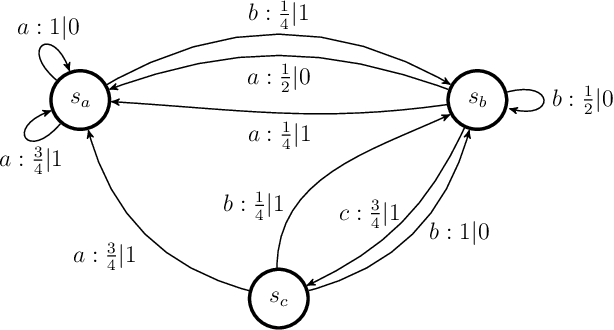
Central to the success of adaptive systems is their ability to interpret signals from their environment and respond accordingly -- they act as agents interacting with their surroundings. Such agents typically perform better when able to execute increasingly complex strategies. This comes with a cost: the more information the agent must recall from its past experiences, the more memory it will need. Here we investigate the power of agents capable of quantum information processing. We uncover the most general form a quantum agent need adopt to maximise memory compression advantages, and provide a systematic means of encoding their memory states. We show these encodings can exhibit extremely favourable scaling advantages relative to memory-minimal classical agents when information must be retained about events increasingly far into the past.
Boosting on the shoulders of giants in quantum device calibration
May 13, 2020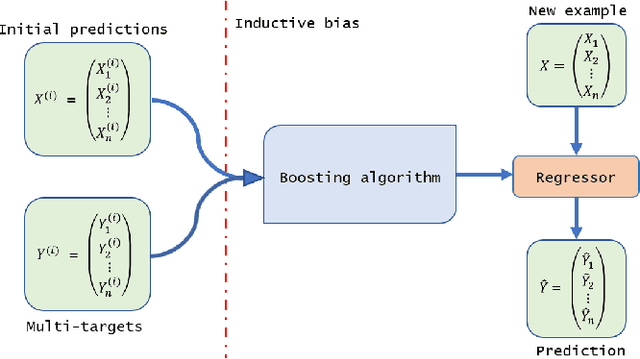
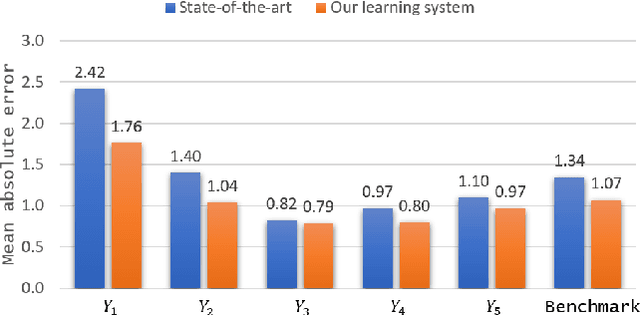
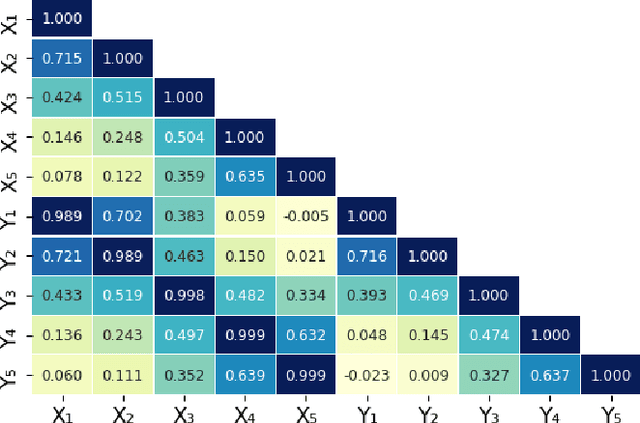
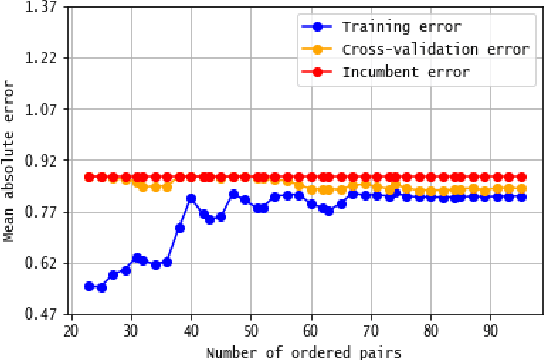
Traditional machine learning applications, such as optical character recognition, arose from the inability to explicitly program a computer to perform a routine task. In this context, learning algorithms usually derive a model exclusively from the evidence present in a massive dataset. Yet in some scientific disciplines, obtaining an abundance of data is an impractical luxury, however; there is an explicit model of the domain based upon previous scientific discoveries. Here we introduce a new approach to machine learning that is able to leverage prior scientific discoveries in order to improve generalizability over a scientific model. We show its efficacy in predicting the entire energy spectrum of a Hamiltonian on a superconducting quantum device, a key task in present quantum computer calibration. Our accuracy surpasses the current state-of-the-art by over $20\%.$ Our approach thus demonstrates how artificial intelligence can be further enhanced by "standing on the shoulders of giants."