 Add to Chrome
 Add to Firefox
 Add to Edge
Topometric Autonomous Vehicle Localization by Combining Visual Embeddings and Feed-Forward 3D Models
Aug 06, 2026
Effective Visual Localization (VL) requires a map of the environment that combines compactness for efficient scalability with robustness against visual appearance changes and metric precision. Through low-dimensional image embeddings, Visual Place Recognition (VPR) is able to successfully meet the first two requirements, but its low metric accuracy makes it less suitable than standard VL approaches based on local features or neural representations. This limitation can be overcome by integrating VPR with the accurate local trajectory estimates produced by feed-forward neural 3D geometry (FF3D) models. In this paper, we address sequential appearance-based localization through a topometric framework that iteratively combines probabilistic VPR with FF3D metric pose estimation in controlled image sets. Our approach proposes an automatic offline mapping tool that models the topometric pose-appearance interaction in the different parts of the scene. This map is later employed by an online particle filter that estimates the pose from odometry and belief over places for FF3D inference, successfully incorporating neural metric estimation into probabilistic appearance-based localization. We extensively evaluate the framework on three known benchmarks, demonstrating substantial improvements over existing appearance-based methods. The modularity of our approach allows the descriptor extractor and FF3D model to remain interchangeable, and a focused analysis further shows that sequential belief can mitigate severe failures under perceptual aliasing.

Human-Robot Interaction in GenAI Architectures via the Agent-Client Protocol
Jul 16, 2026Recent advances in Generative Artificial Intelligence (GenAI), particularly Large Language Models (LLMs), are driving robotic architectures toward agent-based high-level orchestration, in which natural-language instructions can be translated into context-aware action sequences. While the integration of these agents and robotic capabilities is increasingly converging toward standardization through the Model Context Protocol (MCP), the upper Human-Robot Interaction (HRI) layer remains fragmented by proprietary, ad hoc interfaces that hinder real-time human-in-the-loop collaboration. To address this fragmentation, this paper proposes the adoption of the Agent-Client Protocol (ACP) -- a communication standard originally introduced for coding agents in software engineering -- as a unified communication contract for the HRI layer in agent-based robotic systems. By combining ACP at the interface-agent link and MCP at the agent-execution link, we formulate a fully decoupled three-layer architecture that separates human interaction, deliberative orchestration, and physical execution. This topology removes rigid architectural dependencies, enabling heterogeneous user interfaces to connect to the same robotic system and allowing the underlying robotic platform to be replaced without requiring client-specific integration changes. Moreover, it provides native support for collaborative HRI capabilities such as real-time observability, explicit human authorization, and immediate task interruption. We experimentally evaluate the proposed architecture on a physical mobile robot, demonstrating interoperability across three heterogeneous user interfaces and validating real-time human-in-the-loop workflows with negligible latency overhead.
Voxeland: Probabilistic Instance-Aware Semantic Mapping with Evidence-based Uncertainty Quantification
Nov 13, 2024Robots in human-centered environments require accurate scene understanding to perform high-level tasks effectively. This understanding can be achieved through instance-aware semantic mapping, which involves reconstructing elements at the level of individual instances. Neural networks, the de facto solution for scene understanding, still face limitations such as overconfident incorrect predictions with out-of-distribution objects or generating inaccurate masks.Placing excessive reliance on these predictions makes the reconstruction susceptible to errors, reducing the robustness of the resulting maps and hampering robot operation. In this work, we propose Voxeland, a probabilistic framework for incrementally building instance-aware semantic maps. Inspired by the Theory of Evidence, Voxeland treats neural network predictions as subjective opinions regarding map instances at both geometric and semantic levels. These opinions are aggregated over time to form evidences, which are formalized through a probabilistic model. This enables us to quantify uncertainty in the reconstruction process, facilitating the identification of map areas requiring improvement (e.g. reobservation or reclassification). As one strategy to exploit this, we incorporate a Large Vision-Language Model (LVLM) to perform semantic level disambiguation for instances with high uncertainty. Results from the standard benchmarking on the publicly available SceneNN dataset demonstrate that Voxeland outperforms state-of-the-art methods, highlighting the benefits of incorporating and leveraging both instance- and semantic-level uncertainties to enhance reconstruction robustness. This is further validated through qualitative experiments conducted on the real-world ScanNet dataset.
Doppler-only Single-scan 3D Vehicle Odometry
Oct 06, 2023We present a novel 3D odometry method that recovers the full motion of a vehicle only from a Doppler-capable range sensor. It leverages the radial velocities measured from the scene, estimating the sensor's velocity from a single scan. The vehicle's 3D motion, defined by its linear and angular velocities, is calculated taking into consideration its kinematic model which provides a constraint between the velocity measured at the sensor frame and the vehicle frame. Experiments carried out prove the viability of our single-sensor method compared to mounting an additional IMU. Our method provides the translation of the sensor, which cannot be reliably determined from an IMU, as well as its rotation. Its short-term accuracy and fast operation (~5ms) make it a proper candidate to supply the initialization to more complex localization algorithms or mapping pipelines. Not only does it reduce the error of the mapper, but it does so at a comparable level of accuracy as an IMU would. All without the need to mount and calibrate an extra sensor on the vehicle.
Robotic Gas Source Localization with Probabilistic Mapping and Online Dispersion Simulation
Apr 18, 2023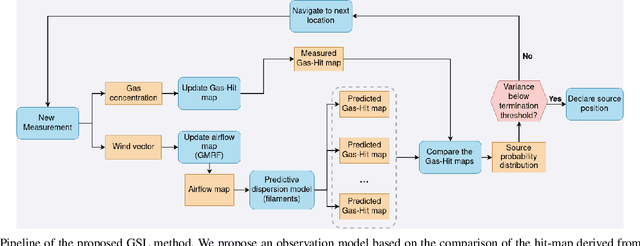
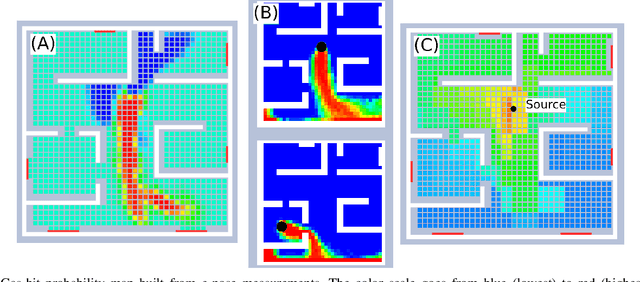
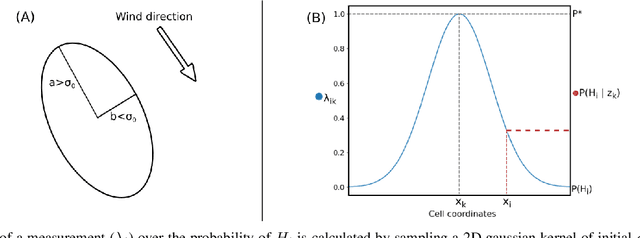
Gas source localization (GSL) with an autonomous robot is a problem with many prospective applications, from finding pipe leaks to emergency-response scenarios. In this work we present a new method to perform GSL in realistic indoor environments, featuring obstacles and turbulent flow. Given the highly complex relationship between the source position and the measurements available to the robot (the single-point gas concentration, and the wind vector) we propose an observation model that derives from contrasting the online, real-time simulation of the gas dispersion from any candidate source localization against a gas concentration map built from sensor readings. To account for a convenient and grounded integration of both into a probabilistic estimation framework, we introduce the concept of probabilistic gas-hit maps, which provide a higher level of abstraction to model the time-dependent nature of gas dispersion. Results from both simulated and real experiments show the capabilities of our current proposal to deal with source localization in complex indoor environments. To the best of our knowledge, this is the first work in olfactory robotics that doesn't make simplistic assumptions about environmental conditions like operating in open spaces and/or having an unrealistic laminar flow wind.
An Analytical Solution to the IMU Initialization Problem for Visual-Inertial Systems
Mar 05, 2021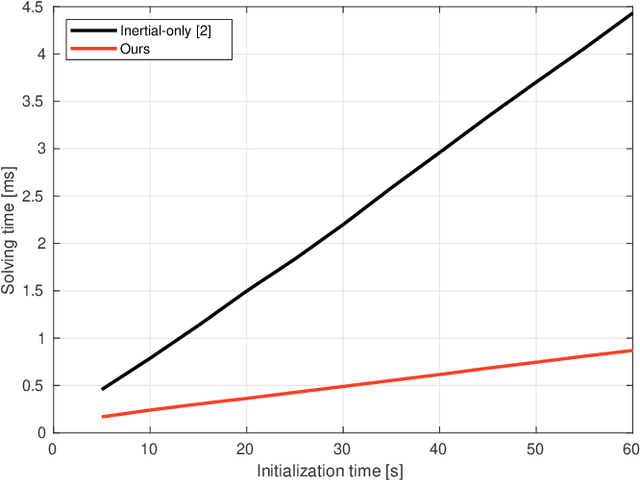
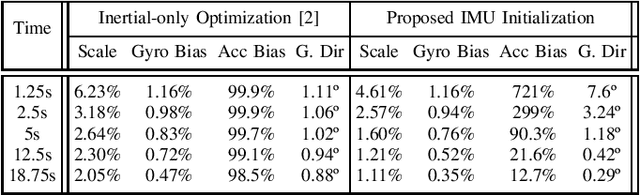
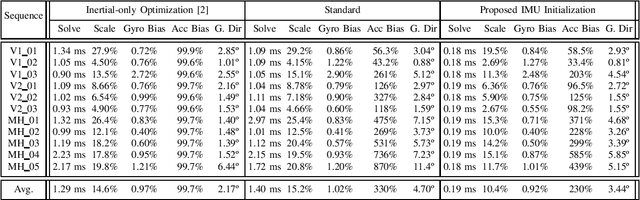
The fusion of visual and inertial measurements is becoming more and more popular in the robotics community since both sources of information complement well each other. However, in order to perform this fusion, the biases of the Inertial Measurement Unit (IMU) as well as the direction of gravity must be initialized first. Additionally, in case of a monocular camera, the metric scale is also needed. The most popular visual-inertial initialization approaches rely on accurate vision-only motion estimates to build a non-linear optimization problem that solves for these parameters in an iterative way. In this paper, we rely on the previous work in [1] and propose an analytical solution to estimate the accelerometer bias, the direction of gravity and the scale factor in a maximum-likelihood framework. This formulation results in a very efficient estimation approach and, due to the non-iterative nature of the solution, avoids the intrinsic issues of previous iterative solutions. We present an extensive validation of the proposed IMU initialization approach and a performance comparison against the state-of-the-art approach described in [2] with real data from the publicly available EuRoC dataset, achieving comparable accuracy at a fraction of its computational cost and without requiring an initial guess for the scale factor. We also provide a C++ open source reference implementation.
Fast and Robust Certifiable Estimation of the Relative Pose Between Two Calibrated Cameras
Jan 21, 2021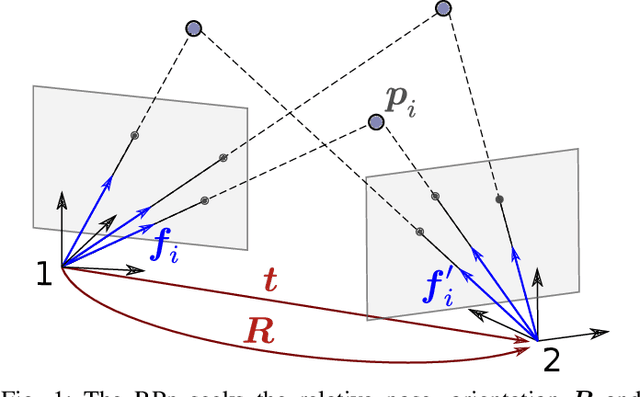
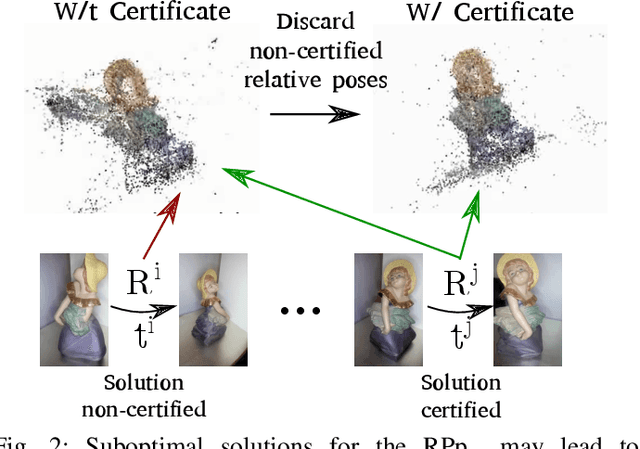
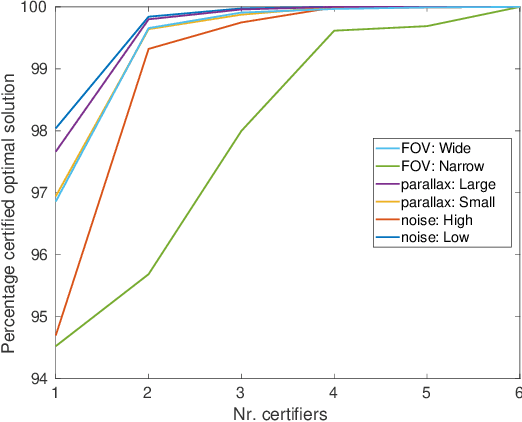
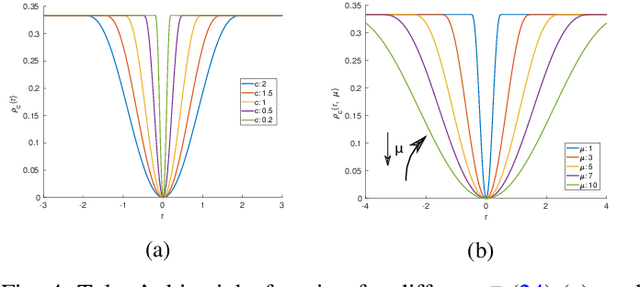
The Relative Pose problem (RPp) for cameras aims to estimate the relative orientation and translation (pose) given a set of pair-wise feature correspondences between two central and calibrated cameras. The RPp is stated as an optimization problem where the squared, normalized epipolar error is minimized over the set of normalized essential matrices. In this work, we contribute an efficient and complete algorithm based on results from duality theory that is able to certify whether the solution to a RPp instance is the global optimum. Specifically, we present a family of certifiers that is shown to increase the ratio of detected optimal solutions. This set of certifiers is incorporated into an efficient essential matrix estimation pipeline that, given any initial guess for the RPp, refines it iteratively on the product space of 3D rotations and 2-sphere and thereupon, certifies the optimality of the solution. We integrate our fast certifiable pipeline into a robust framework that combines Graduated Non-convexity and the Black-Rangarajan duality between robust functions and line processes. This combination has been shown in the literature to outperform the robustness to outliers provided by approaches based on RANSAC. We proved through extensive experiments on synthetic and real data that the proposed framework provides a fast and robust relative pose estimation. We compare our proposal against the state-of-the-art methods on both accuracy and computational cost, and show that our estimations improve the output of the gold-standard approach for the RPp, the 2-view Bundle-Adjustment. We make the code publicly available \url{https://github.com/mergarsal/FastCertRelPose.git}.
Certifiable Relative Pose Estimation
Mar 30, 2020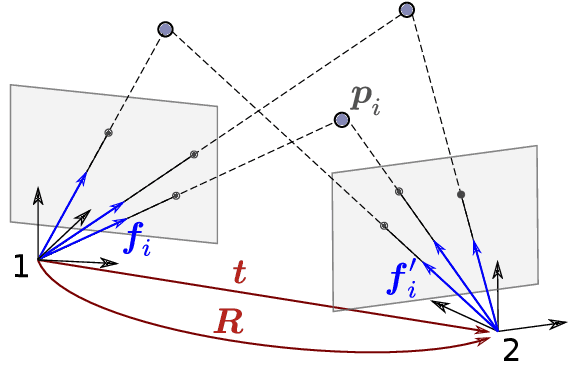
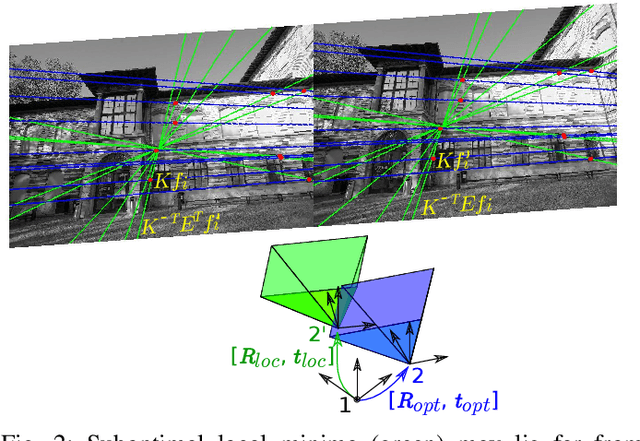
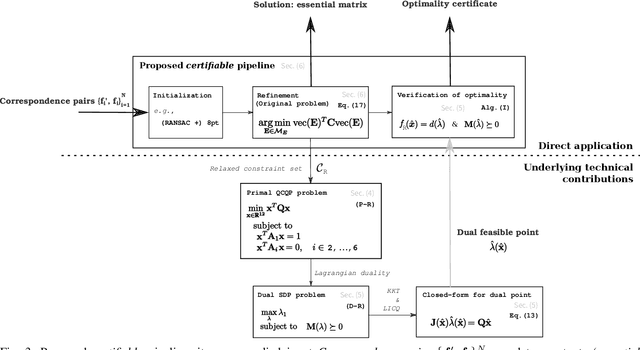
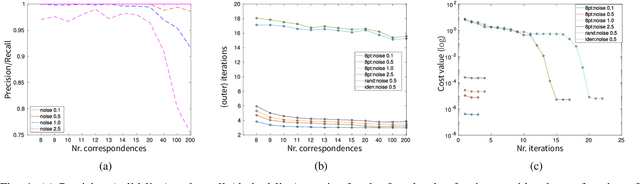
In this paper we present the first fast optimality certifier for the non-minimal version of the Relative Pose problem for calibrated cameras from epipolar constraints. The proposed certifier is based on Lagrangian duality and relies on a novel closed-form expression for dual points. We also leverage an efficient solver that performs local optimization on the manifold of the original problem's non-convex domain. The optimality of the solution is then checked via our novel fast certifier. The extensive conducted experiments demonstrate that, despite its simplicity, this certifiable solver performs excellently on synthetic data, repeatedly attaining the (certified \textit{a posteriori}) optimal solution and shows a satisfactory performance on real data.
Intrinsic Calibration of Depth Cameras for Mobile Robots using a Radial Laser Scanner
Jul 03, 2019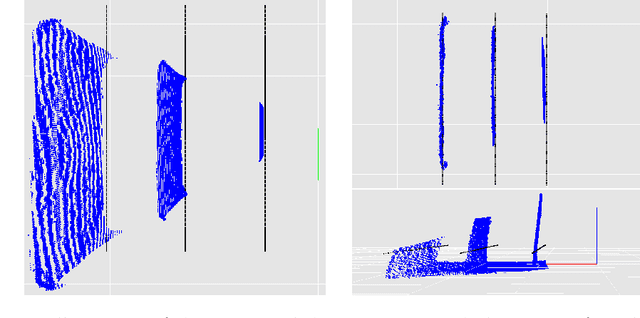
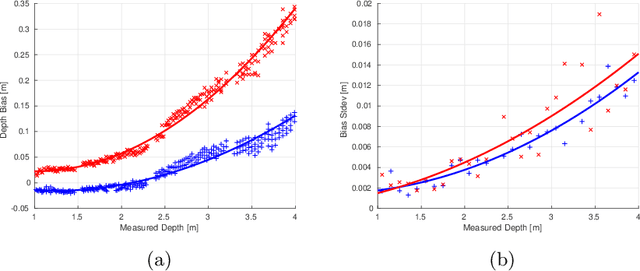
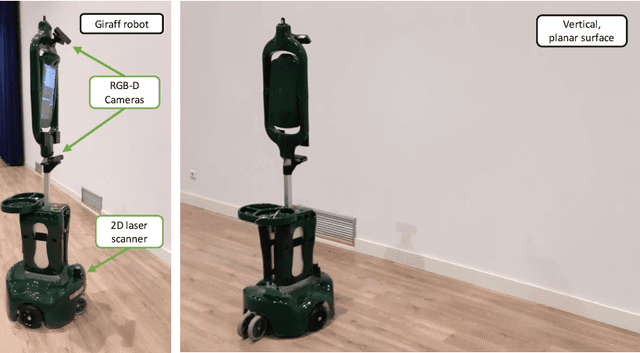
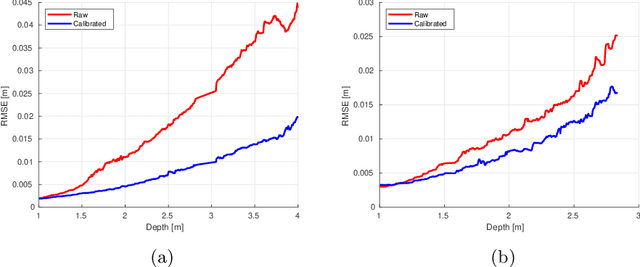
Depth cameras, typically in RGB-D configurations, are common devices in mobile robotic platforms given their appealing features: high frequency and resolution, low price and power requirements, among others. These sensors may come with significant, non-linear errors in the depth measurements that jeopardize robot tasks, like free-space detection, environment reconstruction or visual robot-human interaction. This paper presents a method to calibrate such systematic errors with the help of a second, more precise range sensor, in our case a radial laser scanner. In contrast to what it may seem at first, this does not mean a serious limitation in practice since these two sensors are often mounted jointly in many mobile robotic platforms, as they complement well each other. Moreover, the laser scanner can be used just for the calibration process and get rid of it after that. The main contributions of the paper are: i) the calibration is formulated from a probabilistic perspective through a Maximum Likelihood Estimation problem, and ii) the proposed method can be easily executed automatically by mobile robotic platforms. To validate the proposed approach we evaluated for both, local distortion of 3D planar reconstructions and global shifts in the measurements, obtaining considerably more accurate results. A C++ open-source implementation of the presented method has been released for the benefit of the community.
Automatic Multi-Sensor Extrinsic Calibration for Mobile Robots
Jun 11, 2019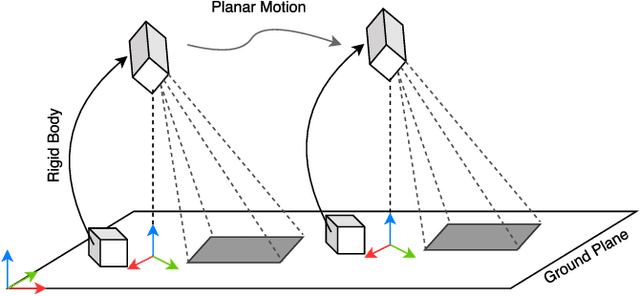
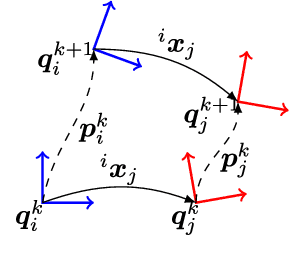
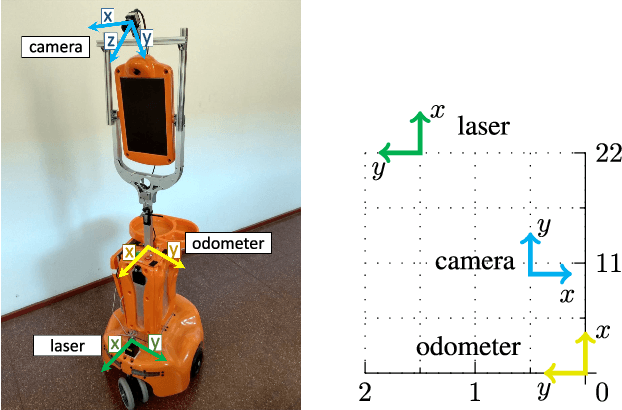
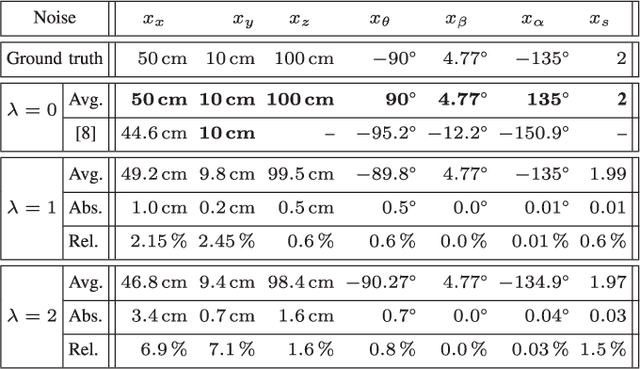
In order to fuse measurements from multiple sensors mounted on a mobile robot, it is needed to express them in a common reference system through their relative spatial transformations. In this paper, we present a method to estimate the full 6DoF extrinsic calibration parameters of multiple heterogeneous sensors (Lidars, Depth and RGB cameras) suitable for automatic execution on a mobile robot. Our method computes the 2D calibration parameters (x, y, yaw) through a motion-based approach, while for the remaining 3 parameters (z, pitch, roll) it requires the observation of the ground plane for a short period of time. What set this proposal apart from others is that: i) all calibration parameters are initialized in closed form, and ii) the scale ambiguity inherent to motion estimation from a monocular camera is explicitly handled, enabling the combination of these sensors and metric ones (Lidars, stereo rigs, etc.) within the same optimization framework. %Additionally, outlier observations arising from local sensor drift are automatically detected and removed from the calibration process. We provide a formal definition of the problem, as well as of the contributed method, for which a C++ implementation has been made publicly available. The suitability of the method has been assessed in simulation an with real data from indoor and outdoor scenarios. Finally, improvements over state-of-the-art motion-based calibration proposals are shown through experimental evaluation.